
How Does a Pressure Cooker Cook Food Faster? The Physics Explained
Key takeaways
- A pressure cooker traps steam to raise internal pressure to about 15 psi, which lifts water's boiling point from 100°C to 121°C.
- Cooking at 121°C instead of 100°C cuts cooking times by 30 to 70 percent, according to cooking-physics writeups.
- The idea is not new: French physicist Denis Papin demonstrated a sealed "steam digester" back in 1679.
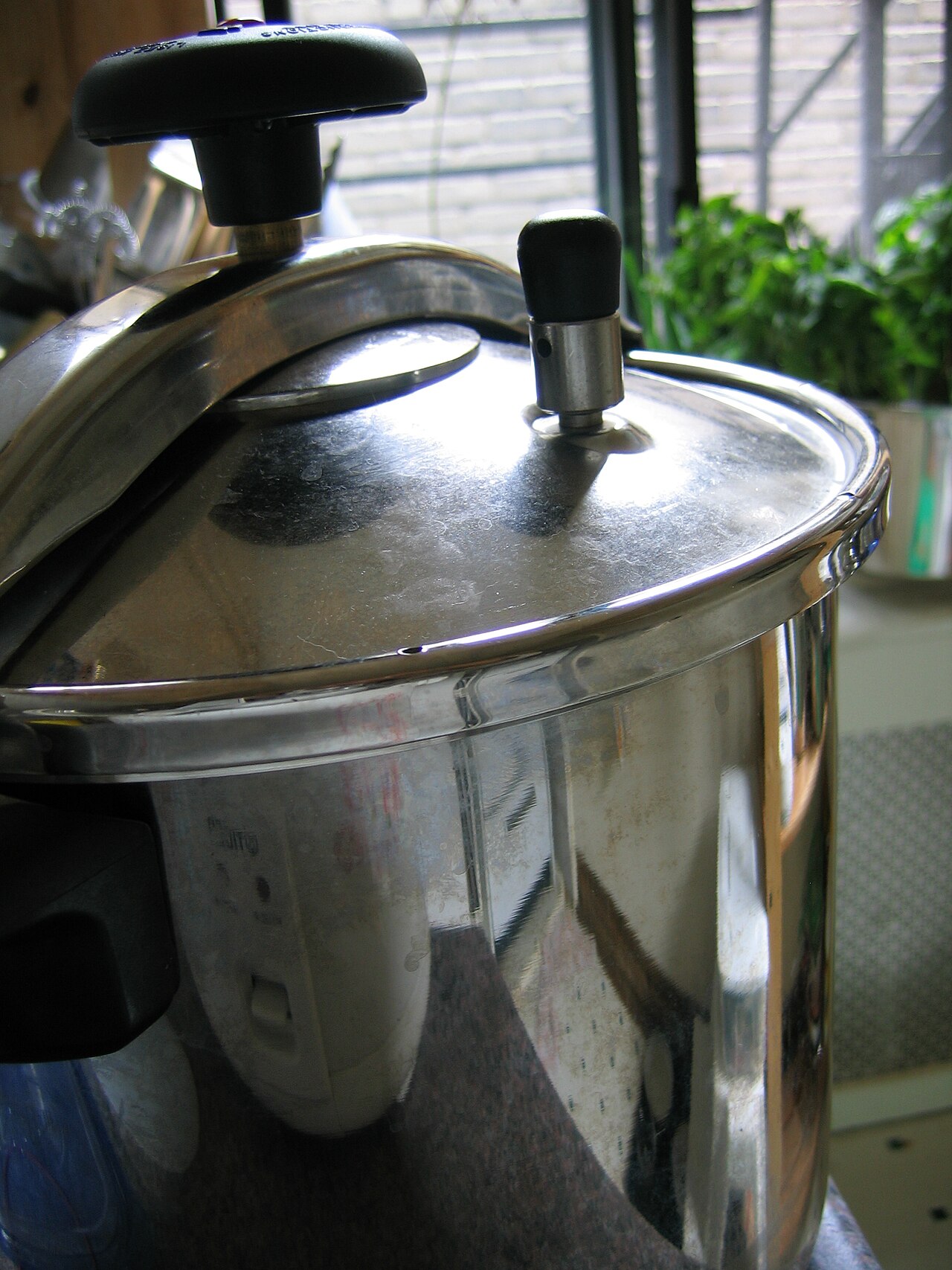
A modern stovetop pressure cooker with its locking lid and pressure-regulating valve. Photograph: Simon Law
A pressure cooker is a sealed metal pot with a locking lid, a valve, and a rubber gasket. Once it heats up, steam cannot escape, so pressure builds inside the pot.
That pressure is the whole trick. It lets water get hotter than it ever could in an open pan.
This article explains how a pressure cooker cooks food faster, including why pressure raises water's boiling point, what the extra heat does to starches and proteins, and the physical limits even pressure cannot beat.
What pressure has to do with boiling water
Water boils when enough of its molecules have the energy to break free as vapor. At sea level, that moment arrives at 100°C (212°F).
The number is not magic. It is simply the temperature at which water's vapor pressure matches the air pressure pushing down on it.
Raise the air pressure and the match point moves. Inside a standard pressure cooker, the steam builds until the pressure sits about 15 pounds per square inch (psi) above normal atmospheric pressure. At that pressure, water needs far more energy to turn into vapor, so its boiling point rises to roughly 121°C (250°F).
This is the central fact behind every pressure cooker claim. Cooking-physics explainers from Cookware Ninja and Testbook both describe the same relationship: a sealed pot at 15 psi holds liquid water at about 121°C, a full 21 degrees hotter than the hardest rolling boil on a stovetop.
The thermodynamic rule at work is described by the Clausius-Clapeyron equation, which predicts how a liquid's boiling point shifts with pressure. You do not need the equation. You only need the outcome: sealed steam makes hotter water possible.
What the extra 21 degrees actually do to food
A hotter cooking environment speeds up every chemical change that turns raw food into a finished dish. Starches gelatinize, which is what softens rice and beans.
Proteins denature and collagen in tough meat breaks down into gelatin. These reactions all run faster at higher temperatures.
The speed-up is dramatic. According to a cooking-science summary published by Spice (Alibaba), pressure cooking cuts cooking times by 30 to 70 percent depending on the food. Cookware Ninja puts the upper end at the same figure, noting that tough meat that needs 3 hours in a conventional pot can turn tender in about 45 minutes under pressure.
The steam itself helps too. When steam touches a cooler food surface, it condenses back into water and dumps a large amount of energy in the process.
Water's latent heat of vaporization is about 2,260 kilojoules per kilogram, as the Spice (Alibaba) summary notes. That energy goes straight into the food, which is why steam transfers heat to food several times faster than dry hot air.
One physics writeup on Testbook describes the hotter steam as transmitting thermal energy at around four times the rate of conventional boiling.
There is a second, quieter advantage. Because less liquid boils away inside a sealed pot, the food reaches cooking temperature faster in the first place.
In an open pot, a lot of the burner's energy leaves as escaping steam. Under pressure, that energy stays put.
The idea is more than 300 years old
The pressure cooker did not arrive with the electric multicooker. Its ancestor was built by French physicist Denis Papin in 1679. Papin called his device a "steam digester," a sealed vessel that used trapped steam pressure to cook food quickly.
Cookware Ninja's physics history notes that Papin's steam digester proved the core principle still used today: trapped vapor accelerates cooking. The device even had an early safety valve, because Papin understood that a sealed pot full of pressurized steam needs a controlled way to release excess pressure.
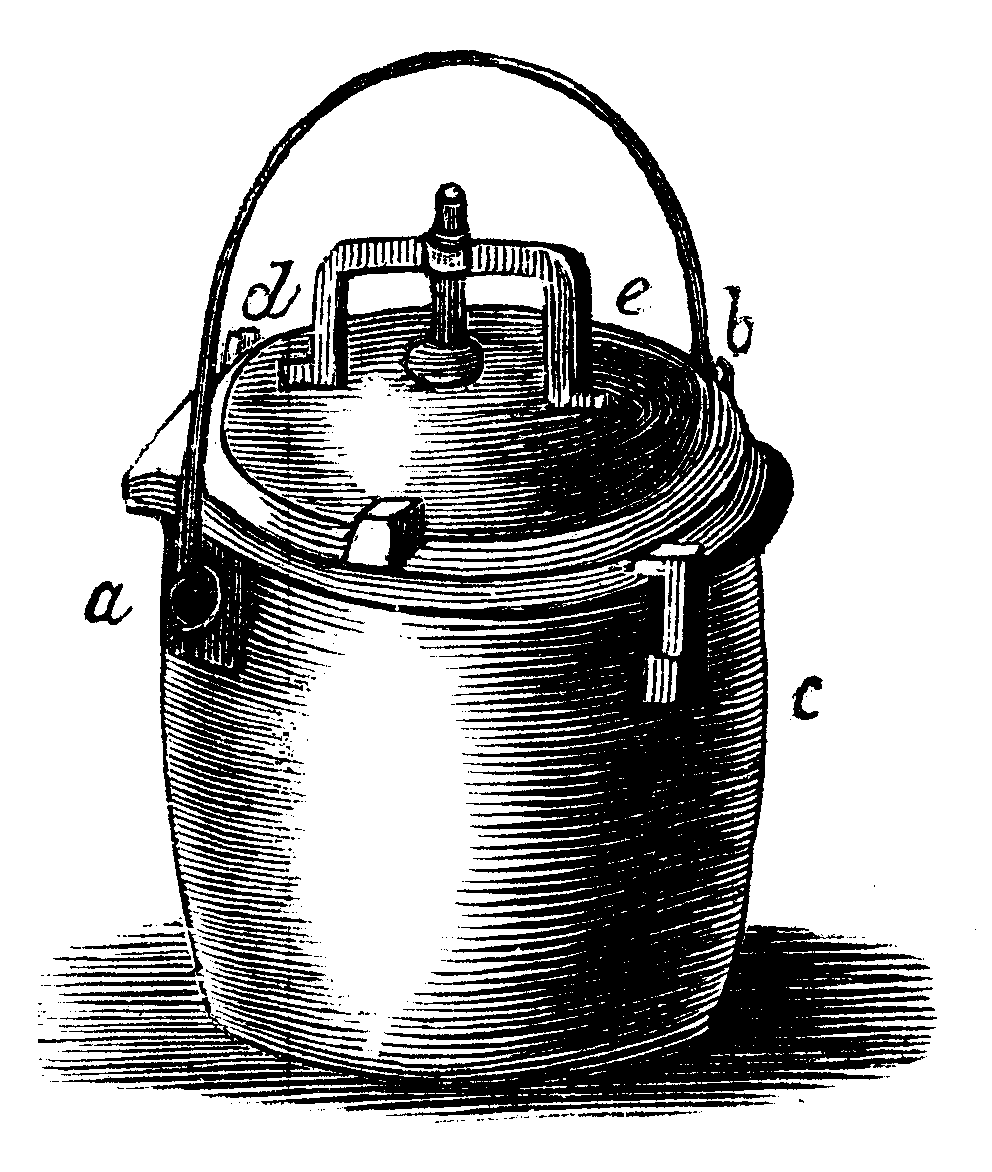
An 1864 illustration showing an early pressure-cooking vessel in the tradition of Papin's steam digester. Photograph: Wikimedia Commons
Modern cookers add locking lids, precision valves, and backup vents, but the physics has not changed since Papin's workshop. The same 15 psi that cooked his experiments cooks today's beans and beef shanks.
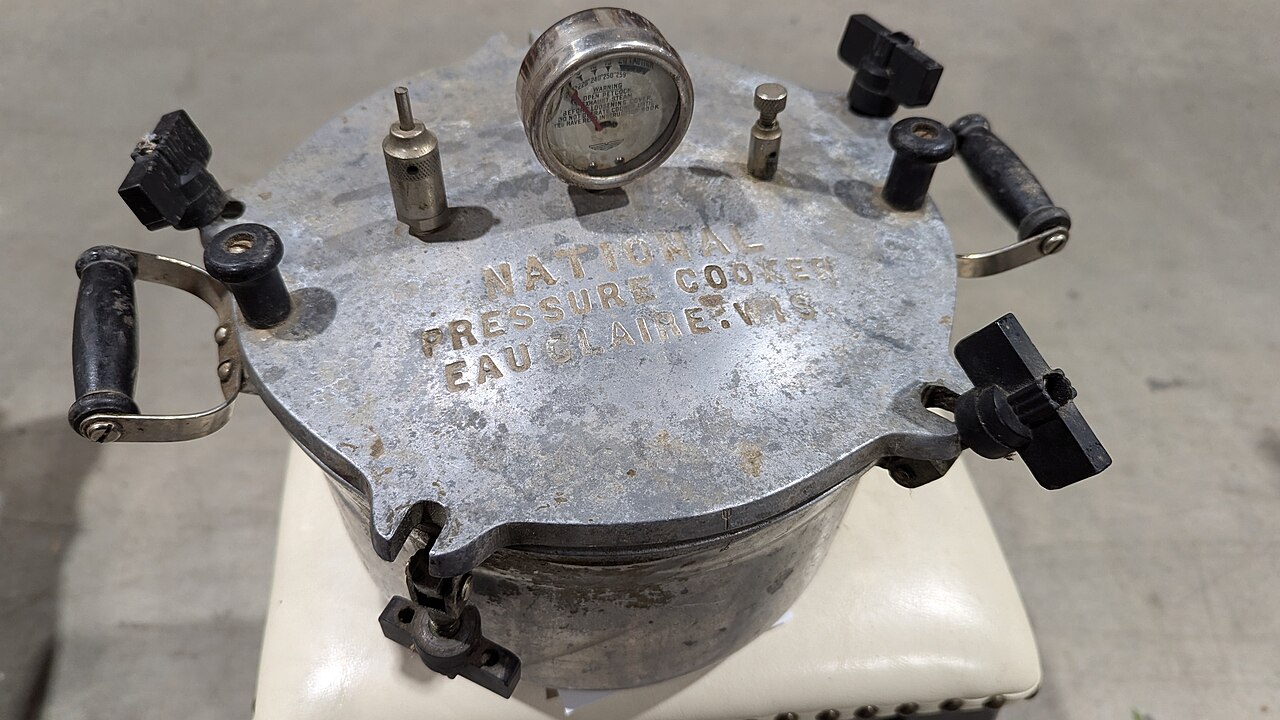
An old-style stovetop pressure cooker with its classic weighted jiggler valve. Photograph: Wikimedia Commons
Why food cooks evenly, not just fast
Heat transfer inside a pressure cooker is remarkably uniform. The sealed chamber fills with saturated steam at one constant temperature, so the food sits in a bath of even heat from all sides. There are no cool spots the way there are over a stovetop flame.
That evenness matters for foods that cook unevenly in open pots, like beans or whole grains. The grains at the bottom of an open pot can scorch while the top layer is still hard. Under pressure, the entire pot hovers at the same temperature, which is one reason pressure-cooked rice comes out so consistent.
The seal also keeps moisture in. Nothing evaporates away, so sauces stay saucy and braised meats stay juicy. This is the flip side of speed: the food not only finishes sooner, it often finishes more tender than its slow-cooked counterpart.
What pressure cannot do
Pressure cooking has real limits, and they follow directly from the physics. The most important one is browning.
The Maillard reaction, which creates the browned crust on seared meat and the flavor of a roasted vegetable, only gets going well above the temperatures liquid water can reach. Since a pressure cooker is full of wet steam, food steams rather than browns.
That is why experienced cooks sear meat before sealing the lid, or finish pressure-cooked dishes under a broiler. The cooker handles tenderness and speed. The open flame handles color and crust.
Pressure also struggles with delicate foods. Vegetables that need two minutes of gentle steaming can turn to mush in the time it takes a cooker to come up to pressure. And at high altitudes, where normal boiling happens well below 100°C, pressure cookers actually become more valuable: they erase the altitude problem entirely by setting their own internal pressure, regardless of the weather outside.
Finally, the valve matters. All that pressure has to go somewhere when cooking ends.
Quick-release drops the pressure fast but can foam starchy foods up through the valve. Natural release is slower and gentler.
Neither is complicated, but both exist because 15 psi of hot steam demands respect.
Frequently asked questions
Why does a pressure cooker cook faster than boiling?
Because water inside it reaches about 121°C instead of 100°C. Chemical changes in food speed up sharply with temperature, so starches, proteins, and tough fibers break down in far less time.
Is food safe when cooked under pressure?
Yes. The high temperature kills microorganisms just as reliably as conventional cooking, and modern cookers include locking lids and multiple pressure-release valves to manage steam safely.
Does pressure cooking destroy nutrients?
Not especially. Studies cited in cooking-science summaries note that the shorter cooking time and minimal water contact can actually preserve more water-soluble vitamins than long boiling. Nutrients are not magically destroyed by pressure.
Can a pressure cooker explode?
Modern cookers are built with locking lids that cannot open under pressure, a primary pressure valve, and backup release vents. Explosions were a risk with damaged or misused antique cookers, not with intact modern ones used as directed.
Why does a pressure cooker hiss?
The hissing is the pressure regulator venting small amounts of steam to hold the internal pressure steady at its set point, usually around 15 psi. Steady hissing during cooking is normal.
The bottom line
A pressure cooker cooks food faster for one reason: trapped steam raises the pressure to about 15 psi, which lifts water's boiling point to roughly 121°C. At that temperature, everything that makes food tender happens in a fraction of the usual time. It is a 1679 invention still doing exactly what Denis Papin designed it to do, only with better valves.
Latest in Food & Cooking
- Why does grilled food taste smoky even on a gas grill?
- Why do doors stick more in summer?
- How do trees survive freezing winters without moving?
- Why does a phone dim in sunlight even at full brightness?
Get one kitchen-science explainer in your inbox every morning. Subscribe for the daily rundown.
Image Credits: Wikimedia Commons / Simon Law and contributors
Related stories
Why Does Bread Go Stale Faster in the Refrigerator?
Bread goes stale faster in the fridge because starch recrystallizes fastest near 4°C. Here is the retrogradation science and the right way
Baking soda and baking powder: what's the difference?
Baking soda is pure sodium bicarbonate; baking powder adds two dry acids for double-acting lift. Learn when to use each, plus exact
What Is the Maillard Reaction in Simple Terms?
The Maillard reaction is the browning chemistry between amino acids and sugars above 140 C that creates the crust, color, and rich flavor