
Why does tomato sauce taste less acidic after a long simmer?
Key takeaways
- A long simmer does not remove most acid. It drives off volatile acids like acetic acid, while citric acid, about 71% of tomato acidity, stays in the pot.
- As water evaporates, natural sugars concentrate and the sugar-to-acid ratio rises. Sweetness then competes with sourness on your tongue, so the sauce tastes milder.
- Tomatoes sit at pH 4.3 to 4.9. If your sauce is still sharp after an hour, the tomatoes or added citric acid are the likely cause, not the time.
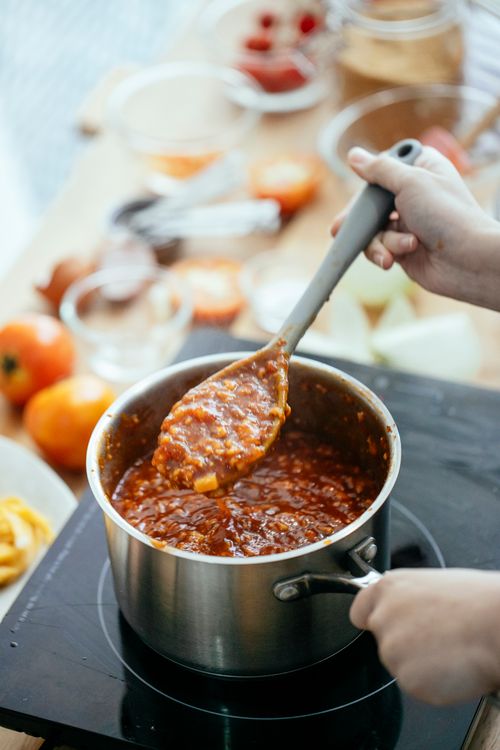
A pot of tomato sauce simmering on a stovetop, with fresh tomatoes ready nearby. Photograph: Katerina Holmes/Pexels
Image Credits: Pexels / Katerina Holmes and Pexels contributors
A tomato sauce that has simmered for hours tastes rounder and gentler than one that cooked for ten minutes. The sour bite softens, the sweetness comes forward, and the whole pot seems to settle down. Most cooks notice it, but few can say exactly what changed in the pot.
The short answer is that two things happen at once. Some of the sharp-tasting compounds physically leave the pot as steam.
And the compounds that remain taste different to your tongue because the sauce around them has changed. This article explains what tomato sauce acidity actually is, which parts of it a long simmer removes, which parts stay put, and why the sauce still tastes milder either way.
What makes tomato sauce taste sour in the first place
Fresh tomatoes are moderately acidic, with a pH typically between 4.3 and 4.9 depending on variety and ripeness. That sourness comes mostly from two organic acids. Citric acid accounts for about 71% of the total acidity, and malic acid contributes roughly 15%.
The amounts are small but easy to taste. One medium tomato carries around 375 milligrams of citric acid and about 45 milligrams of malic acid. Malic acid is actually about 14% more sour than citric acid, but it has less influence on flavor because there is so much less of it.
Canned tomatoes can taste sharper than fresh ones for a simple reason. Processing concentrates the acids, and manufacturers often add citric acid to standardize the pH for safe canning. So the sauce in your pot may have started out more acidic than the fresh tomatoes in the market ever were.
What heat actually takes away: the volatile acids
Not all acids behave the same way over heat. Vinegar smells sharp because its main ingredient, acetic acid, is volatile, meaning its molecules readily take flight into the air.
Citric, malic, and tartaric acids are nonvolatile and odorless. That difference matters enormously in a simmering pot.
Volatile compounds evaporate at room temperature, and they evaporate much faster at higher temperatures. When you simmer sauce uncovered, the small, light molecules escape with the steam. That is partly why your kitchen fills with aroma during a long simmer: flavorful molecules are leaving the pot and reaching your nose.
Acetic acid comes into tomato sauce from the tomatoes themselves in small amounts, and in larger amounts if the recipe includes wine or vinegar. Those volatile acids drift off over a long, uncovered simmer. The steam that carries them away is the same steam you smell.
What never evaporates, no matter how long you boil, are the nonvolatile compounds: the sugars, the salts, the fats, and most of the tomato acids. They stay in the pot, concentrating as the water leaves.
This is why a lid makes a difference. A covered pot lets volatile acids condense on the underside of the lid and drip back into the sauce. Cooking with the lid off gives the sharp, volatile compounds an exit route.
What heat leaves behind: citric acid stays put
Here is the part most explanations skip. Citric acid, which makes up the great majority of tomato acidity, is nonvolatile. A long simmer does not boil it away.
Malic acid behaves the same way. The actual acid content of your sauce barely drops, even after hours on the stove.
ChefsResource puts it bluntly: long simmering does not inherently remove acidity. If the sauce tastes mellower, the change is mostly about balance, not removal. As the food site notes, a sauce that is still sharp after a long cook usually started with aggressive tomatoes or added citric acid, and no amount of extra time fixes that.
There is even a trap at very long cooking times. If water evaporates faster than volatile acids escape, the remaining acids become more concentrated, not less. A sauce reduced hard and fast can taste sharper than a gently simmered one, even though it cooked longer.
Low, slow heat is the whole trick.
Why the sauce still tastes milder: the sugar-to-acid ratio shifts
If the acid mostly stays, why does the sauce taste less acidic? Because taste is about ratios, not just acid content. Food scientists describe the sugar-to-acid ratio as a primary driver of how pleasant a tomato product tastes, and a long simmer pushes that ratio in a sweeter direction.
Two things change the ratio. First, water evaporates. As it leaves, everything dissolved in the pot becomes more concentrated, including the tomato's natural sugars.
The Brix value, which measures soluble solids like glucose and fructose, rises through water removal during cooking. Second, prolonged heat breaks down some complex carbohydrates and pectins into simpler, sweeter-tasting sugars.
Why the sauce still tastes milder: your palate reads the new balance
Your tongue then reads the result differently. Sweetness and sourness compete on the palate, so a sweeter sauce registers as less sour even when the acid is still there.
Added sugar works the same way: it masks sourness without changing pH. A long simmer achieves a similar masking effect with the tomato's own sugars.
There is also a slower browning effect at work. The Maillard reaction, the chemistry between amino acids and sugars that creates roasted, savory flavors, proceeds rapidly between about 140 and 165 degrees Celsius.
A simmering pot sits around 100 degrees, so this browning runs far more slowly than in an oven. Over hours, though, a little of it happens around the edges of the pot, adding savory depth that further distracts from sharpness.
It is the same family of chemistry that builds how crust forms on bread, just running at a crawl.
Aromatics matter too. Raw, grassy-smelling compounds like hexanal break down or drift off during cooking, while new sweet and savory aromas form. A sauce that smells rounder tastes rounder, because smell is half of flavor.
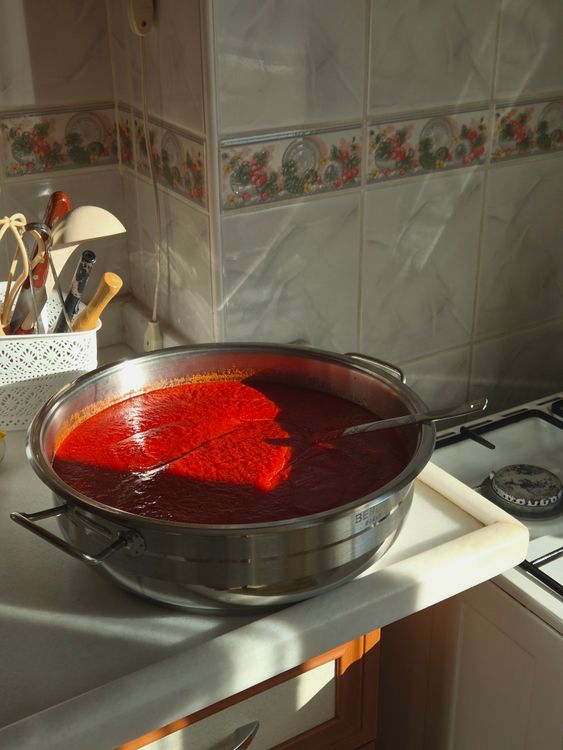
A wide pan of tomato sauce simmering gently, with steam carrying volatile compounds away. Photograph: Pexels
How to simmer for the roundest, mildest sauce
Start with the sweetest tomatoes you can find. Ripe, in-season tomatoes need far less coaxing than pale winter ones, because ripening itself lowers citric acid while sugars build. When the raw material is good, the simmer has less work to do.
Keep the heat low and the lid off, at least partly. A bare simmer lets steam escape, carrying volatile acids with it.
A hard boil does the opposite: it drives water off so fast that acids concentrate before the gentle chemistry has time to work. Think of it like eggs cracking when you boil them: aggressive heat changes food in ways gentle heat does not.
Give it at least 45 minutes. The mellowing is gradual, and most of the volatile loss and sugar concentration happens in the first hour. Going much past two hours gives diminishing returns on flavor while the sauce keeps thickening.
Salt properly before judging acidity. An under-salted sauce tastes sharper than it is, because nothing grounds the flavor. Taste, salt, and taste again before reaching for sugar or baking soda.
Finish with fat. A spoonful of butter or a swirl of olive oil stirred in off the heat coats the palate and softens how sharp flavors land. It does not neutralize acid, but it changes how your tongue meets it, in the same way that chillies burn your mouth differently depending on what coats your tongue.
Frequently asked questions
Does simmering tomato sauce reduce its pH?
No, not in any meaningful way. The main tomato acids, citric and malic, are nonvolatile and stay in the pot. Simmering changes how acidic the sauce tastes, mainly through volatile acid loss and sugar concentration, but the pH barely moves.
Does a long simmer remove all the acid?
It cannot. A long, uncovered simmer removes volatile acids like acetic acid with the steam, but the bulk of the acidity comes from citric acid, which does not evaporate. What changes is the balance of flavors, not the acid count.
Why does my sauce still taste acidic after hours of simmering?
The likely causes are the starting ingredients, not the cooking time. Underripe tomatoes, canned tomatoes with added citric acid, or a hard boil that concentrated the sauce too fast can all leave a sauce sharp. Very long cooking can even concentrate acids if too much water evaporates.
Does adding sugar reduce the acidity of tomato sauce?
Sugar does not change the pH or remove any acid. It masks sourness because sweet and sour flavors compete on your tongue. A long simmer achieves a similar effect naturally, by concentrating the tomato's own sugars.
The bottom line
A long simmer makes tomato sauce taste less acidic through two honest mechanisms. Volatile acids escape with the steam, and the sauce that remains tastes sweeter and rounder as water evaporates and sugars concentrate.
The main acids never leave the pot, which is why ingredient choice matters more than any trick. Start with ripe tomatoes, simmer low with the lid off, salt properly, and finish with fat.
Latest in Food & Cooking
Subscribe for one short food-science answer in your inbox every morning.
Related stories
Why Does Bread Go Stale Faster in the Refrigerator?
Bread goes stale faster in the fridge because starch recrystallizes fastest near 4°C. Here is the retrogradation science and the right way
Baking soda and baking powder: what's the difference?
Baking soda is pure sodium bicarbonate; baking powder adds two dry acids for double-acting lift. Learn when to use each, plus exact
What Is the Maillard Reaction in Simple Terms?
The Maillard reaction is the browning chemistry between amino acids and sugars above 140 C that creates the crust, color, and rich flavor