
What is companion planting and does science support it
By Rive News / Research desk | Rive News / Published October 24, 2026 at 9:00 AM PKT
Key takeaways
- Companion planting means growing specific plants together so they help each other, usually with pests, pollinators, or nutrients.
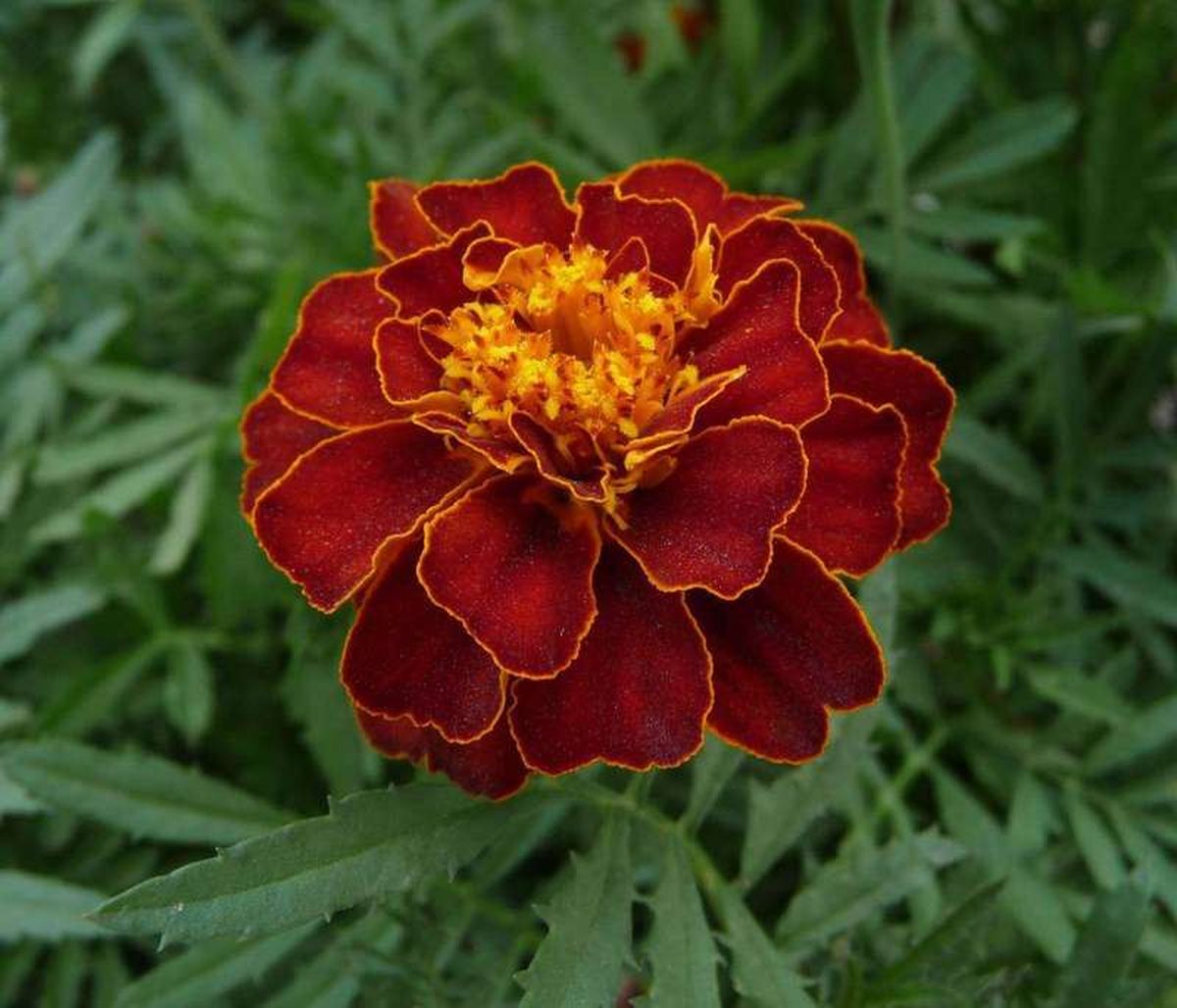
- The science is split: some pairings, like French marigolds protecting tomatoes from whiteflies, have real trial data behind them.
- Most traditional companion-planting charts have little experimental support, so treat pairings as hypotheses, not rules.

[Blooming yellow marigold flower beds, the most studied companion plant in vegetable gardens.] Photograph: Haoreima
Image Credits: Wikimedia Commons
Companion planting is the practice of growing certain plants next to each other so that they benefit one another. The claimed benefits include repelling pests, attracting pollinators and beneficial insects, improving soil, and even improving flavor. Gardeners have used pairings like tomatoes with basil and carrots with onions for generations.
The honest scientific answer is: it depends on the pairing. Some combinations have been tested in real trials and held up.
Many of the charts circulating online have never been tested at all. This article explains what companion planting claims, where the evidence is strong, where it is thin, and how to use the idea without falling for the folklore.
What companion planting actually claims
The core claim is that plant combinations change the growing environment in useful ways. The mechanisms proposed are physical, chemical, or biological.
A tall plant shades a heat-sensitive one. A strongly scented plant masks the smell of its neighbor from pests. A flowering plant feeds the predators that eat the pests.
Intercropping is the broader agricultural version of the same idea: growing two or more crops together to use space, light, and soil better. Scientists generally prefer terms like intercropping or plant associations because they describe measurable arrangements rather than implying plants have friendships.
The popular version goes further. Traditional charts list dozens of "friends" and "enemies" for every vegetable, with confident claims about which pairs boost growth and which stunt it. This is where the trouble starts, because most of those specific pairings were never tested.
The strongest evidence: marigolds and whiteflies
The best-tested companion planting claim involves French marigolds and tomatoes. Gardeners have long said that planting marigolds next to tomatoes protects them from the glasshouse whitefly, a serious greenhouse pest. In 2019, researchers put that claim to a proper test and published the results in PLOS ONE (PMCID PMC6396911, PMID 30822326).
The team ran two large-scale glasshouse trials. In the first, marigolds grew next to tomatoes for the whole growing season, and whitefly population growth was tracked over a 48-day infestation period.
Association with marigolds significantly slowed whitefly population development. Laboratory work showed that limonene, a major chemical component of French marigolds, repels whiteflies, and limonene dispensers alone were also effective.
The second trial tested marigolds as an emergency measure, introduced after whitefly populations had already built up. That worked much less well. The study's conclusion was specific: companion planting short-vine tomatoes with French marigolds throughout the growing season will slow whitefly population development, but adding marigolds after a heavy infestation is far less effective.
A 2025 review by Prakash Awasthi of Tribhuvan University's Institute of Agriculture and Animal Science, published in Sustainability Science and Resources, gathered the wider marigold evidence. Marigolds release bioactive compounds including thiophene and alpha-terthienyl that repel aphids, whiteflies, and root-knot nematodes. The review also notes that marigolds support beneficial insects including ladybugs, hoverflies, and parasitic wasps, and attract pollinators with nectar and pollen.
Where the evidence is thinner
The marigold story is the exception, not the rule. Most classic pairings have little or no experimental backing. The sharpest criticism comes from Linda Chalker-Scott, Extension Urban Horticulturist (Emerita) at Washington State University, who has reviewed the literature on companion planting for extension publications.
Her position, summarized by University of Nevada Cooperative Extension educator JoAnne Skelly, is that research has found real benefits in interplanting and diverse plant associations, including pest effects, beneficial-insect attraction, and even plants sharing root connections or improving soil for neighbors. Legumes like beans and peas genuinely add nitrogen to soil for other plants.
But Chalker-Scott draws a hard line at the charts. As quoted in gardening coverage of her work, "traditional companion planting charts have entertainment, and not scientific, value." Skelly's summary adds that most companion plant lists have little basis in fact, and that the phrase "companion plants" becomes a problem when science gets lost in pseudoscience about plant rhythms, vibrations, or plant feelings.
Some published guides go further into unsupported territory, assigning pairings based on biodynamic methods like sensitive crystallization, which have no verifiable scientific basis. Those should be treated as folklore, not horticulture.
How to use companion planting sensibly
Start with the pairings that have mechanisms and data. Marigolds with tomatoes for whitefly pressure is the single best-supported vegetable-garden pairing. Insectary plantings, flowers grown to feed beneficial predators, have documented effects on aphid control in brassicas.
Think in terms of density and timing. The whitefly trials worked when marigolds were present from the start of the season, not as a rescue treatment. A few scattered plants will not achieve the effect that a real planting does; one UK expert notes you need the companion at roughly the same density as the crop for pest effects.
Use intercropping logic for the rest. Even where a specific pairing lacks proof, diverse plantings still use space better than bare soil, shade out weeds, and feed more kinds of beneficial insects. The Three Sisters combination of corn, beans, and squash has documented land-use efficiency, with land equivalent ratios of 1.2 to 1.4 reported in the literature.
And keep the charts in perspective. If a chart says two plants are "enemies" with no mechanism and no trial behind it, treat it as a suggestion to watch, not a rule to obey. Your local conditions, season length, and pest pressure matter more than any universal chart.

[Marigold beds in flower; the plants release compounds such as limonene and thiophene that deter some pests.] Photograph: Haoreima
Image Credits: Wikimedia Commons
What to plant this season
If you want to try the evidence-backed version, here is a short list. Plant French marigolds (Tagetes patula) alongside tomatoes from transplant time, not after pests arrive.
Add flowering herbs like dill near brassicas to feed aphid predators. Grow beans or peas in rotation before heavy feeders to bank nitrogen.
Skip the elaborate chart-matching. Pick two or three pairings with real mechanisms, plant them at meaningful density, and observe what happens in your own garden. That is closer to how the science actually works than any color-coded diagram.

[A dense marigold bed in full bloom; research finds the pest effect works best when marigolds are planted from the start of the season.] Photograph: Haoreima
Image Credits: Wikimedia Commons
Frequently asked questions
Do marigolds really keep bugs away from tomatoes?
For glasshouse whitefly, yes, with caveats. A 2019 PLOS ONE glasshouse trial found that French marigolds grown with tomatoes all season significantly slowed whitefly population growth, likely through airborne limonene. They worked poorly as an emergency fix after infestations built up.
Is companion planting just a myth?
Not entirely. The broad idea that diverse plantings help each other has real support: pest disruption, beneficial insects, nitrogen from legumes, and shade effects are all documented. But most specific "friends and enemies" charts have no experimental basis, which is the part scientists criticize.
What is the most scientifically supported companion planting pair?
French marigolds with tomatoes for whitefly control has the strongest trial data in a home-garden context. The Three Sisters (corn, beans, squash) has strong agronomic data for land-use efficiency. Beyond those, evidence gets patchier.
Do I need to follow a companion planting chart exactly?
No. Washington State University's Linda Chalker-Scott argues the traditional charts have entertainment rather than scientific value. Use pairings with known mechanisms, plant at real density, and treat the rest as worth testing rather than worth obeying.
Can companion planting replace pesticides?
It can reduce pest pressure, but it is not a replacement for integrated pest management. The whitefly research positions marigolds as one tool for slowing pest buildup, most effective alongside monitoring and other controls.
The bottom line
Companion planting is real horticulture wrapped in a thick layer of folklore. The core mechanisms, pest disruption, beneficial insects, nutrient sharing, hold up. A few specific pairings, led by marigolds with tomatoes, have genuine trial data.
But the confident charts of friends and enemies that dominate garden blogs are mostly untested. Plant the proven pairs, experiment with the rest, and let your own garden be the final judge.
Rive News's research desk covers gardening science, food growing, and home horticulture from published studies and extension sources.
Related
- Why do zucchini plants make flowers but no fruit?
- Why do your roses have black spots on the leaves?
- What to plant in autumn for spring flowers
- Why orchid flowers fall off after bringing them home
Subscribe for one practical gardening explainer every week.
Rive News publishes research-backed explainers; claims are sourced from the studies and extension references listed above.
Related stories
What Is Companion Planting and Does It Work?
Marigolds work as a nematode cover crop, but the basil flavor claim failed repeated tests. An honest evidence review of what companion
Determinate vs. indeterminate tomatoes: growth, pruning, and harvest differences
Determinate tomatoes grow to a set size and ripen all at once, while indeterminate types vine all season. That one difference shapes

How to improve clay soil for gardening
Gypsum will not fix ordinary clay soil, say extension experts. What actually works: 2 to 3 inches of compost, mulch, better drainage,