
Why tomatoes split after heavy rain, and how to stop it
By Rive News / Research desk | Rive News / Published October 29, 2026 at 9:00 AM PKT
Key takeaways
- Tomato splitting follows a sudden surge of water into ripening fruit after a dry spell, when the inside swells faster than the skin can stretch.
- Radial cracks run down from the stem, while concentric cracks ring the shoulder; both come from the same moisture-swing mechanism.
- Steady watering, mulch, and picking nearly ripe fruit before a forecast storm cut the risk, though no method prevents every split.
[Tomato vines glistening in sunlight in a garden.] Photograph: Jidanni
Image Credits: Wikimedia Commons
A split tomato is a fruit that grew faster on the inside than its skin could handle. The skin of a ripening tomato loses elasticity as the fruit matures, so a sudden rush of water can stretch it past its limit and tear it open.
This article explains why tomatoes split after heavy rain, including what splitting actually is, why dry-then-wet weather causes it, which tomatoes split most easily, what to do with split fruit, and how to prevent splits next season.
What tomato splitting actually is
Splitting is a physical failure of the fruit skin, not a disease. The inside of the tomato keeps taking up water and accumulating solids while the skin around it expands more slowly. When the pressure inside exceeds what the skin can bear, the skin tears.
Gardeners usually see two patterns. Radial cracks start at the stem end and run lengthwise down the fruit, sometimes the full length of a cherry tomato. Concentric cracks form rings around the shoulder of the fruit, near the stem.
A single fruit can show both patterns at once, and severe cases can show several crack types together.
A third, finer pattern is called rain check. The University of Maryland Extension describes it as many tiny concentric cracks across the shoulder of the fruit, which feel rough to the touch and can develop into unsightly scabs. Rain check shows up most on exposed, mature green fruit after heavy rain, and it is more common on large fresh-market tomatoes than on smaller types.
Cracks matter because they open the fruit to rot. Once the skin is broken, fungi and bacteria have an entry point, and a split tomato left on the vine deteriorates fast. That is why advice about splits always has two parts: prevent what you can, and use split fruit quickly.
Why rain after dry weather causes splits
The trigger is rarely rain alone. It is the swing from dry to wet. University of Missouri Extension horticulturist David Trinklein describes cracking as a common problem when soil moisture varies widely, especially during the hot, dry days of late summer.
His colleague Michele Warmund explains that too much irrigation or heavy rainfall after a dry period causes rapid water uptake, and ripening fruit splits as a result.
The University of Delaware's Weekly Crop Update, written by extension vegetable and fruit specialist Gordon Johnson, gives the mechanism in more detail. Cracking is most common when water rushes into fruit during ripening, at the same time the fruit is accumulating solids. The combined pressure of water and solutes can split varieties with low skin elasticity.
During heavy rain, water can also enter the fruit directly at the stem scar or through minute cracks in the skin shoulder, adding more pressure and larger cracks.
Fruit temperature plays a supporting role. Tomatoes exposed to direct sun absorb more heat during the day than shaded fruit, and the Delaware update notes that elevated fruit temperatures, often caused by loss of leaf cover, increase susceptibility to cracking. High light levels and high humidity around the fruit add to the risk.
This explains a familiar garden puzzle: two plants in the same bed can crack differently. Variety, leaf cover, sun exposure, and exactly how dry each plant's roots were before the storm all shift the odds. Even careful watering cannot fully control a storm, which is why splitting frustrates experienced growers too.
Which tomatoes split most easily
Large beefsteak-type tomatoes crack most often, according to Iowa State University's Yard and Garden service. Their size works against them: a big fruit has more interior volume expanding against its skin, and many large varieties have thinner or less elastic skin during ripening.
Cherry tomatoes are a partial exception that proves the rule. Many cherry types are also prone to cracking, and when they split, the crack can run the length of the whole fruit. Their thin skins and fast ripening make them sensitive to the same moisture swings.
Variety choice is one of the few levers a gardener fully controls. Iowa State lists 'Jetstar', 'Mountain Spring', and 'Mountain Fresh' among varieties with good to excellent crack resistance. Missouri Extension notes that breeders have developed several crack-resistant cultivars, but adds a candid warning: all tomato cultivars, including cherry, plum, and conventional types, are prone to splitting when dry soil is followed by abundant moisture.
Resistance lowers the odds; it does not remove them.
Fruit left on the vine too long also cracks more readily at the stem end, Missouri Extension reports. A tomato that is already fully ripe has a skin at its least stretchy, so the next rain is the one most likely to split it.
What to do with split tomatoes
Pick split fruit immediately. Missouri Extension advises harvesting any cracked or split fruit right after rainfall and using it quickly, before rot develops. Cut away any sour-smelling, diseased, or rotted portions and discard them.
A split tomato is still usable if the flesh inside is firm and smells fresh. Cooking is the safer use for cracked fruit, since heat and a quick turnaround leave less time for spoilage organisms to establish themselves. A tomato that smells sour, feels slimy, or shows mould belongs in the compost, not the pan.
One habit prevents the worst losses: when rain is forecast after a dry spell, harvest nearly ripe tomatoes before the storm. Missouri Extension makes this recommendation explicitly. The fruit may not taste quite as good as a fully vine-ripened tomato, but it will still be usable, and it will not split on the vine.
How to prevent splitting next season
Steady moisture is the main defence. Iowa State recommends a thorough soaking once every 7 days during dry periods as adequate for most tomato plants, and Missouri Extension recommends a consistent supply of moisture through hand watering or soaker hoses. Drip irrigation tape works the same way, delivering water evenly instead of in floods.
Mulch holds that moisture steady between waterings. Iowa State suggests dried grass clippings, straw, or shredded leaves around tomato plants, and Missouri Extension lists straw and compost among suitable materials. Mulch also keeps soil temperature more even, which helps roots take up water at a steadier rate.
Keep enough leaves on the plant to shade the fruit. Heavy pruning in hot weather exposes fruit to direct sun, raising fruit temperature and cracking risk. Some leaf cover is protection, not untidiness.
Feed with balance. Missouri Extension notes that too much nitrogen, or too little calcium and potassium, predisposes tomatoes to cracking, and recommends maintaining optimum fertility with calcium nitrate and other nutrients during flowering and fruiting. Overfeeding nitrogen pushes fast, soft growth that the skin struggles to contain.
Finally, choose resistant varieties for the spots that dry out fastest. A crack-resistant variety in a sunny, fast-draining bed will outperform a crack-prone one in the same position, even with identical watering.
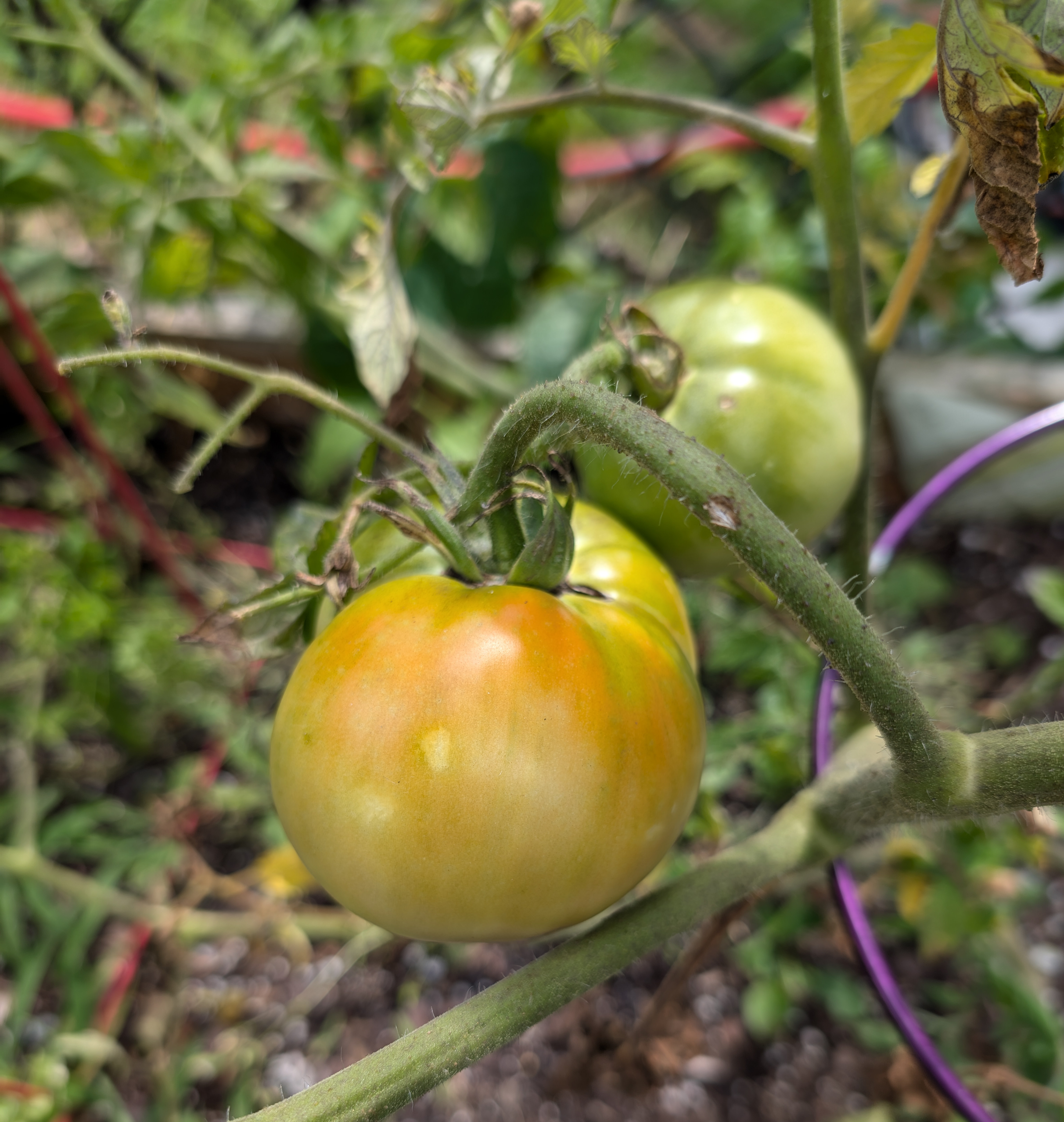
[A tomato growing on the vine, close up.] Photograph: NinjaRobotPirate
Image Credits: Wikimedia Commons
Frequently asked questions
Are split tomatoes safe to eat?
Yes, if the flesh is firm, smells fresh, and shows no mould or sour odour. Cut away damaged parts, use the fruit quickly, and cook it when in doubt. Discard any fruit that smells sour or shows rot.
Why do cherry tomatoes split so easily?
Cherry tomatoes have thin skins and ripen fast, so a moisture swing hits them hard. The University of Delaware update notes that in cherry tomatoes a split can run the length of the fruit.
Does watering cause splitting too?
Irregular watering can. A deep watering after a long dry period creates the same rapid uptake as heavy rain. Steady, even watering is the safer pattern, and mulch helps hold soil moisture between waterings.
Can a split tomato heal on the vine?
No. A crack in a ripe tomato does not close. The fruit may dry over slightly at the edges, but the opening stays vulnerable to rot, which is why split fruit should be picked promptly.
The bottom line
Tomato splitting is a water-pressure problem, not a sign of bad gardening. A dry spell followed by heavy rain swells ripening fruit faster than its skin can stretch, and the skin tears at the stem or around the shoulder. Steady watering, mulch, leaf cover for shade, balanced feeding, and crack-resistant varieties all lower the risk, and picking nearly ripe fruit before a forecast storm saves the crop that would otherwise split.
When splits do happen, pick the fruit at once and use it quickly.
---
Rive News's research desk covers practical gardening, home, and how-things-work explainers, drawing on university extension services and published research.
Related
- What Is Blossom End Rot on Tomatoes and What Causes It?
- How to Grow Tomatoes in Pots on a Balcony
- Why Do Tomato Leaves Curl and How to Fix It Fast
- How to Save Tomato Seeds for Next Year: A 5-Step Guide
Subscribe to Rive News for one practical explainer in your inbox each morning.
Rive News publishes research-desk explainers from public sources. Corrections: contact the desk and cite the article and the fact in question.
Related stories
What Is Companion Planting and Does It Work?
Marigolds work as a nematode cover crop, but the basil flavor claim failed repeated tests. An honest evidence review of what companion
Determinate vs. indeterminate tomatoes: growth, pruning, and harvest differences
Determinate tomatoes grow to a set size and ripen all at once, while indeterminate types vine all season. That one difference shapes
How to improve clay soil for gardening
Gypsum will not fix ordinary clay soil, say extension experts. What actually works: 2 to 3 inches of compost, mulch, better drainage,