
How to hang heavy shelves on drywall safely
Key takeaways
- Screw into wall studs whenever possible. That is the strongest mounting point in any drywall wall.
- Without a stud, use toggle bolts. They clamp against the back of the drywall and hold far more than plastic anchors.
- Add up the shelf plus everything on it. Keep the total under the anchor's rated load, and leave a safety margin.

Wall-mounted items like this guitar hanger depend on the same hardware choices as heavy shelves. Photograph: Yutaka Tsutano/Wikimedia Commons
Image Credits: Wikimedia Commons
Drywall is a skin, not a structure. The gypsum panel you see is only half an inch thick. It was never designed to carry weight on its own.
Everything you hang borrows strength from what is behind that skin. The best case is a wooden wall stud. The next best is a heavy-duty anchor that spreads the load across the back of the panel.
This article explains how to find the studs, how to choose the right anchor, how to install a toggle bolt, how much weight drywall can hold, the mistakes that bring shelves down, and the bottom line.
Find the studs first
Studs are the vertical wooden boards behind your drywall, usually spaced 16 inches apart in the US. A shelf bracket screwed into a stud transfers its load into the house frame itself.
A basic stud finder locates them in seconds. Klinbi's drywall guide calls the stud the best attachment point whenever the load is substantial. That is the rule to internalize before anything else.
If the shelf must go where no stud exists, do not give up. That is exactly what hollow-wall anchors are for. Just know you are stepping down one rung of strength, so the anchor choice matters more.
Mark your bracket positions with a pencil and check them with a level before drilling anything. Measuring twice is cheaper than patching drywall.
Choose the right anchor
Anchors are not interchangeable. Each type holds a different amount of weight, and the differences are large.
Plastic expansion anchors are the weakest option. Engineer Fix puts their total capacity at about 25 pounds. That covers small pictures and light shelves but nothing you would call heavy.
Self-drilling anchors thread directly into the drywall with no pilot hole. The metal versions can hold up to 75 pounds, per Engineer Fix. They are convenient for mid-range loads.
Molly bolts are a step up. A metal sleeve expands behind the wall as you tighten the screw. They handle medium-to-heavy loads, often cited around 50 to 100 pounds. But they punish over-tightening during installation.
Toggle bolts are the strongest common choice. A metal wing or channel opens behind the drywall and clamps the panel like a vise. Engineer Fix calls them the preferred choice for heavier applications, with the highest load capacity among common drywall anchors.
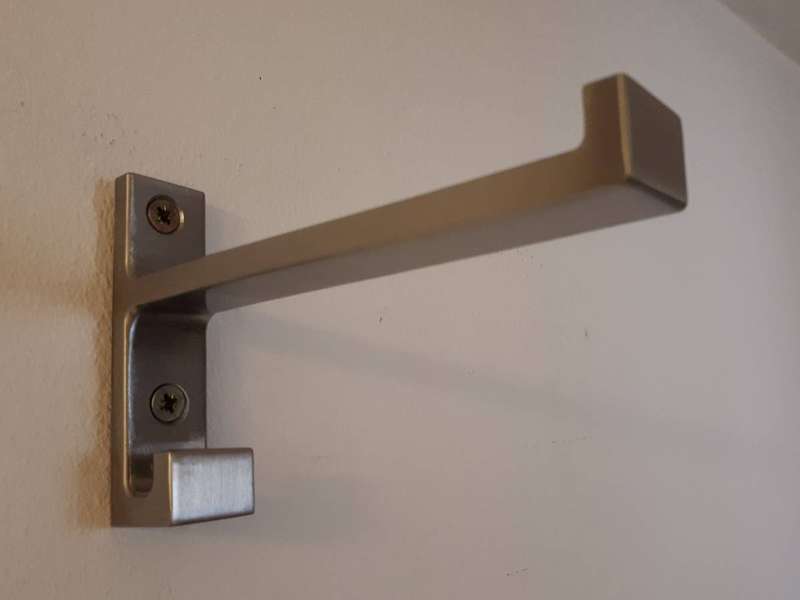
A bracket is only as strong as its anchor, so match the hardware to the load. Photograph: Fructibus/Wikimedia Commons
Image Credits: Wikimedia Commons
How to install a toggle bolt
Start with the weight math. Add the shelf's own weight to everything you plan to put on it, including books you might add later. Engineer Fix recommends keeping the total at least 10 percent under the anchor system's rated capacity as a safety buffer.
Mark and level your bracket holes. Drill a pilot hole slightly larger than the anchor's folded wings. Follow the package instructions for the exact bit size.
Push the toggle through the hole. You will feel the wings spring open behind the drywall. Pull the bolt gently toward you so the wings sit flat against the back of the panel.
Tighten the screw. The wing draws tight against the inner face of the drywall, sandwiching the panel between the wing and your bracket. Stop when it is snug. Cranking further can crush the gypsum.
Mount the bracket, set the shelf, and test before loading. Press down firmly on the shelf and check for flex or movement at the wall. A solid mount feels like part of the wall.
How much weight can drywall hold?
It depends on the anchor, not the drywall. The numbers below are manufacturer-style ratings cited by the sources above, for standard half-inch drywall in good condition.
A single quarter-inch SnapToggle, a popular toggle-bolt design, is rated up to 265 pounds in half-inch drywall, per the engineer's guide on Medium. That rating exceeds what the surrounding drywall can take before it fails.
Two anchors do not simply double everything. They share the load, but uneven tightening or one weak spot in the panel can leave one anchor carrying more. Keep the combined load comfortably under the combined rating.
Shear strength and pullout strength are different things. A shelf bracket pulls mostly downward along the wall, which drywall handles well. Anything that pulls outward from the wall is far more dangerous. That brings us to the biggest mistake.
Mistakes that bring shelves down
The classic failure is trusting plastic anchors with a heavy shelf. They rely on friction in crumbly gypsum, and a loaded shelf works them loose over months. If the shelf matters, skip the plastic.
The dangerous failure is the lever-arm trap. A full-motion TV mount or a shelf bracket that extends far from the wall multiplies force through torque. The Medium engineer's guide warns that a 30-pound TV extended 20 inches on an arm can crush drywall and rip anchors out regardless of their rating.
The rule is simple: anything on a swivel arm must hit studs, or the wall needs a plywood backing plate. No anchor in hollow drywall is exempt.
Other mistakes are smaller but common. Drilling without checking for pipes and wires, over-tightening molly bolts until they strip, and skipping the level all cause grief. Take the extra five minutes.
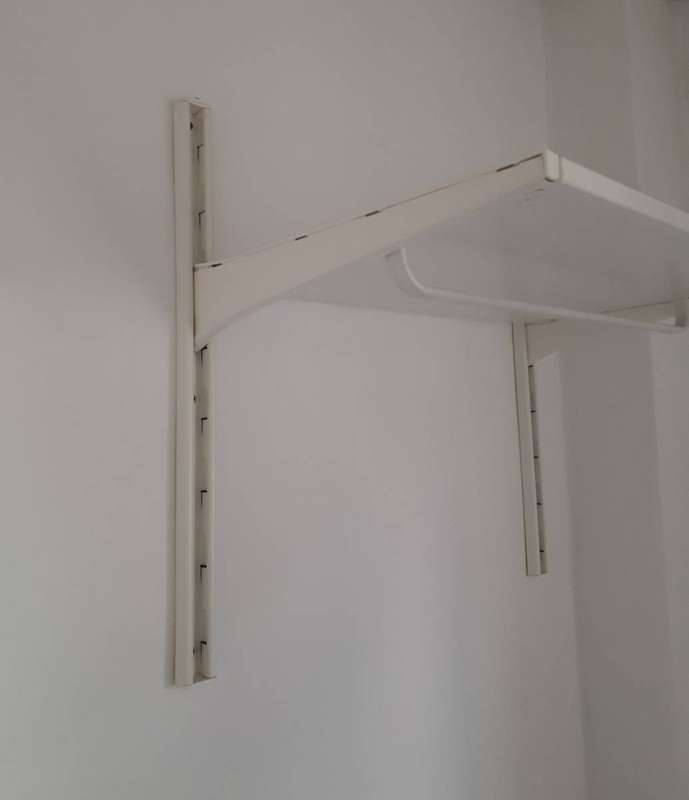
Long brackets create leverage that multiplies force on the anchor, which is why swivel mounts must hit studs. Photograph: Fructibus/Wikimedia Commons
Image Credits: Wikimedia Commons
A French cleat is worth knowing for the heaviest jobs. It is a beveled strip screwed to the wall that mates with a matching strip on the shelf. It spreads weight across a wide area. Conflingo's guide recommends it when you want maximum holding power without studs.
Frequently asked questions
Can I hang a heavy shelf on drywall without studs?
Yes, with the right hardware. Toggle bolts in half-inch drywall can carry heavy shelf loads when the total stays under their rated capacity. Keep a safety margin and avoid swivel-style brackets.
How do I know if I hit a stud?
The drill bit meets firm resistance after passing through the drywall, and wood shavings come out instead of white gypsum dust. A stud finder used beforehand removes the guesswork.
Are molly bolts or toggle bolts better for shelves?
Toggle bolts, for most shelf jobs. Both are strong, but toggle bolts spread force over a wider area behind the panel and tolerate installation mistakes better. Molly bolts work but punish over-tightening.
How much does the shelf itself weigh?
More than people guess. A solid wood shelf three feet long can weigh 10 to 15 pounds before you put a single book on it. Weigh the shelf on a bathroom scale and include it in your total.
The bottom line
Heavy shelves on drywall are a solved problem: studs first, toggle bolts second, honest weight math always. The failures come from plastic anchors and from leverage, not from drywall itself.
Before you drill, add up the real load, pick hardware rated well above it, and check for studs one more time. Your books will thank you.
---
About the author: Rive News is a research desk covering home improvement with explainers built from public sources.
Latest in Home
- How to prevent bathroom mold without an exhaust fan as a renter
- How to improve clay soil for gardening
- How to Reduce Humidity Without a Dehumidifier: 8 Practical Methods
- Why does condensation form on windows in winter?
Subscribe for weekly home and DIY explainers grounded in public sources.
Found an error? Corrections are welcome at the Rive News desk and are logged with the publish date.
© 2026 Rive News. All rights reserved.
Related stories

Why Your Faucet Keeps Dripping After You Turn It Off
A dripping faucet is usually a worn washer, O-ring, or cartridge that can no longer seal. One drip per second wastes over 3,000 gallons

How to fix a running toilet without a plumber in 30 minutes
A running toilet can waste 200 gallons of water a day. Diagnose the flapper, float, or fill valve in two minutes, then fix it yourself

Do Houseplants Raise Indoor Humidity? What the Research Says
Houseplants release water vapor through transpiration, and studies show offices with plants measure higher humidity. Here is how much,