
How a thermostat actually senses your room temperature
By Rive News / Research desk | Rive News / Published October 28, 2026 at 9:00 AM PKT
Key takeaways
- Old thermostats sense heat with a bimetallic strip that bends as metals expand.
- Modern thermostats use a thermistor, a resistor whose resistance changes with temperature.
- The thermostat compares that reading with your setpoint, then switches heating or cooling.
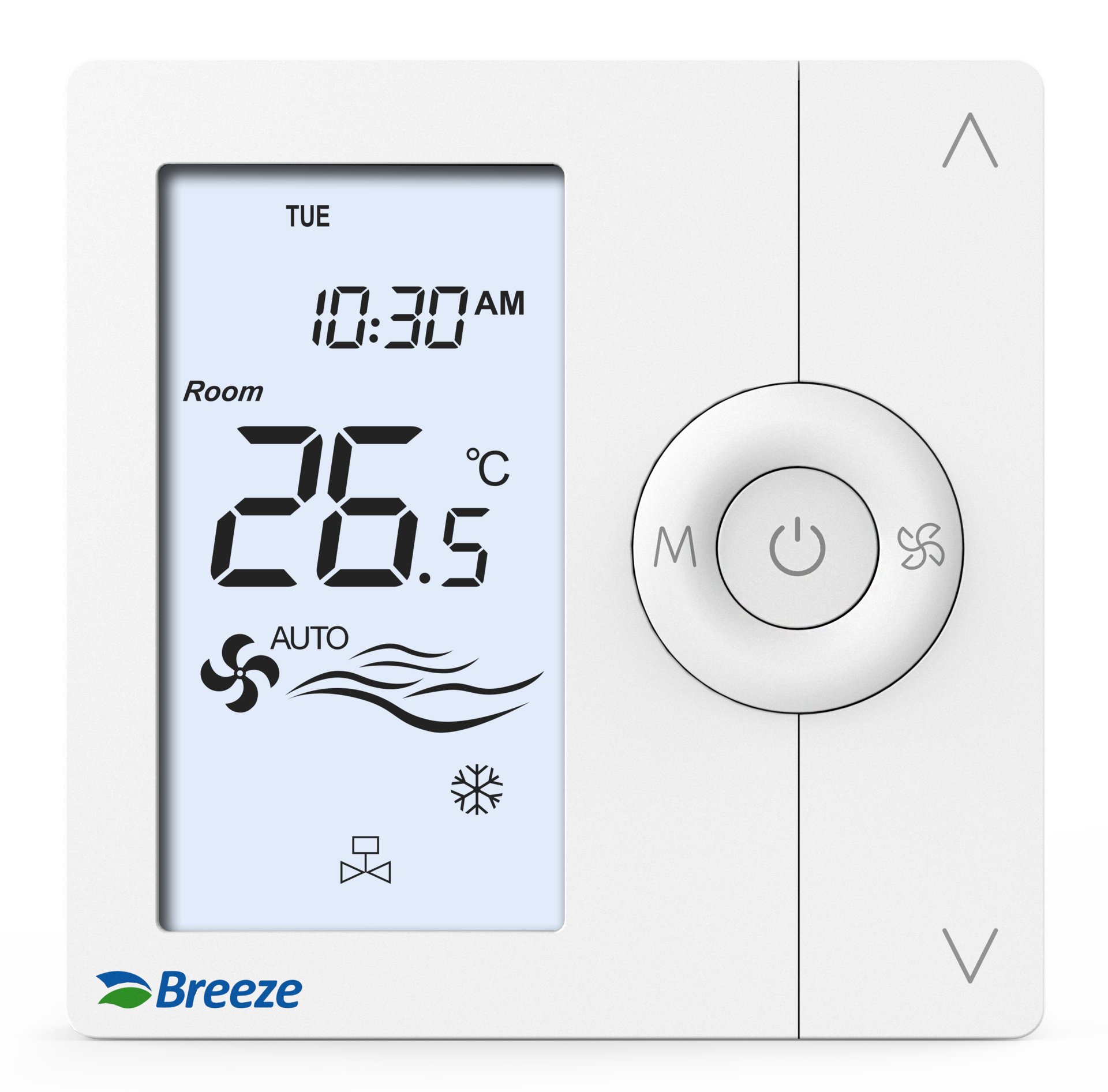
[A wall thermostat with a temperature display.] Photograph: Wikimedia Commons contributor
Image Credits: Wikimedia Commons
A thermostat does not sense comfort. It senses the temperature of the air around one small device, then decides whether to switch your heating or cooling on or off.
This article explains how a thermostat actually senses room temperature, including the bimetallic strip in older models, the thermistor in modern models, and the feedback loop that keeps a home near its setpoint. It also explains why a thermostat in the wrong spot reads the wrong room.
The core job: sense, compare, act
Every thermostat runs the same three-step loop. First it measures the temperature near its sensor, then it compares that reading with the temperature you set, then it acts on the difference.
Designing Buildings describes this as a closed-loop control system, where the output affects the input to maintain a desired value. The heating warms the air, the sensor reads the warmer air, and the loop repeats.
If the sensed temperature sits below the setpoint in heating mode, the thermostat switches heating on. When the reading reaches the setpoint, it switches heating off.
Cooling mode reverses the logic. Above the setpoint, cooling switches on, and at the setpoint it switches off again.
The bimetallic strip: bending metal as a sensor
Older mechanical thermostats sense temperature with a bimetallic strip. This is a strip made from two different metals bonded together, each expanding at a different rate when heated.
Testbook explains the principle as thermal expansion: materials change size with temperature, and the two metals in the strip expand by different amounts. The strip therefore bends as temperature changes.
Designing Buildings gives brass and steel as the classic pairing, though other metal combinations exist. As the strip warms, one side lengthens more than the other, and the strip curves.
That bending moves a contact in an electrical circuit. At a set position, the contact closes or opens, switching the heating or cooling system on or off.
The design is simple and needs no software. Its drawback, noted by Designing Buildings, is that bimetallic strips react relatively slowly to temperature changes.
Mercury switches and the old dial
Many classic round thermostats paired a bimetallic coil with a small mercury switch. The coil wound and unwound with temperature, tilting a tiny glass vial of mercury.
Energy Education describes this older type as a small vial with three wires inside. Tilting the vial left or right made one of two connections, turning the heater on or off.
Moving the dial changed the tilt point, which changed the temperature at which switching happened. The user never saw the mechanism, only the number on the dial.
Mercury thermostats are now rare, partly because of mercury itself and partly because digital models offer more control. The sensing idea, though, was the same: a physical change driven by temperature.
The thermistor: resistance as a thermometer
Modern digital thermostats sense temperature electronically with a thermistor. A thermistor is a resistor whose electrical resistance changes as temperature changes.
Energy Education explains that a digital thermostat uses a thermistor to measure temperature, then a microcontroller converts the varying resistance into a temperature reading. The conversion uses a known relationship between resistance and temperature for that sensor type.
Most home thermistors are the negative temperature coefficient type. As temperature rises, resistance falls, and the electronics read that fall as warming.
The microcontroller compares the converted reading with the setpoint many times per minute. It then drives a relay, an electronic switch, that calls for heating or cooling.
Thermistors react faster than bimetallic strips and read more precisely. That precision is why digital thermostats hold a steadier temperature than old dial models.
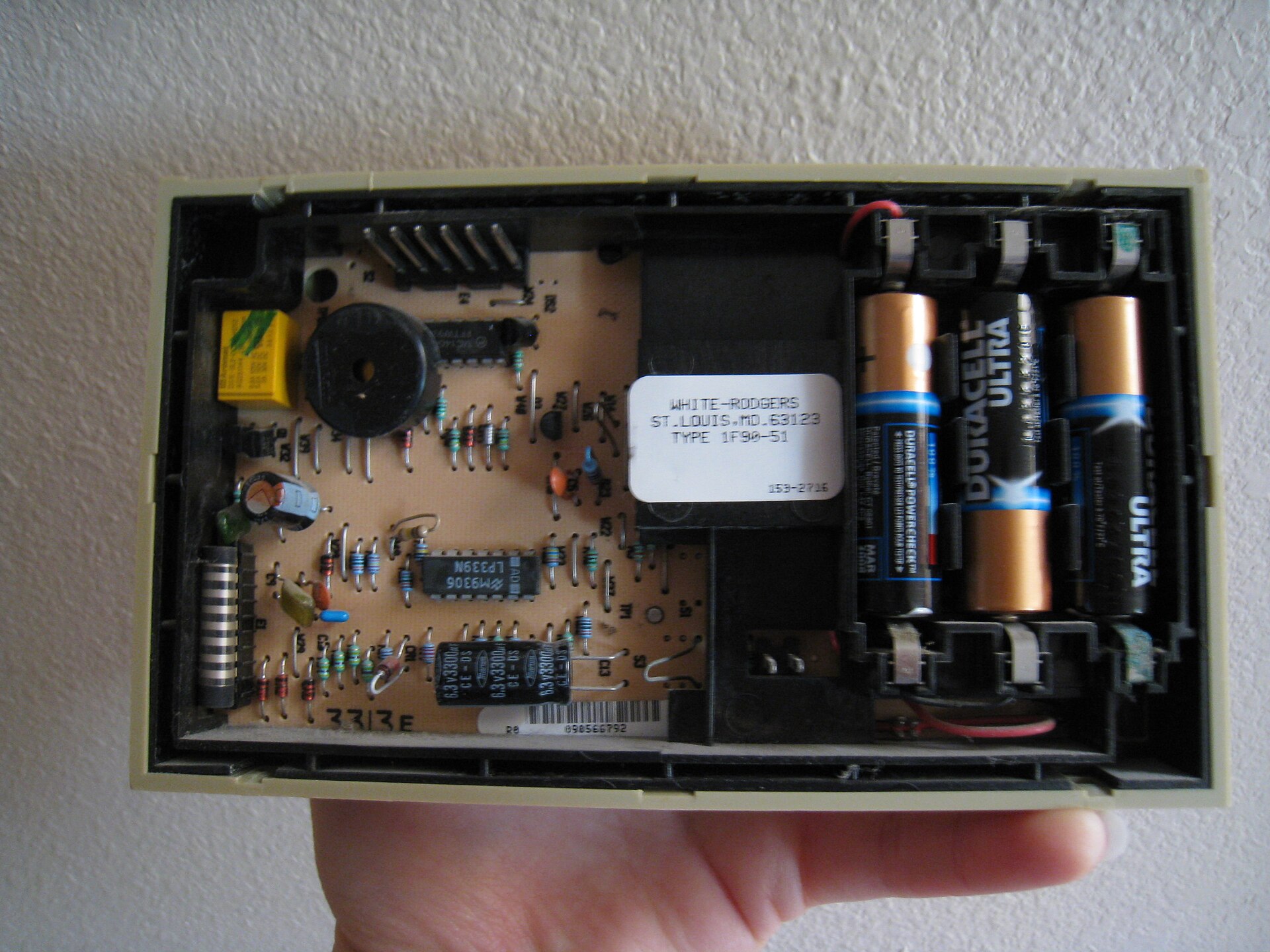
[The inside of a digital thermostat, showing its circuit board and batteries.] Photograph: Wikimedia Commons contributor
Image Credits: Wikimedia Commons
Gas-filled bellows: a third method
A less common mechanical design uses a gas-filled bellows enclosed by metal discs. As temperature rises, the gas expands and pushes the discs apart, switching the system off.
Designing Buildings notes that this type typically reacts faster than a bimetallic strip thermostat. The expanding gas gives a stronger, quicker mechanical movement.
Gas bellows appear more often in appliance thermostats, such as ovens and water heaters, than in room thermostats. The principle is still the same: a physical expansion driven by heat becomes a switching signal.
Why the reading is local, not whole-house
A thermostat measures air at its own location, not the average temperature of the house. Energy Education advises placing thermostats far from doors, windows, and heater vents, precisely because local air misleads the sensor.
A thermostat above a radiator reads warm air first and switches heating off early. The rest of the house stays cold while the thermostat believes its job is done.
A thermostat in a draughty hallway reads cold air and runs heating longer than needed. The living room overheats while the hallway sensor still calls for heat.
Sunlight through a window warms the thermostat body itself. The sensor then reports the temperature of a sunlit plastic case, not the room air.
Smart thermostats with remote sensors address this by averaging readings from several rooms. The sensing method stays the same, but the sample of air becomes wider.
Setpoint, swing, and cycling
A thermostat does not hold a temperature exactly. It allows a small swing around the setpoint before switching, to avoid flicking the system on and off constantly.
This swing is sometimes called differential or hysteresis. A heating system might switch on 0.5 degrees below the setpoint and off at the setpoint, for example.
Without that gap, the relay would chatter as the reading wobbled by tiny amounts. Short cycling also wears out heating equipment and wastes energy.
The result is a gentle wave around the target temperature rather than a flat line. Most people never notice the wave, since room air changes slowly.
Why smart thermostats still need a sensor
Smart features do not replace sensing. Learning schedules, weather forecasts, and phone apps all sit on top of the same basic loop: measure, compare, act.
A smart thermostat still reads its thermistor to know the current room temperature. Its extra value comes from better scheduling, occupancy sensing, and remote control, not from a different thermometer.
Some smart models add humidity sensing or occupancy detection. Those extra inputs adjust the schedule, but the temperature decision still starts with the thermistor reading.
If the sensor itself reads wrong, because of placement or a fault, no software feature can fix the result. The system will faithfully hold the wrong temperature.
Signs the sensor is reading wrong
A home that feels cold while the thermostat shows the target temperature points to placement or a faulty sensor. So does a system that runs constantly without reaching the setpoint.
Check for nearby heat sources first: lamps, televisions, direct sun, and radiators all warm the thermostat body. Check for draughts from doors and vents too.
Dust inside an old mechanical thermostat can also slow the strip or stick the contacts. A gentle clean sometimes restores normal switching, though mercury models need careful handling.
A digital thermostat that reads several degrees away from a separate room thermometer may have a failing thermistor. Replacement is usually simpler than repair for a sealed electronic unit.
Frequently asked questions
Does a thermostat measure the whole house?
No, it measures air near its own sensor. A single thermostat cannot know the temperature of closed-off rooms, which is why placement matters and why remote sensors help in larger homes.
Why does my thermostat read warmer than the room feels?
Heat sources near the thermostat, such as sun, lamps, or a radiator, warm the sensor directly. The reading then reflects that local warmth rather than the general room air.
How accurate is a modern thermostat sensor?
Digital thermistors are more accurate and faster than bimetallic strips, and they hold a steadier temperature. Placement errors usually matter far more than sensor accuracy.
Can turning the thermostat higher heat a room faster?
No, a thermostat is a switch, not a throttle. Setting it higher only raises the target temperature, so the system runs longer, but it does not produce heat any faster.
The bottom line
A thermostat senses room temperature through a physical change: bending metal in older models, or changing electrical resistance in modern thermistors. That change becomes a signal, the signal is compared with your setpoint, and the result switches heating or cooling.
The whole system depends on one small patch of air. Put the thermostat where the air truly represents the room, and the loop works as designed.
Tags: thermostats, heating, home heating
Rive News's research desk covers everyday science and home topics from published sources, with no invented experts or first-hand claims.
Related
- Why one room is colder than the rest of the house
- What is the ideal indoor humidity level
- How to stop condensation on bedroom windows
- Why your ceiling fan wobbles and how to balance it
Subscribe to Rive News for one plain-English explainer each day.
Rive News follows a published standards policy: no invented facts, quotes, or statistics, and every number traces to a cited source.
Related stories
Why Your Faucet Keeps Dripping After You Turn It Off
A dripping faucet is usually a worn washer, O-ring, or cartridge that can no longer seal. One drip per second wastes over 3,000 gallons
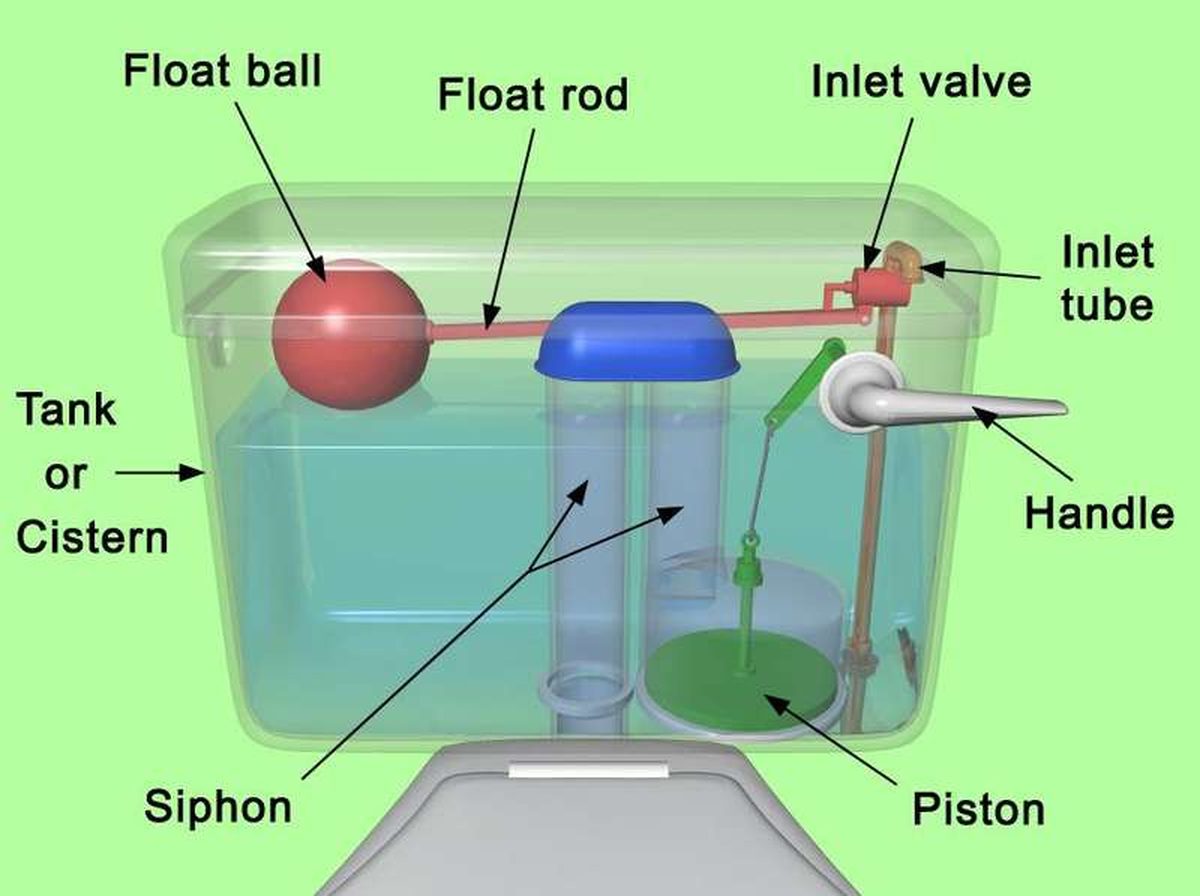
How to fix a running toilet without a plumber in 30 minutes
A running toilet can waste 200 gallons of water a day. Diagnose the flapper, float, or fill valve in two minutes, then fix it yourself

How to hang heavy shelves on drywall safely
Studs first, toggle bolts second, plastic anchors never for heavy loads. Weight ratings, installation steps, and mistakes that bring