
Why Do Budgies Bob Their Heads When They Walk? The Vision Science
Key takeaways
- A walking budgie's head bob has two phases: a hold phase that locks the gaze steady, then a rapid thrust forward.
- The classic 1978 experiments showed the behavior is an optokinetic response for image stabilization, not balance.
- Stationary head bobbing means something different: excitement, courtship, or attention-seeking.
Watch a budgie cross a tabletop and the head seems to have a mind of its own. It lunges forward, freezes, then lunges again, always out of sync with the feet. The motion looks comical, but it is one of the most precisely studied behaviors in bird biology.
The bobbing is about vision. Birds cannot move their eyes the way we do, so they stabilize the world with their necks instead. This article explains the two-phase mechanism, the landmark experiments that decoded it, and when head bobbing means something else entirely.
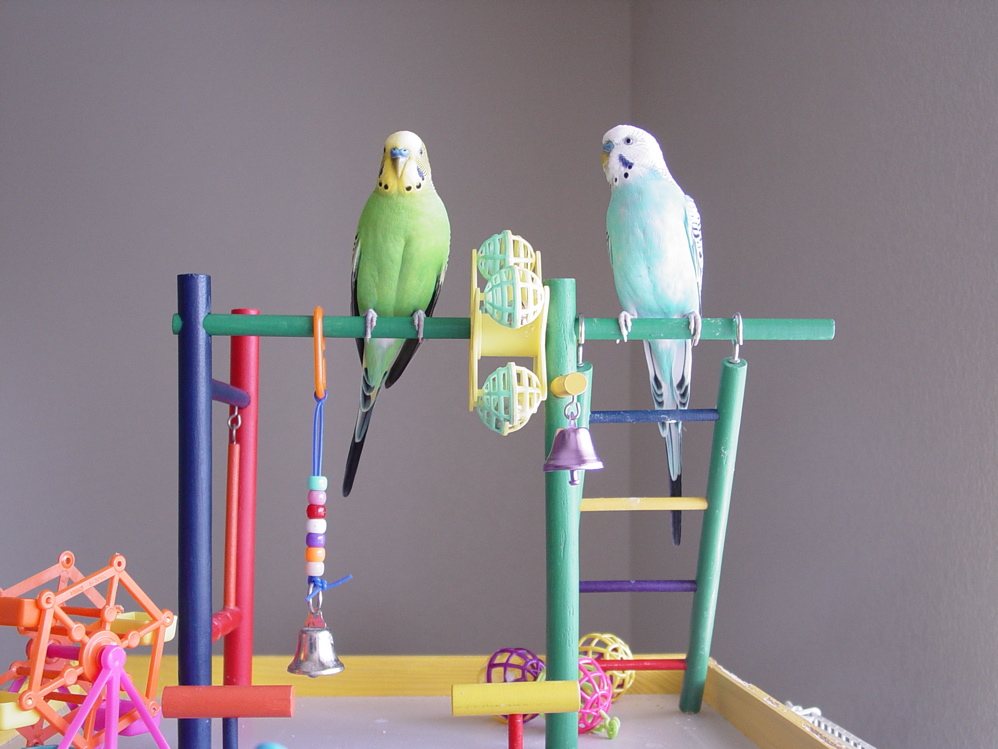
Image Credits: Wikimedia Commons / Anna Saccheri
The two-phase bob: hold, then thrust
High-speed photography of walking birds revealed that head bobbing is not one motion but two, repeated with every step. First comes the hold phase: the head locks onto a fixed point in space while the body walks forward underneath it. Then comes the thrust phase: the head snaps forward to a new position in a fraction of a second.
This hold-and-thrust cycle is the whole trick. During the hold phase, the bird's view of the world stays perfectly still, giving its visual system a clear, stable image to process. During the thrust, vision is effectively suppressed, much like your own eyes stop registering detail during a fast eye movement called a saccade.
Barrie J. Frost of Queen's University in Kingston, Ontario, documented this in his landmark 1978 paper, "The Optokinetic Basis of Head-Bobbing in the Pigeon," published in the Journal of Experimental Biology (volume 74, pages 187-195). Using high-speed motion photography, he showed the head remaining locked in space while moving backward relative to the forward-moving body, then thrusting rapidly forward to a new position.
Twenty-two years later, Frost and Nikolaus F. Troje refined the picture in the Journal of Experimental Biology (2000, volume 203, pages 935-940). Their videography showed that during the hold phase, the pigeon's head stays virtually motionless not just horizontally but in all dimensions of translation and rotation, with only a small systematic slip that serves as an error signal for the stabilization system.
The rhythm is fast. Research reviewed by Laura Jimenez Ortega and colleagues in Experimental Brain Research (2009) reports that a walking bird's head moves backward and forward with a frequency ranging from about 2 to 10 Hz, meaning up to ten hold-thrust cycles every second.
Why vision, not balance, is the main reason
The cleverest part of Frost's 1978 study was a treadmill experiment.
When pigeons walked on a treadmill, where the body stays in place and the world does not flow past, head bobbing stopped entirely. If the behavior were about balance or about coordinating the legs, it would have continued.
Its disappearance showed that the bobbing is primarily a visual response, triggered by the optic flow of the world moving past the eyes.
The accepted name for it is an optokinetic response: a reflex that stabilizes the retinal image. Without it, a walking bird's view would smear with every step, a blur called retinal slip that would make fine detail impossible to see. By locking the head during each hold phase, the bird gets a series of sharp snapshots instead of one long blur, and it can distinguish its own motion from the motion of the outside world.
Birds need this trick because their eyes are nearly fixed in their sockets. Humans stabilize vision with tiny, rapid eye movements; birds do the equivalent job with their necks, using highly flexible cervical vertebrae and specialized musculature. Some bird species carry up to 25 neck vertebrae, compared with 7 in humans, giving them the range and precision for the job.
The same visual mechanism also helps depth perception.
With eyes set on the sides of the head, birds get a wide field of view but limited overlap between the two eyes. The stop-and-start head motion creates motion parallax, slight shifts in an object's position against the background that help the bird judge distances as it walks.
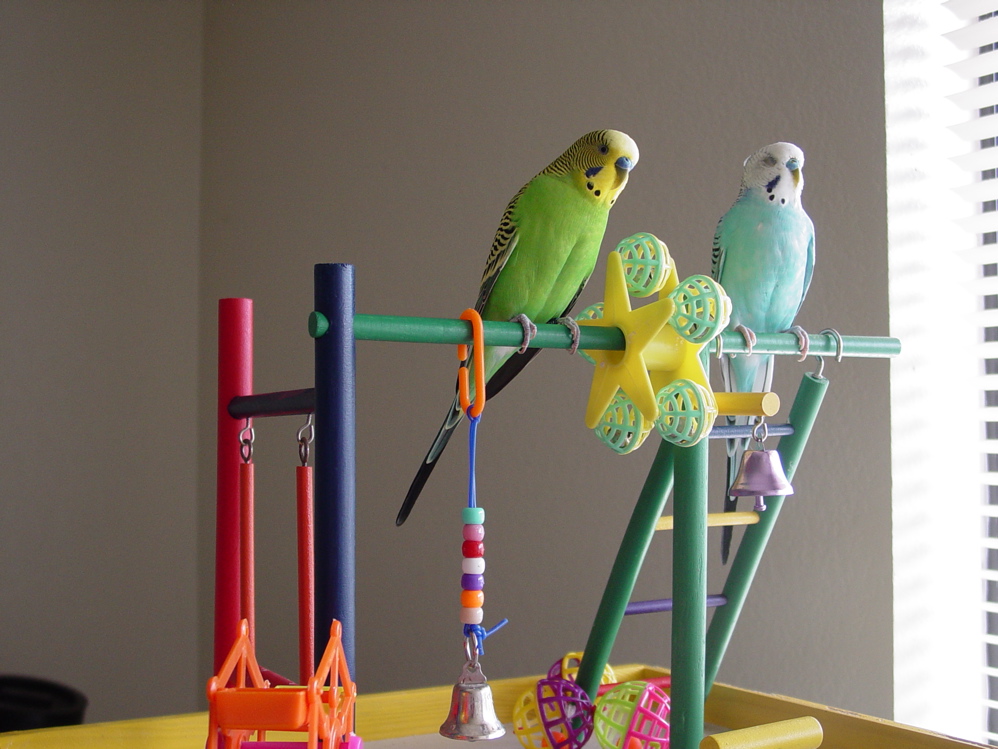
Budgie-care sources consistently list focus and visual stabilization as the primary reasons a budgie bobs while moving, which matches the laboratory findings.
When head bobbing means something else
The vision explanation applies to bobbing while walking. A budgie bobbing its head while sitting still is speaking a different language, and the context changes the meaning.
Excitement and attention-seeking are the most common reasons.
Budgies bob, chirp, and flick their wings when they are happy, when they want interaction, or when they are practicing sounds; rhythmic bobbing often accompanies mimicry practice, a sign of cognitive engagement rather than mating intent.
If your bird bobs while chattering at you, it is usually a social gesture. Why dogs tilt their heads when you talk is a similar story of an animal calibrating its senses to you.
Courtship, young birds, and warning signs
Courtship is another. Male budgies perform displays with puffed feathers, chirping, and repetitive head movements to attract mates, and a receptive female may answer with reciprocal bobbing. Young birds bob more than adults generally; fledglings learning to walk, hop, and coordinate their bodies use the same stabilization system constantly, and some extra bobbing is part of growing up.
One honest caveat: the classic laboratory work was done on pigeons, not budgies.
Pigeons, chickens, crows, and many other walking birds all show the same hold-thrust pattern, and the optokinetic explanation is accepted across them. Budgies are smaller and more social, so their stationary bobbing carries more social meaning, but the walking bob is the same ancient mechanism.
If you keep parrots too, the reason parrots mimic speech while most birds cannot is another window into how bird brains differ from ours.
Watch for patterns that look wrong. Constant, jerky bobbing paired with fluffed feathers, loss of appetite, or discharge around the cere can indicate illness rather than behavior, and an avian vet should see the bird. Normal bobbing is rhythmic and tied to movement or social moments.
Do all birds bob their heads when they walk?
No. Head bobbing is characteristic of pigeons, chickens, budgies, and many other walking birds, but not universal. Birds that walk rarely or fly most of the time tend not to show it, and the intensity varies by species and gait.
Is head bobbing in budgies a sign of happiness?
Often, yes, when the bird is stationary. Rhythmic bobbing paired with chirping, wing flicking, and an alert posture usually signals excitement, bonding, or attention-seeking. Walking bobbing, by contrast, is mostly visual stabilization.
Why did the treadmill experiment matter so much?
Frost's 1978 treadmill test separated vision from balance. On a treadmill the bird walks but the world does not flow past its eyes, and head bobbing stopped. That proved the behavior is driven by optic flow, the visual movement of the environment, rather than by the mechanics of the legs.
How fast is the head-bobbing cycle?
Research places the frequency at about 2 to 10 Hz for walking birds, meaning the head locks and thrusts two to ten times per second. The thrust phase is so fast that the visual system effectively skips it, spending most of the cycle in the stable hold phase.
Should I worry if my budgie bobs its head constantly?
Context decides. Rhythmic bobbing during walking, play, or social chatter is normal. Constant jerky bobbing with fluffed feathers, lethargy, or appetite loss is not, and warrants an avian vet visit.
The bottom line
A budgie's walking head bob is a precision instrument: hold the gaze steady, snap the head forward, repeat up to ten times a second. Science decoded it in 1978 with pigeons and a treadmill, and the answer was vision, not balance. The next time your budgie crosses the table, you are watching an optokinetic reflex doing what your own eyes do without thinking.
Latest in Pets
- Why do dogs tilt their heads when you talk?
- Why parrots mimic speech and most birds cannot
- Why do cats purr? What the science says
- Why does my cat knead with its paws?
One practical pet behavior explainer each week. Subscribe to the Rive News newsletter.
Related stories
Why Does My Dog Eat Grass and Vomit?
A UC Davis study of 1,571 owners found grass eating is normal dog behavior, not self-medication: only 10% were ill first. What the science
Why Does My Dog Stare at Me While I Eat?
Dogs stare at you while you eat because it has worked before, and mutual gaze raises bonding hormones. Learn the reinforcement science
Foods toxic to dogs: the list, with reasons
Chocolate, xylitol, grapes, onions: common foods can harm dogs. Learn what makes each one toxic, the warning signs, and what to do if your