
Why cats bring dead animals home as gifts
By Rive News / Research desk | Rive News / Published October 27, 2026 at 9:00 AM PKT
Key takeaways
- A dead bird or mouse on the doorstep is usually hunting instinct mixed with social behaviour, not a complaint about dinner.
- Mother cats teach kittens by bringing them prey, and pet cats appear to extend that same behaviour to their human household.
- The habit has a wildlife cost, so play, bells, and supervised outdoor time are the practical ways to reduce it.
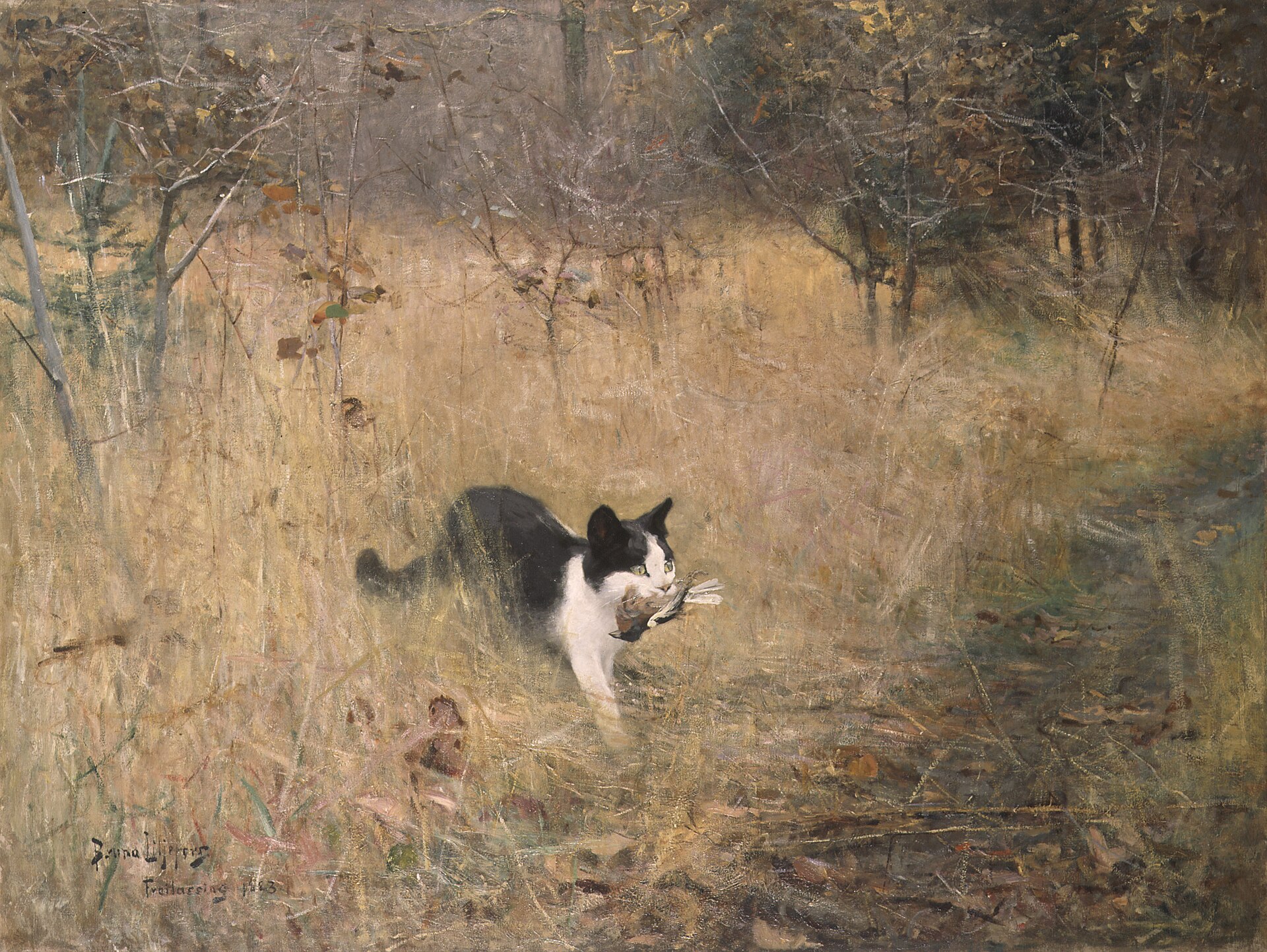
[A cat crouched in hunting posture in a painting from 1883.] Photograph: Bruno Liljefors
Image Credits: Wikimedia Commons
A cat bringing a dead animal home is doing something that looks like gift-giving to a human and like ordinary hunting to a cat. The animal is usually a bird, a mouse, or another small creature the cat caught outdoors and carried back to the house. The behaviour survives in well-fed pets because domestication never removed the hunting drive.
This article explains why cats bring dead animals home, including the teaching instinct, the family-bond explanation, and the risks for wildlife. It also covers what owners can do about it without punishing a behaviour the cat does not understand as wrong.
What the gift actually is
A cat that hunts is following a sequence built into its biology: stalk, chase, catch, and kill. Food is only part of that sequence, which is why a cat that has just eaten can still hunt. The carried prey is the end of that sequence, delivered to a place the cat treats as its own territory.
Dr. Stephanie Liff, a veterinarian and medical director at Pure Paws Veterinary Care in New York City, told Live Science that the behaviour is not an insult to the owner.
"It's somewhat of a compliment," Liff said. "They feel comfortable in their home. They consider you part of their family.
"
That framing matters because it changes the response. Scolding a cat for bringing prey home does not teach it that hunting is wrong, since the cat cannot connect the scolding to a hunt that happened outside. Calm removal of the animal, with gloves, is the safer and more effective response.
Mother cats and the teaching instinct
The strongest explanation for the behaviour comes from how mother cats raise kittens. A mother cat brings dead or injured prey to her kittens when they are a few weeks old, giving them a slow, catchable target to practise on. The kittens learn handling, biting, and killing in stages, rather than being expected to hunt perfectly on their first attempt.
Pet cats without kittens appear to redirect that same behaviour toward the people they live with. The idea, described by behaviour writers and veterinarians, is that the cat treats its human as a family member who does not hunt, and therefore as someone who could use a lesson or a share of the catch. This is a theory about motive, not a proven fact about any single cat, and different cats may bring prey home for different reasons.
Some cats also bring toys instead of animals, which fits the same pattern in a tidier form. A toy mouse carried to a bedroom door suggests the carrying and sharing part of the sequence matters to the cat, not only the kill. Owners who reward toy-bringing with play can sometimes shift the habit toward toys over time.
Family, territory, and a safe place to eat
Another explanation is simpler: home is where the cat feels safe. A cat that kills outdoors may carry prey inside because the house is a refuge from rivals, dogs, and other cats that might steal the catch. In that reading, the "gift" is partly storage and partly a meal brought to a private place.
Feral cats live in colonies, and females in those groups often care for kittens that are not their own. Sharing food within a social group is therefore normal cat behaviour, even though house cats are often described as solitary. A pet cat that shares prey with its household is acting as a group member, not as a loner showing off.
Personality, surroundings, and how owners manage the cat all affect how often a cat hunts. Some cats hunt constantly, while others rarely bother, according to researchers quoted by Live Science. Breed can play a part too, with active breeds such as Siamese, Maine Coon, and Bengal cats often described as keener hunters than relaxed breeds such as Ragdolls.
Why a full food bowl does not stop hunting
Hunger is a weak explanation for most pet-cat hunting, because the behaviour continues in cats fed on a regular schedule. Hunting and eating are partly separate drives in cats: the chase itself is rewarding, and the cat may not even eat what it kills. That is why cutting food portions never fixes the problem and can create new ones.
Play that mimics hunting is a better outlet for the same drive. Interactive toys that move like prey, rotated so they stay novel, let a cat complete the stalk and chase sequence indoors. A short play session before meals can also help, because it ends the sequence with food, which is how a real hunt would end.
Owners sometimes notice their cat chattering at birds through a window, a behaviour linked to the same predatory arousal. The chatter, the crouch, and the carried prey are all parts of one system, not separate quirks. Treating them as one system makes the response clearer: give the system a safe outlet, and reduce its outdoor opportunities.
The wildlife cost is large
The uncomfortable side of this behaviour is its effect on wild animals. A systematic review by Scott Loss, Tom Will, and Peter Marra, published in Nature Communications in 2013, estimated that free-ranging domestic cats in the United States kill 1.3 to 4.0 billion birds and 6.3 to 22.3 billion mammals every year. Unowned cats cause most of that mortality, the authors found, but owned pets add a share.
Those numbers explain why conservation groups take pet-cat hunting seriously, especially on islands and in places where native animals evolved without cats. A single cat's contribution looks small, but the total across millions of outdoor cats is not. It also explains why "my cat only catches a few" is a weak defence: the few are multiplied across every similar household.
Indoor cats, cats with bells on breakaway collars, and supervised outdoor time all reduce kills, though no single measure stops hunting entirely. Bells help some birds escape, but they do not make a cat harmless, and determined hunters learn to move quietly despite them. Keeping a cat indoors, at least during dawn and dusk when birds are most active, cuts risk further.
What to do when your cat brings prey home
Stay calm, even though the sight is unpleasant. Put on gloves, pick the animal up with a bag or paper, and dispose of it without making a scene in front of the cat. Scolding after the event teaches the cat nothing except that its owner sometimes becomes loud near prey.
Check the cat for bites or scratches afterwards, since prey animals can carry parasites and infections. A cat that hunts regularly should be on a parasite-control routine recommended by its veterinarian, and any wound should be checked promptly. Wash your hands after handling the animal, and keep children away from it.
If the behaviour is frequent, add more play and consider a bell collar or restricted outdoor access. Talk to a veterinarian about the right combination for the cat, since some cats become stressed by sudden confinement. The goal is fewer kills, not a punished cat, and gradual changes last longer than sudden bans.

[A cat in a hunting scene, from a museum collection.] Photograph: museum collection image
Image Credits: Wikimedia Commons
Frequently asked questions
Is my cat bringing me dead animals because it is hungry?
Usually not, since well-fed cats hunt just as readily as hungry ones. Hunting and eating are partly separate drives, so a full bowl does not switch the chase instinct off. If a cat is underfed or has experienced food insecurity, it may hide prey instead of sharing it.
Should I punish my cat for bringing dead animals home?
No, because punishment after the event does not connect in the cat's mind to the hunt outside. It risks damaging trust without reducing hunting, since the cat does not understand the dead animal as a misdeed. Calm removal and more play are more effective responses.
Do bells on collars stop cats hunting?
Bells reduce kills by warning some prey, but they do not stop hunting, and skilled cats learn to stalk quietly. They work best combined with play, supervised outdoor time, and keeping cats in at dawn and dusk. A breakaway collar is important so the cat cannot get caught on a branch.
Are some cats more likely to hunt than others?
Yes, since personality, environment, and management all affect hunting frequency. Active breeds and cats with outdoor access hunt more, while indoor cats and relaxed breeds hunt less. Individual variation is large, so two cats in one household can differ greatly.
The bottom line
A dead animal on the doorstep is best read as instinct plus social behaviour, not as a message of anger or a complaint about food. The mother-cat teaching pattern and the family-group explanation together account for most cases, even though no single motive fits every cat. The practical response is calm cleanup, more indoor play, and steps that reduce kills, because the wildlife numbers show the habit matters beyond one household.
Tags: cats, cat behaviour, pets
The Rive News research desk writes plain-language explainers from published sources, with no invented experts or first-hand claims.
Related
- Why your cat bites you gently then licks you
- Why do cats chatter at birds?
- Why do cats knead with their paws?
- Why do cats sleep so much?
Subscribe for one plain-language explainer a day, drawn from published sources.
Rive News publishes explainers from public sources; corrections are noted on the article when a sourced fact changes.
Related stories

Why Does My Dog Eat Grass and Vomit?
A UC Davis study of 1,571 owners found grass eating is normal dog behavior, not self-medication: only 10% were ill first. What the science
Why Does My Dog Stare at Me While I Eat?
Dogs stare at you while you eat because it has worked before, and mutual gaze raises bonding hormones. Learn the reinforcement science
Foods toxic to dogs: the list, with reasons
Chocolate, xylitol, grapes, onions: common foods can harm dogs. Learn what makes each one toxic, the warning signs, and what to do if your