
Why cats follow you to the bathroom, explained
By Rive News / Research desk | Rive News / Published October 28, 2026 at 9:00 AM PKT
Key takeaways
- Bathroom trips are predictable, quiet, and stationary, which makes them prime bonding time for a cat.
- Cats also follow out of curiosity, routine, territory, and a wish to stay near a trusted person.
- It is usually normal behaviour, but sudden or extreme clinginess deserves a vet check.
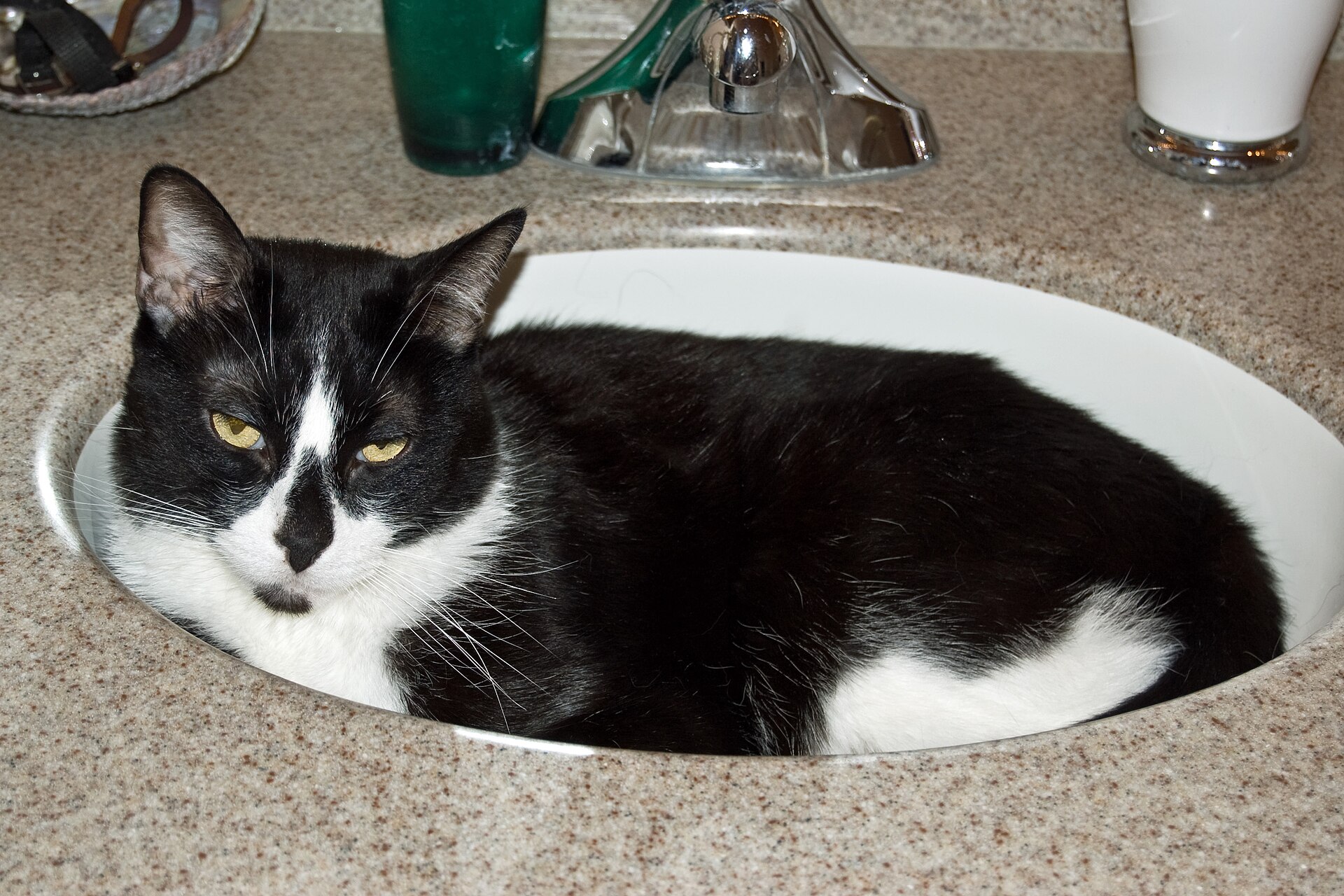
[A cat sits in a bathroom sink.] Photograph: Kenneth Bosma
Image Credits: Wikimedia Commons
Few cat habits puzzle owners quite like the bathroom escort. The door closes, a paw slides underneath, and a small supervisor takes up position by the sink.
It looks intrusive, but it is rarely about the bathroom itself. It is about what the bathroom visit offers: a still, quiet, predictable person in a small room.
This article explains why cats follow you to the bathroom, including bonding, routine, curiosity, territory, scent, and security, and it covers when the habit is normal and when it is worth checking.
You are finally sitting still
The strongest single explanation is also the simplest. Cats approach people most readily when those people are stationary.
A person sitting in the bathroom is not walking away, typing, or cooking. They are seated, quiet, and unlikely to move suddenly.
Chewy's behaviour guidance quotes feline behaviourist Nagelschneider, who notes that cats feel most comfortable approaching when a person is stationary, and that a sitting posture can signal openness to interaction. Bathroom trips also follow a regular schedule, which makes them reliable bonding slots in a cat's day.
That captive-audience quality matters. Maggie Placer, a veterinarian and veterinary science programme manager at EveryCat Health Foundation, told Chewy that bathroom time gives a cat undivided attention from a preferred person. For a cat that wants interaction, that is a better bet than following a person who is busy with chores.
Routine turns it into a ritual
Cats are creatures of habit, and they learn household rhythms quickly. Morning and evening bathroom visits happen at similar times each day, in the same order, with the same sounds. Once a cat links that sequence to attention, following becomes part of the ritual rather than a fresh decision each time.
This is why the habit often appears suddenly and then sticks. A cat that is petted once or twice during bathroom visits learns the payoff, and the behaviour repeats. The bathroom itself becomes a cue, in the same way a food bowl or a lap can become a cue.
Changes to routine can sharpen the habit. A house move, a new person in the home, or a change in work hours can make a cat seek familiar rituals more strongly. The bathroom visit is one of the few constants, so it gets extra weight.
Curiosity and the closed door
Closed doors are a standing invitation to a cat. Cats.com notes that curiosity, attention-seeking, and a wish to use the litter tray all feature among the reasons cats follow owners to the bathroom.
A closed bathroom door hides sounds, smells, and running water, all of which a cat wants to investigate.
The bathroom is also unusually interesting as a room. It has dripping taps, rustling paper, reflective surfaces, and a litter tray in some homes. For a curious animal, that is a lot of stimulation in a small space, and the owner's arrival is the signal that the room is open.
This curiosity is not mischief. Cats monitor their territory constantly, and a room that is closed most of the day is a gap in that map. Following the owner in closes the gap, at least for a few minutes.
Territory, scent, and social bonds
Cats are territorial, and owners are part of that territory. Bunko's behaviour summary puts it directly: to a cat, the owner is part of what they protect daily, and following into the bathroom is a way of supervising that space.
Scent plays a quiet part in this. Cats deposit pheromones from glands in their cheeks and paws when they rub against legs or furniture, and they read the scent of their people in return. A small, humid bathroom concentrates those scent signals, which may make the room feel socially significant to a cat in a way that a large, airy room does not.
That scent exchange also reinforces bonding. The cat is not just checking a room. It is refreshing its social map, confirming that its person is present, and marking the shared space as familiar and safe.
Security and the vulnerable moment
Some explanations turn the usual story around: the cat may be guarding you, not just seeking you. In the wild, cats watch over one another during vulnerable moments, and a seated, quiet person in a small room can trigger that protective instinct.
This fits with the security explanation for cats that have experienced rehoming or past trauma. Such cats often show stronger attachment behaviours, including constant following, kneading, and close shadowing. For them, a closed door can feel like a separation, and staying close reduces mild stress.
Separation-related behaviour is the sharper end of this spectrum. Cats.com notes that cats with separation-related problems tend to seek their owners' undivided attention and may guard them in the bathroom.
That is different from casual following, and it usually comes with other signs such as distress when the owner leaves the house.
Breed and personality set the baseline
Not every cat follows, and the difference often comes down to breed and temperament. Cats.com lists Maine Coon, Burmese, Ragdoll, Scottish Fold, and Himalayan breeds among the most attention-seeking, with somewhat dog-like habits of accompanying owners around the house.
Siamese, Burmese, and Ragdoll cats are also frequently described as people-oriented, while some other breeds are more independent. Early socialisation matters too. Kittens handled often and exposed to household routines tend to grow into adults that seek human company more readily.
Personality still overrides breed. Plenty of independent-breed cats are devoted followers, and plenty of sociable-breed cats prefer their own space. The bathroom habit is best read as part of an individual cat's pattern, not as a breed rule.
When following is a concern
Bathroom following is usually harmless, and Cats.com notes there is nothing wrong with a cat shadowing its owner from time to time, as long as it does not become obsessive. The shift to watch for is a change in intensity rather than the habit itself.
Warning signs include sudden clinginess in a previously independent cat, distress vocalisation when separated, destructive behaviour, or changes in eating, grooming, or litter habits. Those patterns can accompany anxiety, pain, or illness, and they deserve a vet visit rather than a behaviour fix alone.
A vet can rule out medical causes first, which matters because pain and illness can both increase clinginess. If the cause is behavioural, the vet or a feline behaviourist can advise on enrichment, routine changes, and gradual desensitisation to short separations.
Living with a bathroom shadow
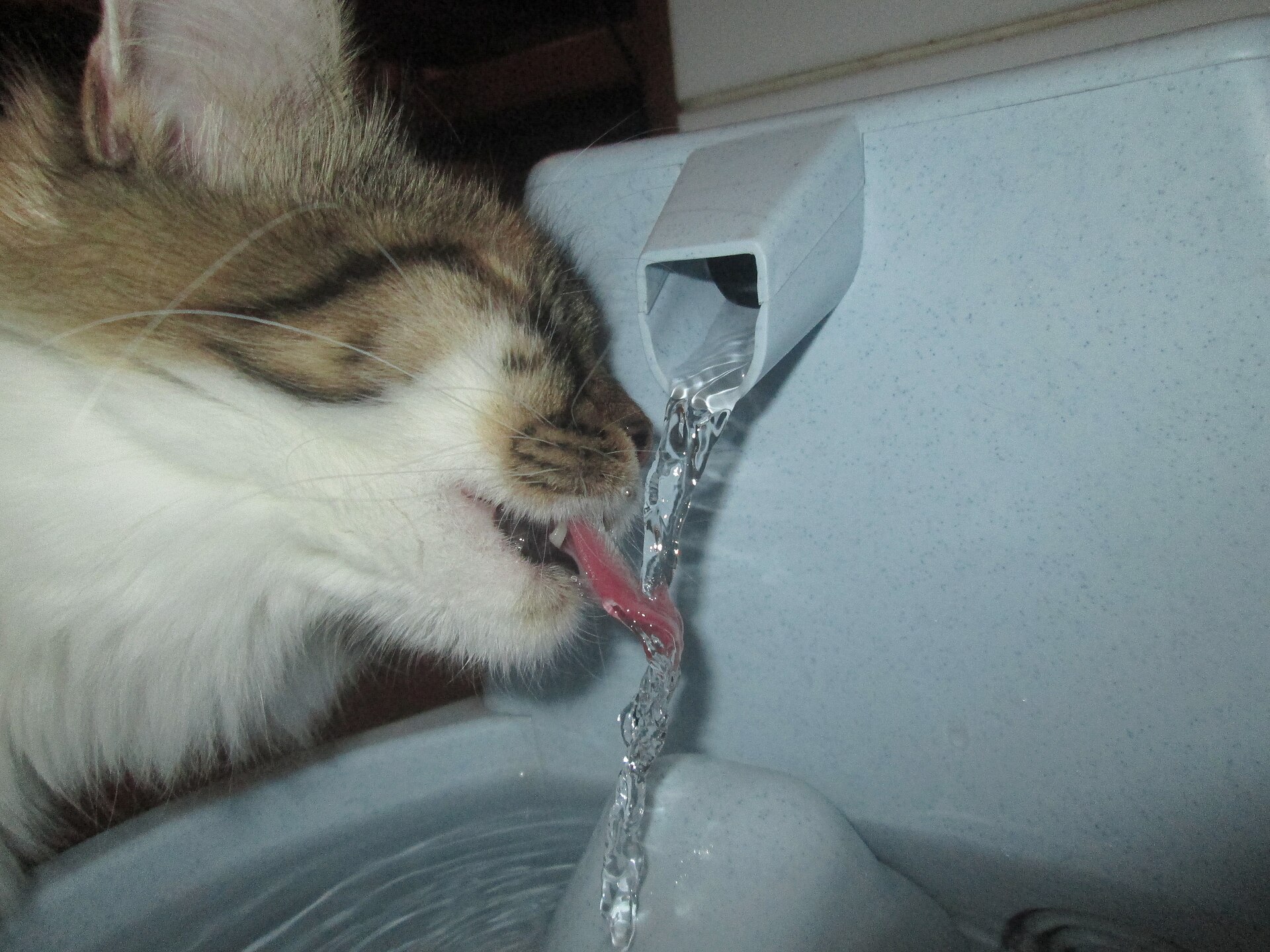
[A cat drinks water from a fountain, one of the bathroom attractions for cats.] Photograph: TrainSimFan
Image Credits: Wikimedia Commons
Most owners do not need to stop the habit, only to manage it safely. Keeping the toilet lid down, storing medicines, cleaners, and dental products in closed cabinets, and keeping small objects out of reach all make the bathroom safer for a curious cat. Lidded bins help too, since bathroom bins often hold items a cat should not chew.
For owners who want privacy, a gradual approach works better than a sudden closed door. Short separations, rewarded calm behaviour outside the bathroom, and a comfortable spot nearby give the cat an alternative without a sharp break in routine. A sudden ban can increase anxiety and make the following more intense, not less.
If the cat's main need is attention, offering a dedicated play or petting session before bathroom visits can reduce the demand. A cat that has just had focused interaction is less likely to insist on more of it immediately afterwards.
Frequently asked questions
Is it normal for cats to follow you to the bathroom?
Yes, it is normal for cats to follow their caregivers to the bathroom. It reflects bonding, curiosity, routine, and territory, and it is common across many breeds and personalities. It only becomes a concern when it is obsessive or comes with distress.
Why does my cat guard me in the bathroom?
Cats are protective of their territory, and that includes their people. A cat that sits facing the door or stays close while you are in the bathroom may be monitoring the space and keeping watch. Cats with separation-related problems are especially likely to show this guarding pattern.
Why does my cat follow me everywhere, not just the bathroom?
A cat that follows everywhere is usually showing strong attachment, curiosity, or a wish for attention. The bathroom stands out because you are stationary there, but the underlying drive is the same. If the following is sudden or extreme, a vet check is sensible.
How can I get privacy without upsetting my cat?
Use gradual, short separations and reward calm waiting outside the door. Provide a comfortable spot nearby, and keep bathroom visits brief and boring if you want the habit to fade. Avoid sudden, long lockouts, which can raise anxiety.
The bottom line
Cats follow owners to the bathroom because the visit concentrates everything they value: a still person, a predictable routine, a curious closed room, and a small territory rich in scent. It is bonding behaviour first, and only rarely a problem.
Enjoy the company if it suits you, make the room safe for a curious visitor, and treat sudden or extreme clinginess as a prompt to check with a vet. The bathroom escort is not a mystery to solve so much as a small daily sign of how attached your cat actually is.
Tags: cats, cat behaviour, cat bonding, pet behaviour
The Rive News research desk covers everyday science and pet behaviour from published veterinary and institutional sources, without first-hand testing claims.
Related
- Why do cats stare at you for so long
- Why cats sit in boxes, even tiny ones
- Why your cat meows loudly at night
- How to keep a cat entertained when you are at work
Subscribe to the Rive News newsletter for one clear explainer each morning.
Rive News publishes general information from named public sources. Corrections are welcomed and checked against those sources.
Related stories
Why Does My Dog Eat Grass and Vomit?
A UC Davis study of 1,571 owners found grass eating is normal dog behavior, not self-medication: only 10% were ill first. What the science
Why Does My Dog Stare at Me While I Eat?
Dogs stare at you while you eat because it has worked before, and mutual gaze raises bonding hormones. Learn the reinforcement science
Foods toxic to dogs: the list, with reasons
Chocolate, xylitol, grapes, onions: common foods can harm dogs. Learn what makes each one toxic, the warning signs, and what to do if your