
How do birds know where to migrate
By Rive News / Research desk | Rive News / Published October 25, 2026 at 9:00 AM PKT
Key takeaways
- Birds use several navigation tools at once, not a single built-in compass.
- The sun, the stars, landmarks, and Earth's magnetic field all supply direction.
- Young birds on a first migration can find the route without ever being shown it.
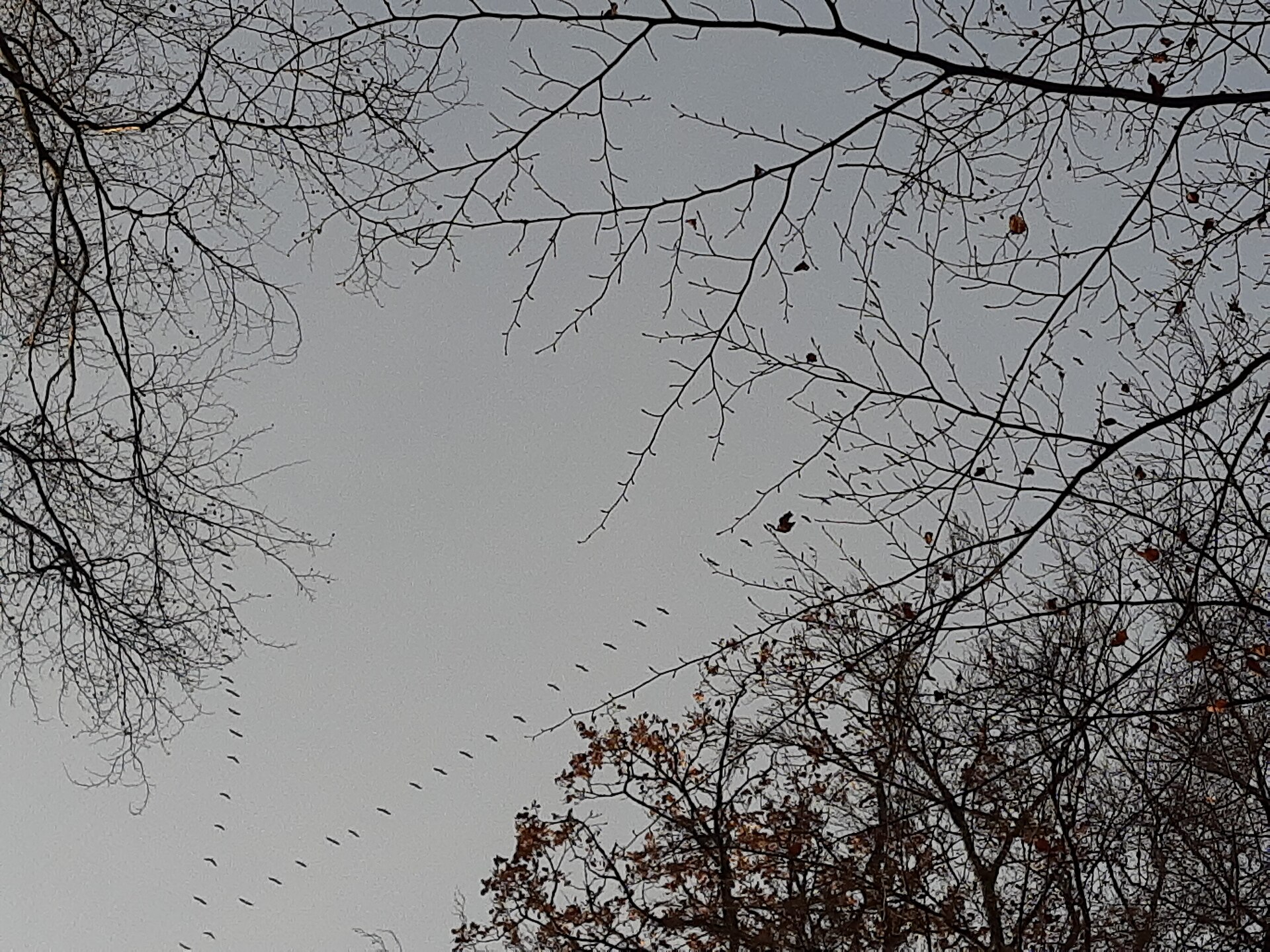
[A flock of birds in flight during migration, travelling between seasonal homes.] Photograph: Migrating birds in flight
Image Credits: Wikimedia Commons
Bird migration is the regular seasonal journey between breeding grounds and wintering grounds. Some birds travel a few hundred kilometres, while others cross whole continents twice a year. This article explains how birds know where to migrate, including the sun compass, the star compass, landmarks, and the magnetic sense.
No single compass
The short answer is that birds do not rely on one navigation system. Researchers describe a layered toolkit, with different cues taking over as conditions change. On a sunny day a bird may steer by the sun, while on an overcast night it may fall back on its magnetic sense.
That redundancy is the point. A single cue can fail, since clouds hide the stars and a storm can disturb the magnetic field. A bird that cross-checks several cues stays on course when one of them drops out.
Scientists also draw a distinction between a compass and a map. A compass gives direction, while a map tells the bird where it is. Evidence suggests birds have both, and that is why a displaced bird can correct its course rather than just flying in a straight line.
The sun compass
The sun is the most familiar daytime cue. A bird that knows the time of day can read direction from the sun's position, since the sun rises in the east, climbs, and sets in the west. The bird's internal clock supplies the time, and the sun's angle supplies the bearing.
This system has a catch. The sun moves across the sky during the day, so a fixed sun position does not always mean the same direction. Birds compensate for that movement using their circadian clock, adjusting their reading as the hours pass.
Birds also use the pattern of polarized light in the sky. At dawn and dusk, sunlight scatters in a band that runs across the sky, and birds that migrate at those hours can read direction from it even when the sun itself sits below the horizon.
The star compass
Many songbirds migrate at night, and for them the stars are the guide. Young birds appear to learn the pattern of the night sky, memorizing how stars rotate around the celestial pole. Once that pattern is learned, the centre of rotation marks north.
Experiments in planetariums support this idea. When researchers shifted the projected stars, caged birds shifted their hopping direction to match, as if the sky itself had moved. The birds were reading the sky, not a memorized route on the ground.
The star compass has limits. Cloud cover hides the stars, and a young bird must learn the pattern during a window early in life. That learning period is one reason the first migration looks so remarkable, since the bird is using a sky map it studied while still in or near the nest.
Landmarks and memory
Over land, birds use what they can see. Rivers, coastlines, mountain ranges, and valleys act as signposts, and experienced birds follow the same flyways year after year. Cranes and waterfowl, for example, often return to the same stopover sites each season, where food is reliable.
Memory sharpens with experience. Cornell Lab of Ornithology notes that young birds on their first journey can reach wintering grounds they have never visited, but returning adults navigate with greater precision. The first flight is rough, while later flights benefit from a learned map of stops and hazards.
Smell may help too. Research on homing pigeons has long suggested that birds build odour maps from winds carrying scents across their home region. For long-distance migrants the evidence is thinner, but smell is one more cue in the toolkit rather than the whole answer.
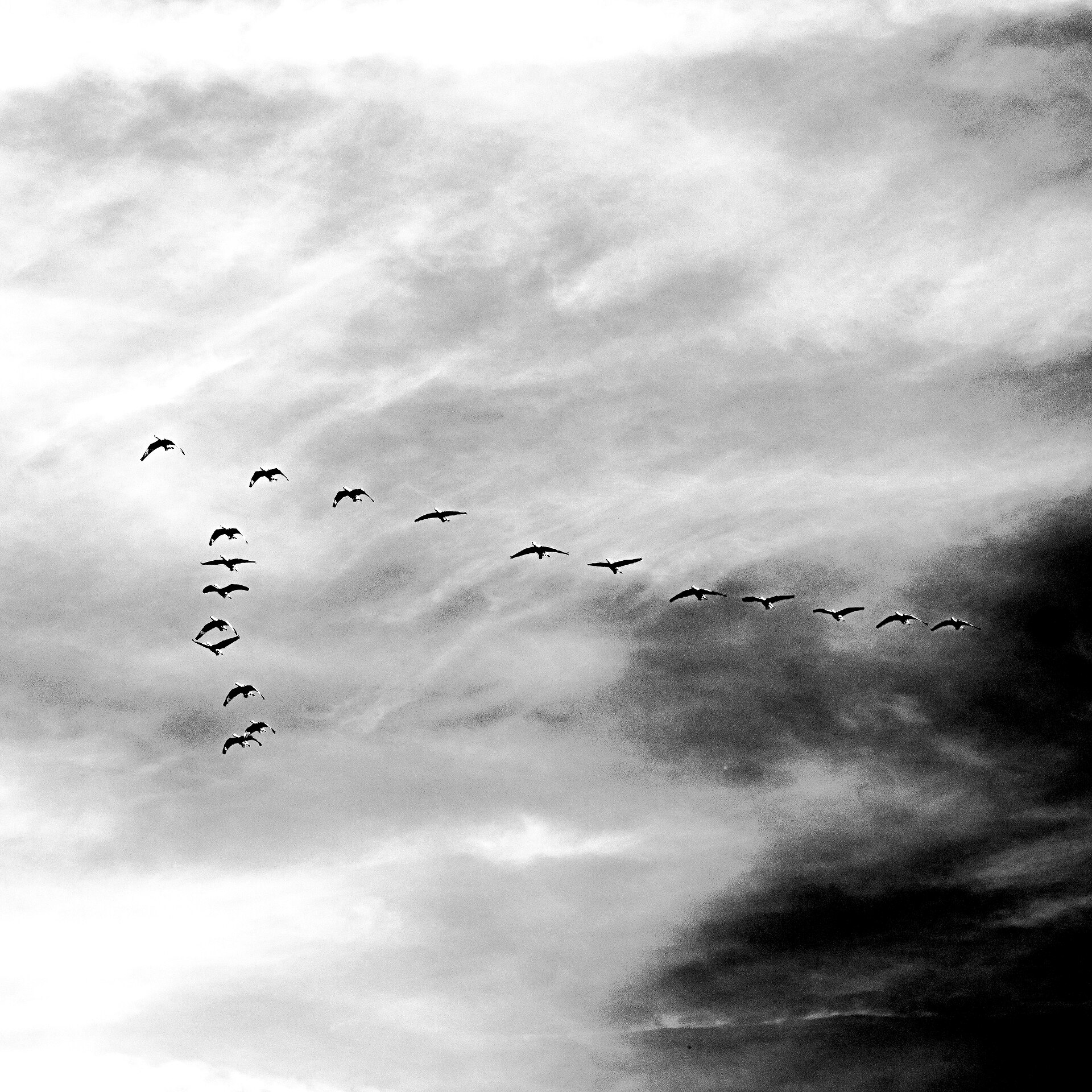
[Geese in flight during migration, navigating by several cues at once.] Photograph: Migrating geese
Image Credits: Wikimedia Commons
The magnetic sense
The most striking tool is magnetoreception, the ability to sense Earth's magnetic field. The field runs from pole to pole, strongest and most vertical near the magnetic poles and weakest and most horizontal near the magnetic equator. Those gradients give a bird two kinds of information: direction from the field's angle, and rough position from its strength and inclination.
Two mechanisms are under study. One involves cryptochromes, light-sensitive proteins in the retina that react to magnetic fields in a way researchers believe could let a bird effectively see magnetic information as a visual pattern. The other involves iron-bearing structures that could act like tiny compass needles.
The evidence for a magnetic map is strong. In work led by Richard Holland at Bangor University, Eurasian reed warblers exposed to a simulated magnetic field from a different location adjusted their migratory direction as if they really were in that place, even though their total magnetic intensity stayed unchanged. As Holland put it, the birds did not need every component of the field to work out their position, since inclination and declination alone carried the information.
A related Bangor study showed the same logic in reverse. Birds held at their capture site but exposed to a magnetic signature from thousands of kilometres beyond their normal route still oriented as if they were in the simulated location. The magnetic cue overrode the real sights, smells, and starlight around them.
Why first-timers still find the way
The hardest question is the first migration. A young cuckoo, for example, is raised by foster parents of another species and never meets its biological parents, yet it still reaches the wintering grounds in Africa. No one shows it the way.
The explanation is a mix of inheritance and learning. The broad programme, including the direction, the timing, and the distance to fly, appears to be inherited. The fine detail, including exact stopovers and feeding sites, is learned on the journey and refined on later trips.
That also explains why first flights are costly. Discover Magazine reported that fewer than half of young Arctic terns survive their first migration, while returning adults make the round trip for 20 years or more. Experience turns a rough inherited heading into a precise route.
What happens when cues conflict
Birds weigh cues against each other, and the winner depends on conditions. On sunny days homing pigeons lean on the sun compass, while on overcast days they consult their magnetic sensors. When researchers set cues against each other, some species follow the sunset, while others follow the magnetic field.
Solar storms can upset the system. Disturbances from the sun alter Earth's magnetic field, and studies have found that bird migration patterns shift during strong storms. The birds do not simply get lost, since other cues remain, but their routes and timing can change.
Human activity adds new interference. Bright city lights can disorient night migrants, and electromagnetic noise from cities may mask the subtle magnetic signals birds read. That is one reason conservation groups ask people to dim lights during peak migration nights.
How far some birds go
The distances put the navigation feat in perspective. White storks from Eastern Europe travel more than 10,000 kilometres to reach South Africa, following routes through Turkey, the Middle East, and the Nile Valley. Arctic terns commute between the Arctic and Antarctic, covering tens of thousands of kilometres each year.
Those journeys are also timed. Day length is the main trigger for migration, telling a bird's body when to fatten up and when to leave. A bird that leaves too early may meet winter at its destination, while one that leaves too late may miss the best feeding.
Frequently asked questions
Do birds follow their parents on migration?
Usually not. Most young migrants travel alone or with other young birds, and many species migrate separately from their parents. The route is guided by an inherited programme plus cues learned along the way.
Can birds get lost during migration?
Yes, and storms blow many off course. Birds that are displaced can often correct their route using their magnetic map and landmarks, though young birds on a first trip are more likely to fail.
Do all birds migrate?
No. Only a minority of bird species migrate long distances, while many stay in one region year-round or make shorter seasonal movements. Migration pays only where the seasonal gain in food and nesting outweighs the journey's risk.
How do birds know when to leave?
Day length is the main cue, acting on hormones that trigger fattening and restlessness. Weather and food supply fine-tune the exact departure, but the calendar is set by light.
The bottom line
Birds know where to migrate because they carry several navigation tools at once. The sun and stars give direction, landmarks and memory confirm position, and the magnetic field supplies both a compass and a rough map. Young birds start with an inherited heading and build precision with experience, which is why the first journey is the hardest and later ones look effortless.
No single sense explains the whole feat. The wonder is the combination, and the way each cue covers the others when conditions turn against it.
Tags: bird migration, animal navigation, magnetoreception
Rive News is a research desk covering everyday questions with sourced, practical explainers.
Related
- How do birds navigate during long migrations
- Why do flocks of birds fly in V formation
- How does a compass actually find north
- How do birds know where to fly during migration
Subscribe for one practical explainer a day in your inbox.
Rive News publishes sourced explainers and corrects errors promptly when readers flag them.
Related stories

Why diamond is hard and graphite is soft when both are carbon
Diamond and graphite are both pure carbon, yet diamond is 10 on the Mohs scale and graphite is 1 to 2. The difference is not the atoms;

Why Hot Water Can Freeze Faster Than Cold: The Mpemba Effect Explained
Hot water can freeze faster than cold under specific conditions. The Mpemba effect, named for a 1963 schoolboy experiment, still divides

How Magnets Work at the Atomic Level: Spins, Domains, and Iron
Magnetism comes from electrons: their spin and orbits make each atom a tiny magnet. In iron, quantum forces align these atomic magnets into