
How your brain remembers faces: the pattern and emotion shortcut
By Rive News / Research desk | Rive News / Published October 24, 2026 at 9:00 AM PKT
Key takeaways
- A dedicated patch of cortex, the fusiform face area, reads faces as whole patterns rather than collections of features.
- The system identifies a familiar face in under 170 milliseconds, faster than conscious thought.
- A parallel emotion stream through the amygdala tags faces with feeling, which is why emotional faces stick in memory.

[A crowd of faces; your brain's face system scans scenes like this and sorts identities in fractions of a second.] Photograph: Tony Alter
Image Credits: Wikimedia Commons
You can recognize a friend across a crowded room in a fraction of a second, often before you have consciously registered that you are looking at anyone. That speed is not a trick of attention. It is hardware.
Deep in the temporal lobe sits a small patch of cortex devoted almost entirely to faces. It reads them as whole patterns, tags them with emotion, and files them away with unusual durability. This article explains the dedicated face patch in your temporal lobe, why faces get processed as a whole rather than in parts, how emotion gives face memories extra glue, and what happens when the system breaks.
The dedicated face patch in your temporal lobe
The fusiform face area, usually shortened to FFA, is a region of cortex within the fusiform gyrus, a ridge-like fold on the underside of the temporal lobe. It responds far more strongly to faces than to any other class of visual object, and it sits where vision and social cognition converge.
Neuroscientists formally identified the region in 1997 using functional magnetic resonance imaging. The work is associated with Nancy Kanwisher and her team at MIT, whose scans showed a quarter-sized patch of brain tissue responding about three times more strongly to faces than to other stimuli. "It was a startling discovery," explains Dr.
James Haxby, a neuroscientist at Dartmouth College who has studied face perception extensively. "The fusiform face area suggested the brain contains highly specialized modules dedicated to processing specific categories of information that were particularly important throughout human evolution."
The patch is small but not tiny. It spans roughly 8 to 10 square centimeters of cortical surface, with the most consistent activation in the right hemisphere.
It does not work alone: the occipital face area feeds it early feature detection, the superior temporal sulcus tracks dynamic signals like gaze and lip movement, and the medial prefrontal cortex connects a recognized face to stored social knowledge. But the FFA is the identity engine at the center of the network.
The wiring starts early. Newborns prefer face-like patterns over scrambled versions within hours of birth. The FFA itself refines through childhood and into adolescence, shaped by every face the growing brain encounters.
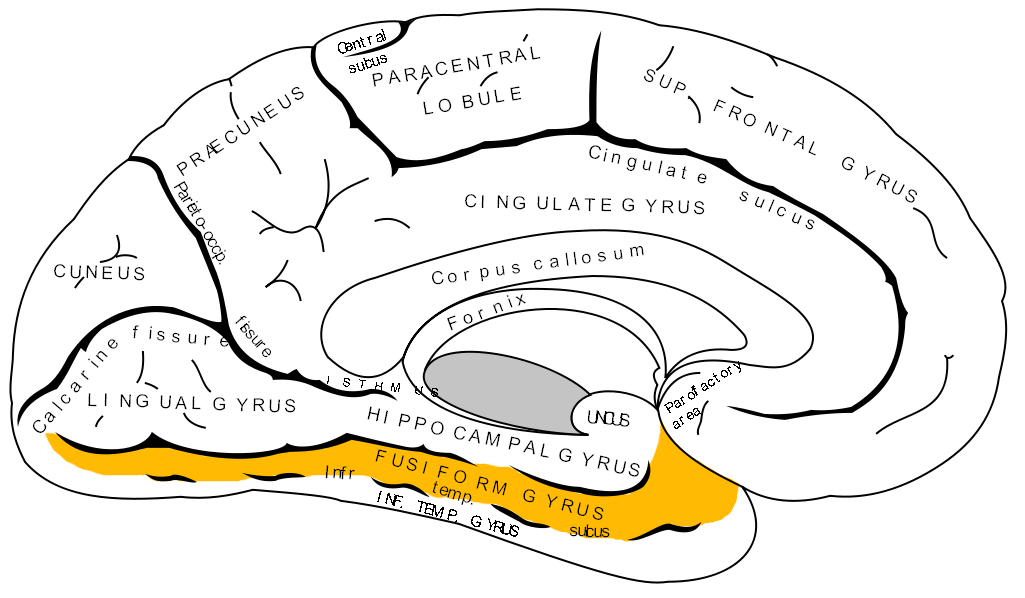
[An anatomical diagram highlighting the fusiform gyrus, the fold of cortex on the underside of the temporal lobe that houses the face area.] Photograph: Gray's Anatomy, vectorized by Mysid
Image Credits: Wikimedia Commons
Why faces get processed as a whole, not in parts
Here is the core difference between face memory and object memory. When you look at a chair, your brain can work part by part: legs, seat, back.
When you look at a face, the FFA treats it as one unified configuration. The spacing between the eyes, the curve of a smile, the relation of nose to mouth, all get read together as a single pattern.
This holistic processing is what makes the system so fast and so robust. A familiar face can be identified in under 170 milliseconds, faster than conscious thought, and the recognition survives changes in lighting, partial occlusion, and years of aging. The pattern is what gets stored, not a list of features.
The classic proof is the face inversion effect. Turn a photo of a face upside down, and recognition collapses far more dramatically than it does for any other object.
The FFA depends on upright, configural processing; inversion breaks the pattern the system is tuned to read. Object recognition degrades only modestly with rotation, because it never depended on the whole.
The same whole-pattern habit explains a familiar frustration: blanking on names while remembering faces. The face system stores a configural pattern automatically, but a name is an arbitrary verbal label with no pattern to lock onto, so it needs a different, weaker memory route.
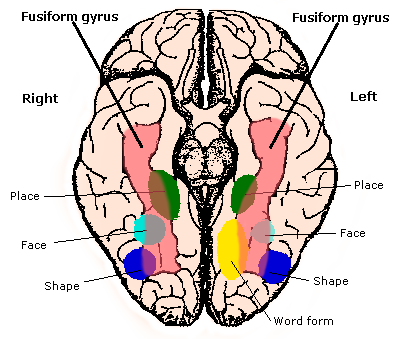
[An inferior view of the brain showing the fusiform gyrus, where the face-recognition machinery sits.] Photograph: RobinH
Image Credits: Wikimedia Commons
How emotion gives face memories extra glue
Identity is only half the job. Running in parallel with the FFA, the amygdala processes the emotional weight of a face: fear, anger, warmth, threat. The two streams communicate constantly, and that conversation is a big part of why face memories are so durable.
An emotional face is not just identified; it is tagged. The amygdala signals that this face matters, and that tag strengthens the memory trace. This is the pattern-and-emotion shortcut the system runs on: the FFA delivers the who, the amygdala delivers the why-it-matters, and together they make the memory stick.
Evolution explains the priority. Long before language, distinguishing friend from foe and reading emotional states was a survival skill, and faces were the richest source of that information. The brain invested dedicated hardware in the category that mattered most, and emotion was wired in as the importance signal.
The calibration is experience-driven. People are reliably better at recognizing faces from groups they see most often, the well-known other-race effect.
The FFA tunes itself to the face statistics it encounters, which is optimization, not prejudice: the brain builds its finest discrimination for the faces it meets daily. The region also stays plastic through life, and it even fires for face-like patterns that are not faces at all, which is why you see faces in clouds and toast.
When the system breaks: face blindness and super-recognizers
Damage to the right fusiform gyrus and surrounding cortex produces prosopagnosia, the inability to recognize faces, including the faces of people you love. What makes the condition striking is its selectivity.
People with prosopagnosia see faces clearly, two eyes, a nose, a mouth, but cannot extract identity from the configuration. The pattern registers; the person does not.
The congenital form, present from birth without any brain injury, affects roughly 1 in 40 people severely enough to interfere with daily life, according to Neurolaunch's review of the research. Most go undiagnosed, because they develop workarounds: memorizing voices, gaits, hairstyles, and glasses. Some can even read the emotional expression on a face they cannot identify, which neatly shows the parallel streams running separately.
There is a mirror image, too. Some people possess extraordinary face memory, sometimes called super-recognition: the ability to recognize thousands of faces after a single brief exposure.
Unusual connectivity between the FFA and memory regions may underlie the talent. Between the two extremes sits everyone else, carrying a face system that quietly outperforms every other kind of visual memory they own.
Why do I remember faces but forget names?
Faces and names use different memory routes. The FFA stores faces as holistic visual patterns automatically, while a name is an arbitrary verbal label with no pattern to anchor it. The face gets the brain's specialized hardware; the name gets ordinary verbal memory, which is why the face survives and the name does not.
Can brain damage make you unable to recognize faces?
Yes. Damage to the fusiform face area, usually from stroke or head injury, causes acquired prosopagnosia: the person sees faces clearly but cannot identify them.
Object recognition typically survives intact, which shows how specialized the face system is. A congenital form exists too, affecting about 1 in 40 people severely.
Do babies recognize faces?
The foundations are present almost immediately. Newborns prefer face-like patterns over scrambled images within hours of birth, suggesting the brain arrives pre-tuned for faces. The full system refines through childhood and adolescence as the FFA calibrates to the faces the child actually sees.
Why are upside-down faces so hard to recognize?
Because the FFA reads faces as upright whole patterns, not feature lists. Inverting a face breaks the configural processing the system depends on, so recognition collapses. Objects do not suffer the same fate, since object recognition works part by part and tolerates rotation.
The bottom line
Your brain remembers faces so well because it does not treat them like other objects. A dedicated patch of cortex reads each face as a whole pattern in under 170 milliseconds, while a parallel emotion stream tags it with feeling so the memory sticks. When that machinery breaks, identity vanishes but vision remains, which is the clearest proof of how specialized the system is.
Tags: neuroscience, memory, face recognition
Written by the Rive News research desk, which covers everyday science with sourced explainers and no filler.
Related
- Why Do You Blank on Names but Remember Faces?
- Why Does Hot Water Sometimes Freeze Faster Than Cold Water
- What Is Gravity in Simple Words: A Plain Guide
- Why does the earth have seasons? The 23.5-degree tilt
Get one practical explainer like this in your inbox each morning.
Rive News publishes sourced explainers. Facts are checked against public sources listed above; corrections are noted with an update timestamp.
Related stories
Why diamond is hard and graphite is soft when both are carbon
Diamond and graphite are both pure carbon, yet diamond is 10 on the Mohs scale and graphite is 1 to 2. The difference is not the atoms;

Why Hot Water Can Freeze Faster Than Cold: The Mpemba Effect Explained
Hot water can freeze faster than cold under specific conditions. The Mpemba effect, named for a 1963 schoolboy experiment, still divides
How Magnets Work at the Atomic Level: Spins, Domains, and Iron
Magnetism comes from electrons: their spin and orbits make each atom a tiny magnet. In iron, quantum forces align these atomic magnets into