
Why Do Candles Flicker Even Indoors With No Wind?
Key takeaways
- A candle flame flickers in still air because its own heat creates rising convection currents that disturb the flame from within.
- Diffusion flames are natural oscillators: research shows they pulse at roughly 10 to 20 hertz even in controlled laboratory conditions.
- Gentle swaying is normal physics; violent dancing usually means a draft, a too-long wick, or a nearby heat source.
You close the windows, switch off the fan, and sit perfectly still. The candle on the table keeps dancing anyway. No wind, no movement, yet the flame leans, stretches, and pulses as if stirred by an invisible hand.
It is not your imagination, and it is not a draft you failed to notice. The flicker is coming from inside the flame itself.
This article explains how a candle flame burns, why the air around it is never truly still, why combustion scientists consider flickering an inherent property of flames, and when a flickering candle is actually telling you something is wrong.

A candle flame in close-up. The hottest, cleanest-burning region sits at the base and edges, while the bright yellow body is glowing soot. Photograph: Maximilian Schönherr / Wikimedia Commons
How a candle flame actually burns
A candle flame is not burning wax, and it is not burning the wick. It is burning wax vapor. When you light the wick, the heat melts the solid wax pooled around its base.
That liquid wax climbs the woven fibers of the wick through capillary action, the same force that pulls water up a paper towel. Near the top of the wick, the heat vaporizes the liquid into a hot hydrocarbon gas, which mixes with oxygen from the surrounding air and combusts. The visible flame is that combustion happening in real time.
A steady flame holds its familiar teardrop shape because the whole system is balanced. The heat of combustion warms the nearby air, which rises and draws fresh, oxygen-rich air in at the base to feed the reaction. Fuel delivery, oxygen supply, and heat release stay in equilibrium, and the flame sits still.
As the engineering site EngineerFix explains, this continuous balanced inflow of fuel and oxygen is what keeps the flame from jumping or flickering erratically.
The flame has distinct zones. The outer sheath, where combustion is complete, is the hottest part and glows faint blue. The bright yellow body that dominates what you see is incandescent soot particles heated to glowing.
Understanding these zones matters because flickering is, at its core, a disturbance in how fuel and oxygen meet across them. Anything that changes the delivery of wax vapor or the inflow of air, even slightly, shows up immediately as motion.
The room is never as still as you think
The first suspect in any flickering investigation is air movement, and it is often guilty even when you feel nothing. A candle flame is exquisitely sensitive to airflow. Drafts from open windows and ceiling fans are obvious culprits, but the subtle ones do most of the mischief: the cycling of an air conditioning vent, the pressure shift when a door opens down the hall, or the wake of someone walking past quickly.
Even with every one of those eliminated, the air around a burning candle is never still. The flame heats the surrounding air, which expands, grows less dense, and rises. Cooler air flows in from below and around the base to replace it.
This self-sustaining upward draft is called a thermal plume, and the candle manufactures it continuously just by burning.
The plume does not flow smoothly. Small fluctuations in temperature, density, and velocity create tiny vortices in the rising column. Those vortices momentarily starve parts of the flame of oxygen or push the wax vapor off-center, and the flame tilts, stretches, or pulses in response.
What you perceive as a gentle, random dance is the flame negotiating with its own exhaust. It is the same invisible-airflow principle that makes shower curtains billow inward: moving air creates pressure differences you cannot see but can absolutely observe.
Flicker is built into the flame itself
Here is the deeper answer: even if you could freeze every air current in the room, the flame would still move. Combustion scientists have shown that flickering is an intrinsic instability of diffusion flames, not merely a reaction to drafts.
In a 2019 paper in Scientific Reports, researchers studying candle flames as nonlinear oscillators found that flames spontaneously pulse and that their flickering follows regular mathematical patterns. When several candles burn close together, their flames synchronize, pulsing in-phase at short distances and anti-phase at larger ones, before becoming uncorrelated when moved far apart. A flame that can fall into step with its neighbors is not being pushed around randomly.
It is oscillating according to its own internal dynamics.
The characteristic frequency of this oscillation has been measured precisely. Research published in the Proceedings of the Combustion Institute found that diffusion flames exhibit periodic flicker at low frequencies ranging from 10 to 20 hertz, driven by buoyancy and large-scale vortices in the hot gas plume. Follow-up work in centrifuges, testing flames under artificial gravity from 1 G up to 11 G, confirmed that the flicker scales with buoyancy forces.
Stronger gravity means a stronger plume, which means faster, more vigorous flickering.
This is why the dance never quite repeats. The feedback loop between heat release, fuel vaporization, and airflow amplifies microscopic perturbations into visible motion, and no two cycles are identical. A perfectly still candle flame would actually be the strange phenomenon, not a flickering one.
When flicker means something is wrong
Normal flicker is a gentle sway. Abnormal flicker is violent, jerky, smoky, or one-sided, and it usually has a fixable cause.
The most common material cause is the wick. An ideal wick length is about 1/4 inch. A wick that has grown too long draws up more wax vapor than it can burn cleanly, and carbon builds up at the tip in a lump sometimes called mushrooming.
The oversized flame that results is unstable by nature. Trimming the wick before each burn is the single most effective thing you can do for a calm flame.
The second cause is asymmetric heating. If one side of the candle sits near a cold surface, like a windowsill in winter, the wax melts unevenly and capillary delivery becomes lopsided. Radiant heat from nearby electronics or lamps can do the same thing in reverse, cooking one side of the wax pool.
Both create the fuel-supply imbalances that show up as flicker.
The third is the hidden draft audit. Electronics with cooling fans, including laptops, push out warm exhaust that rises in a micro-convection current. Placed six inches from a candle, that silent exhaust is enough to destabilize the flame completely.
If a candle flickers violently in a seemingly still room, check what is plugged in nearby before blaming the wax.
One more practical note: burning several candles close together creates interacting convection currents and, as the synchronization research shows, coupled oscillation. Space them a few inches apart and each flame will burn calmer.
Is it normal for a candle to flicker slightly in a closed room?
Yes. Gentle, rhythmic swaying is the signature of the flame's own convection plume and its natural 10 to 20 hertz oscillation. It means the combustion system is working, not failing.
Why does my candle flicker more at night?
Nighttime often means the heating or cooling system cycling, cooler window glass creating downdrafts, and still household air that lets the candle's own plume dominate. The flame is not behaving differently; the room is.
Can flickering damage anything or waste wax?
Heavy flickering burns wax faster and less completely, producing more soot. That is why a constantly dancing candle develops a blackened jar rim and seems to burn down quickly. Trimming the wick usually fixes both.
Do expensive candles flicker less?
Price is a weak predictor. Wick sizing matched to the wax and container matters far more than branding. A cheap candle with a correctly sized, trimmed wick burns steadier than a luxury candle with an overgrown wick.
The bottom line
A candle flickers indoors with no wind because stillness is an illusion: the flame's own heat drives a rising convection plume that constantly disturbs it, and diffusion flames are natural oscillators that pulse at 10 to 20 hertz even in laboratory conditions. Gentle swaying is physics doing its job. Violent dancing means checking the wick length, nearby electronics, and hidden drafts.
Image Credits: Wikimedia Commons / Maximilian Schönherr, Wikimedia Commons / Richard W. M. Jones, Wikimedia Commons / domdomegg
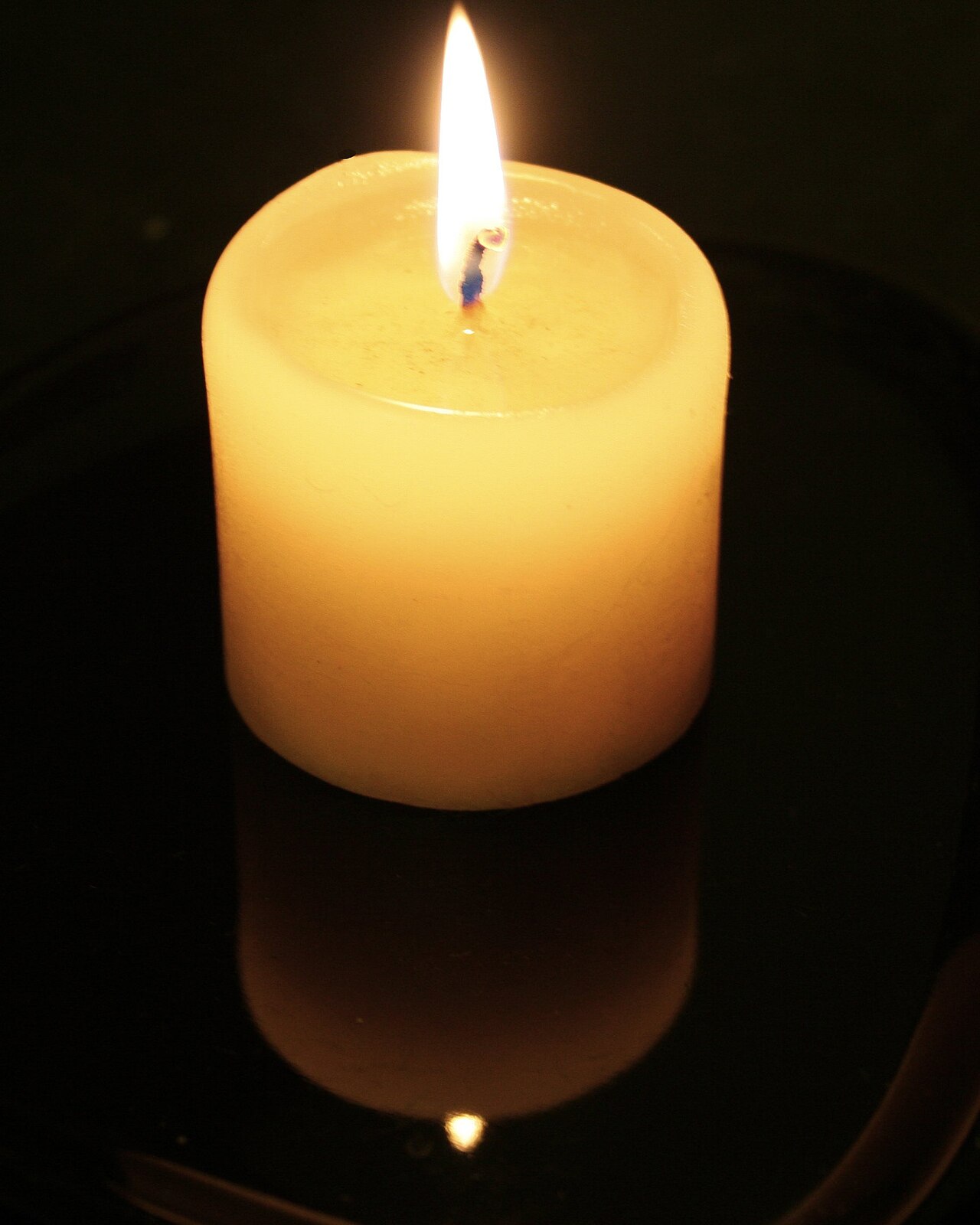
A candle flame leaning in its own thermal plume. Photograph: Richard W. M. Jones / Wikimedia Commons

Close-up of a candle flame: the bright yellow body is glowing soot particles. Photograph: domdomegg / Wikimedia Commons
Latest in Science
- Why a compass needle points north
- Why you can only see stars at night
- Why stars appear to move across the sky overnight
- Why shower curtains billow inward
Subscribe to the Rive News newsletter for one clear science explainer every morning.
Related stories
Why diamond is hard and graphite is soft when both are carbon
Diamond and graphite are both pure carbon, yet diamond is 10 on the Mohs scale and graphite is 1 to 2. The difference is not the atoms;

Why Hot Water Can Freeze Faster Than Cold: The Mpemba Effect Explained
Hot water can freeze faster than cold under specific conditions. The Mpemba effect, named for a 1963 schoolboy experiment, still divides
How Magnets Work at the Atomic Level: Spins, Domains, and Iron
Magnetism comes from electrons: their spin and orbits make each atom a tiny magnet. In iron, quantum forces align these atomic magnets into