
Why shower curtains billow inward during hot showers
By Rive News / Research desk | Rive News / Published October 29, 2026 at 9:00 AM PKT
Key takeaways
- Fast-moving air inside the stall drops in pressure, so still air outside pushes the curtain inward.
- Rising warm air adds a chimney effect, pulling cooler air in under the curtain to replace it.
- No single theory explains every case, since the effect also happens with cold water.
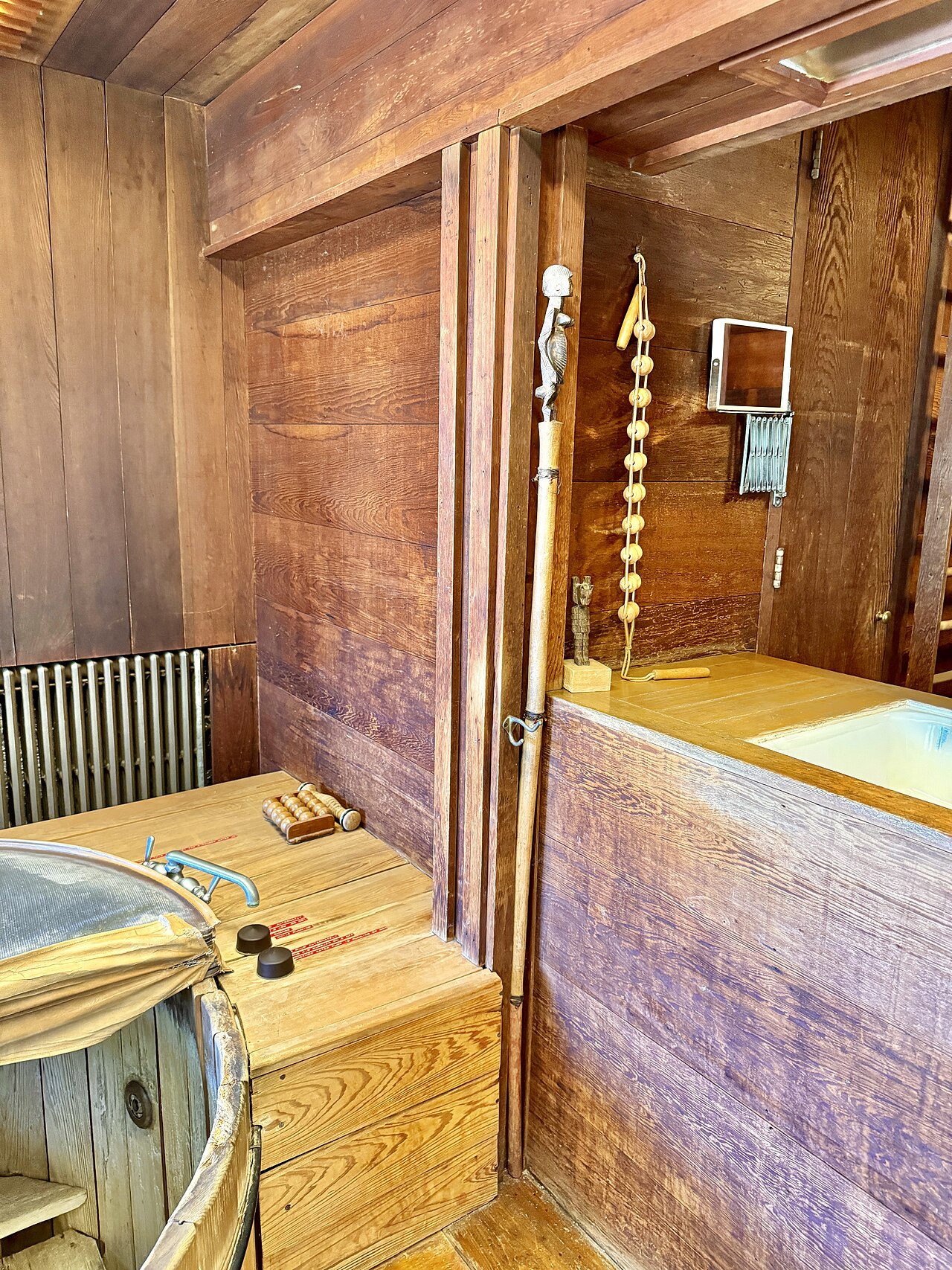
[A wood-panelled bathroom with a cypress tub in the Paul Schweiker House, Schaumburg, Illinois. Photograph: w_lemay]
Image Credits: Wikimedia Commons
A shower curtain billows inward because the air pressure inside the shower falls below the pressure outside it. The curtain is light, flexible, and fixed only at the top, so even a small pressure difference is enough to push it toward you.
Several forces create that difference at once. Warm air rises, the shower spray drags air along with it, and the moving air inside the stall can spin into a vortex. This article explains the three main explanations, why physicists still argue about them, and which fixes actually help.
The pressure difference in plain terms
Air, like any fluid, flows from higher pressure toward lower pressure. A shower curtain hangs between two pockets of air: the air inside the stall and the air in the rest of the bathroom. When the shower runs, conditions inside the stall change fast, while conditions outside it barely change at all.
The curtain itself does the rest. Because it is light and hangs free at the bottom, it moves toward the lower-pressure side instead of resisting. The effect is strongest where the gap between you and the curtain is smallest, which is why the curtain so often ends up stuck to your legs rather than just bowing gently.
Wikipedia's summary of the shower-curtain effect puts the puzzle in context. The problem has been featured in Scientific American magazine, with several hypotheses offered and no definite conclusion reached. That honesty matters: anyone selling a single simple answer is skipping the interesting part.
The Bernoulli explanation
The most popular explanation uses Bernoulli's principle. The principle states that an increase in fluid velocity results in a decrease in pressure. LibreTexts, the open textbook library, uses the shower curtain as a textbook example of exactly this.
The argument runs like this. Water flowing from the shower head drags the air it passes through along with it, setting that air moving in the same direction as the water.
That moving air runs parallel to the inside surface of the curtain. Bernoulli's principle says the pressure there drops, so the higher-pressure still air outside the curtain pushes the curtain inward.
The explanation is elegant, and it matches other familiar cases. LibreTexts notes the same mechanism when a car passing a truck on the highway seems to veer toward it: fast air between the vehicles drops in pressure, and greater pressure on the outside pushes them together. The shower curtain is the bathroom version of that highway effect.
But the Bernoulli explanation has a weakness. Critics argue that the air speeds inside a shower stall may not be high enough, on their own, to create a pressure drop strong enough to explain how firmly the curtain clings. That doubt is one reason physicists kept looking for other mechanisms.
The stack effect, or chimney explanation
The second explanation relies on temperature rather than speed. Hot water heats the air inside the stall, and hot air is less dense than cold air, so it rises. As warm, moist air climbs and escapes over the top of the curtain, cooler air from the room flows in near the floor to replace it.
Wikipedia calls this the buoyancy hypothesis, also known as the chimney effect or stack effect. It describes the same loop: warm air out over the top, cooler air in underneath, and a circulation that drags the flexible curtain inward as air moves to fill the rising column.
This explanation fits hot showers well. The hotter the water, and the longer the shower, the stronger the rising current and the harder the curtain pulls. It also explains why ventilation helps: a fan or an open window breaks up the temperature difference and weakens the circulation.
It fails one simple test, though. Wikipedia notes that the shower-curtain effect persists when cold water is used.
If rising warm air were the only mechanism, a cold shower should leave the curtain hanging still. It does not, so buoyancy cannot be the whole story either.
The vortex explanation and the Ig Nobel Prize
The third explanation came from computer simulation. David Schmidt of the University of Massachusetts modelled a typical bathroom with computational fluid dynamics software. His simulation found that the spray from the shower head drives a horizontal vortex, a spinning column of air with a low-pressure zone at its centre, and that low-pressure centre sucks the curtain inward.
Alchetron's summary of the effect reports the same finding and adds the detail that made it famous. Schmidt was awarded the 2001 Ig Nobel Prize in Physics for his partial solution to the question of why shower curtains billow inward. The Ig Nobel Prizes honour research that first makes people laugh, then makes them think, and a shower curtain study fits that brief well.
Schmidt himself stressed the limits of his result. Alchetron notes that he described the work as done for fun, in his own free time, without grant funding. His simulation supported the vortex explanation for a typical bathroom layout, but bathrooms vary in size, shape, and ventilation, so one simulation cannot settle every case.
Why the honest answer is a combination
Each theory captures part of what happens, and each fails somewhere. Bernoulli's principle explains how moving air lowers pressure, but the air speeds may be too low alone.
The stack effect explains hot showers, but not cold ones. The vortex model explains the simulation, but not every bathroom.
The most defensible picture is a combination that shifts with conditions. In a hot shower, rising warm air and the spray-driven vortex both lower pressure inside the stall.
In a cold shower, the spray still drags air and spins it, so the curtain still moves, just less dramatically. Smaller stalls amplify the effect because the same air movement acts on a smaller volume of air.
That combined picture also explains why the curtain behaves inconsistently. A curtain that billows badly on a cold morning may behave on a warm evening, because the temperature gap between shower water and bathroom air has changed. Ventilation, stall size, water pressure, and curtain weight all shift the balance between the forces.
Fixes that address the cause
Weight is the simplest fix. Curtains with weighted hems or magnetic bottoms resist the pressure difference because gravity and the magnets hold the bottom edge down. A heavier fabric curtain behaves better than a thin vinyl liner for the same reason: the same pressure difference produces less movement in a heavier sheet.
Shape helps too. A curved shower rod bows outward and gives you more room inside the stall, so the curtain starts farther from your body. That extra distance weakens the cling even when the pressure difference remains, because the curtain has farther to travel before it reaches you.
Ventilation attacks the stack effect directly. Running the bathroom fan, or cracking a window before and during the shower, reduces the temperature buildup that drives rising air. Lowering the water temperature slightly also weakens the rising current, though that trades comfort for physics.
Sticking the curtain to the tub wall with suction cups is a common workaround. It holds the bottom edge in place, but it does not change the pressure difference, so the curtain may still bow above the cups. Weight, shape, and ventilation address the forces themselves, which is why they tend to work better over time.
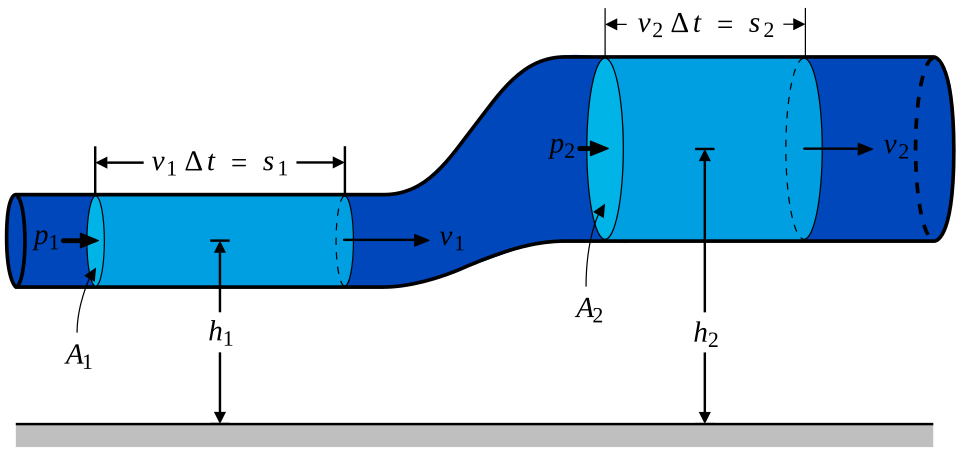
[A streamtube diagram for Bernoulli's principle, showing pressure, elevation, flow speed, and cross-sectional area. Photograph: Wikimedia Commons diagram]
Image Credits: Wikimedia Commons
Frequently asked questions
Why does my shower curtain stick to me even in a cold shower?
Because temperature is only one driver. The shower spray still drags air along and can spin it into a vortex, lowering pressure inside the stall. That is why the effect persists with cold water, as Wikipedia notes, even though buoyancy alone cannot explain it.
Does a heavier curtain really stop the billowing?
It reduces it. A weighted hem or magnetic bottom resists the pressure difference with gravity, so the same forces move the curtain less. It does not remove the pressure difference itself, so a very strong draft can still bow the curtain above the weights.
Who won a prize for studying shower curtains?
David Schmidt of the University of Massachusetts, who won the 2001 Ig Nobel Prize in Physics for a computational fluid dynamics study of the effect. His simulation found that shower spray drives a horizontal vortex whose low-pressure centre pulls the curtain inward.
Will opening the bathroom window fix it?
It helps with the hot-shower part of the effect. Ventilation reduces the temperature difference that drives rising warm air, weakening the stack effect. It has less effect on the spray-driven vortex, so it may reduce rather than remove the billowing.
The bottom line
Your shower curtain billows inward because the shower turns the stall into a low-pressure pocket, and the curtain is light enough to move toward it. Bernoulli's principle, rising warm air, and a spray-driven vortex all contribute, and none of them alone explains every shower.
That combined answer points to combined fixes: a heavier or magnetic curtain, a curved rod for more room, and ventilation to break up the rising warm air. Together they do not repeal physics, but they give the curtain far less reason to come and meet you.
Tags: shower curtains, bathroom, physics at home, air pressure
The Rive News research desk covers personal finance, home, and everyday science explainers from public sources, with claims checked against the cited pages.
Related
- How to stop mirrors from fogging after a shower
- How to fix a dripping shower head in under 30 minutes
- Why a clean shower drain can still smell
- How to get rid of mould on bathroom walls safely
Subscribe for one practical explainer a day, drawn from real sources and checked before publication.
Rive News publishes explainers based on public sources. Corrections are noted on the article when a cited fact changes.
Related stories
Why Your Faucet Keeps Dripping After You Turn It Off
A dripping faucet is usually a worn washer, O-ring, or cartridge that can no longer seal. One drip per second wastes over 3,000 gallons
How to fix a running toilet without a plumber in 30 minutes
A running toilet can waste 200 gallons of water a day. Diagnose the flapper, float, or fill valve in two minutes, then fix it yourself
How to hang heavy shelves on drywall safely
Studs first, toggle bolts second, plastic anchors never for heavy loads. Weight ratings, installation steps, and mistakes that bring