
How to stop mirrors from fogging after a shower: 7 methods
By Rive News / Research desk | Rive News / Published October 21, 2026 at 9:00 AM PKT
Key takeaways
- A mirror fogs because its glass is cooler than the dew point of the steamy bathroom air, so vapor condenses into droplets on it.
- The three real fixes are ventilating the moisture out, warming the glass above the dew point, or coating the surface so water cannot bead.
- Run the exhaust fan during the shower and 15 to 20 minutes after; that alone prevents most fogging.
You step out of a hot shower and the mirror is a white wall. The fog is not steam sticking to the glass. It is physics: warm moisture-laden air meeting a cooler surface and surrendering its water as thousands of microscopic droplets.
Every fix for a foggy mirror attacks one side of that equation.
This article explains why mirrors fog, how ventilation removes the moisture, how heated pads and mirrors warm the glass, and which coatings keep the reflection clear: seven methods, ranked from free habit to permanent hardware.
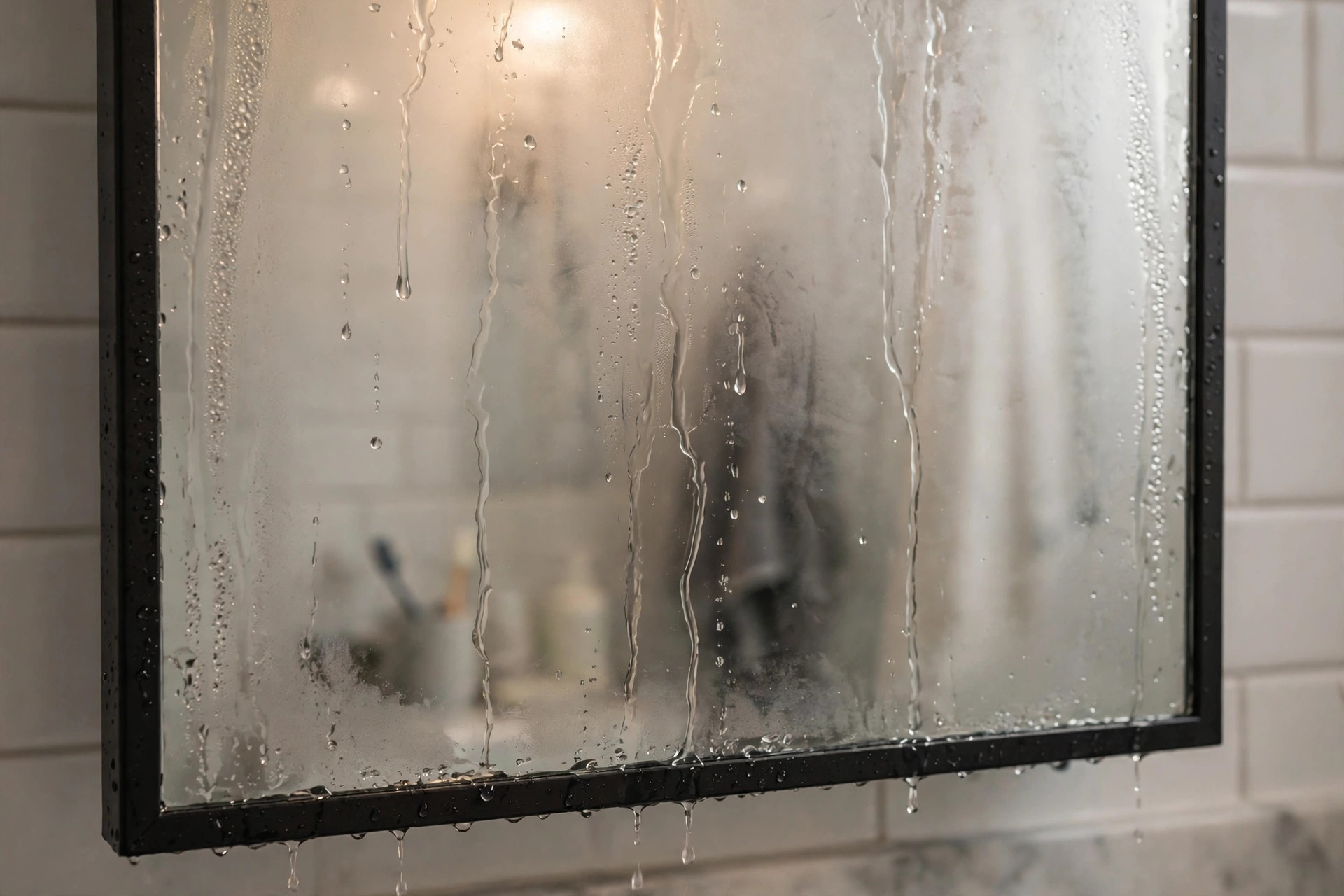
A bathroom mirror whited out by condensation after a hot shower. Illustration: AI-generated for Rive News.
Image Credits: AI-generated (Rive News)
Why the mirror fogs at all
Condensation needs two things: humid air and a surface colder than that air's dew point. A hot shower supplies the humidity. The mirror, mounted on a cold wall and untouched by warm water, supplies the cold surface.
When the vapor hits the glass, it condenses into tiny discrete droplets instead of a smooth film. Those droplets scatter light, which is why fog looks opaque white rather than wet. The same physics fogs car windscreens and glasses in winter, and our guide to stopping car windows from fogging tackles the same dew point problem on the road.
Engineer Fix frames the permanent solutions around this cause: by either removing the moisture or warming the glass, the problem can be solved permanently. Everything below is a variation on one of those two moves, plus a third trick: changing the glass surface itself so droplets cannot form.
Method 1: Run the exhaust fan longer
Ventilation is the most direct fix because it removes humid air before it can condense. An exhaust fan running during the shower and for 15 to 20 minutes afterward pulls the steam out of the room, lowering the overall humidity and shrinking the temperature gap that drives fogging.
The numbers back this up. One industry summary cites the American Society of Heating, Refrigerating and Air-Conditioning Engineers (ASHRAE) finding that a fan running during and for 15 to 20 minutes after a shower can cut humidity by up to 60%. For the fan to do its job, it needs enough capacity (a minimum of 50 CFM, cubic feet per minute, for a standard bathroom), and the duct must vent outside, not into an attic or wall cavity where the moisture causes structural damage.
Timing matters as much as capacity. Switch the fan on before the hot water starts, not after the mirror is already fogged. If your fan is weak or noisy enough that nobody runs it, upgrading to a quieter high-CFM unit pays off in clear mirrors and less mould.
Good ventilation also protects the walls; see our guide to getting rid of mould on bathroom walls for what happens when moisture lingers.
Method 2: Crack the door or a window
If the bathroom has a window, opening it during the shower creates an escape route for humid air. Even a 2-inch gap builds cross-flow that accelerates moisture escape. In windowless bathrooms, leaving the door ajar after the shower helps, though it exports the humidity to the hallway rather than outside.
This is a free supplement to the fan, not a replacement. In winter, an open window also chills the mirror further, so keep the fan running too.
Method 3: Install a heated demister pad
The most reliable hardware fix warms the glass itself. A demister pad is a thin, self-adhesive electric heating element that sticks to the back of the mirror and gently raises its surface temperature a few degrees above the room's dew point. Because the glass is no longer the coldest surface in the room, vapor cannot condense on it.
Bathroom Mountain notes that these pads heat the rear of the mirror by approximately 5 to 10 degrees Celsius, a small lift but enough to break the fog cycle completely. Manufacturers typically recommend covering at least 70% of the mirror's surface for uniform heating, though the pad only needs to cover the area where you want a clear reflection.
Installation usually means wiring the pad into the bathroom's lighting circuit by a qualified electrician, so it switches on with the lights. Once fitted, the pad runs silently for years with no maintenance. Units typically cost $30 to $60 and use less energy than a nightlight.
Method 4: Upgrade to a heated anti-fog mirror
If you are replacing the mirror anyway, buy one with heating built in. Factory-integrated elements deliver the same dew-point lift as a retrofit pad, often with an LED-lit frame as a bonus.
This is the highest-upfront-cost option but the most invisible: no pads, no sprays, no routine. For a full renovation, it is the set-and-forget answer.
Method 5: Apply a commercial anti-fog spray
Anti-fog sprays take the third approach: changing the surface chemistry. These products lay down a hydrophilic, water-attracting, polymer film on the glass. Instead of beading into light-scattering droplets, the moisture spreads into an ultra-thin transparent sheet that does not obstruct the view.
Products like Rain-X Anti-Fog and Fog Gone work this way, adapted from automotive windshield coatings, giving one to two weeks of clarity per application. Clean the mirror first with isopropyl alcohol, spray evenly, and let it dry without wiping.
Over-application leaves streaks.
Nano-coating liquids are the longer-lived cousin of sprays, creating a molecular-level treatment that can last six months or more, though they demand careful application. Anti-fog wipes (single-use pre-treated cloths) are the travel version: fine for one shower, not a household solution.
Method 6: The shaving-cream and soap trick
The classic DIY method uses ordinary shaving cream. Spread a thin layer over the mirror, let it sit for a minute or two, then buff it off with a dry cloth until the glass looks clear. What remains is an invisible surfactant film that works like a weak version of the commercial coatings: it lowers the surface tension so water sheets instead of beading.
Diluted dish soap (about one drop per cup of water, wiped on and buffed dry) does the same job. Both last a few days to a week, and both need reapplication after any real mirror cleaning. They can also attract dust over time, so they are a good test of whether a hydrophilic coating suits you before you buy the commercial version.
Method 7: Wipe, squeegee, and manage the aftermath
If the mirror still fogs despite everything, manage it rather than fight it. A quick squeegee pass clears the glass in seconds without the streaking that towels leave. A hairdryer on warm, held at a distance, evaporates the film in under a minute and doubles as a way to warm the glass slightly for the next shower.
The moisture that fogs your mirror also feeds mould in grout and behind paint. If the mirror fogs daily, the bathroom needs the Method 1 ventilation upgrade regardless of which quick fix you choose. Our renter-friendly guide to preventing bathroom mold without an exhaust fan covers the interim measures.
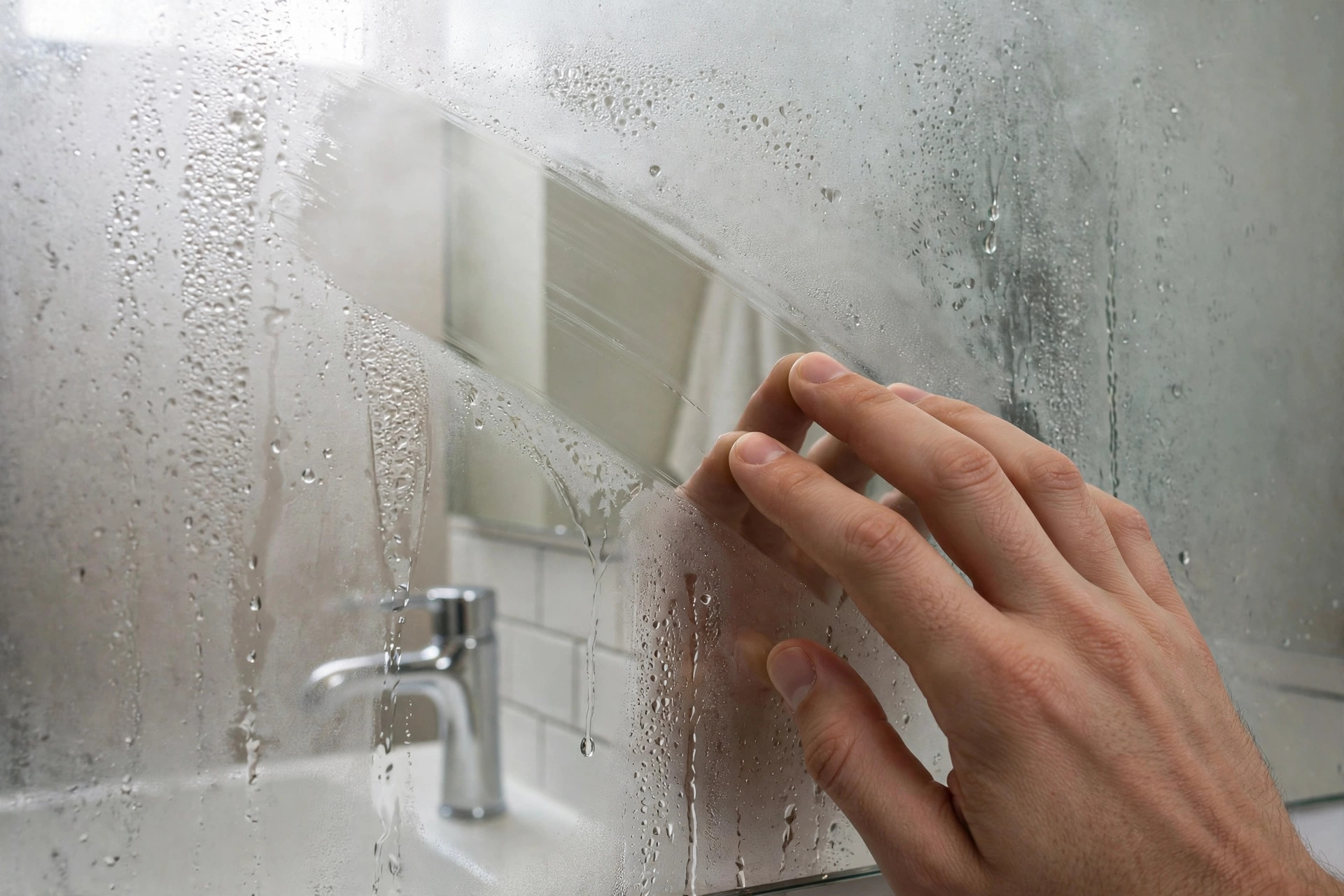
A clear streak wiped through the fog, with condensation droplets still beading around it. Illustration: AI-generated for Rive News.
Image Credits: AI-generated (Rive News)
What actually works best
For most bathrooms, the winning combination is Method 1 plus Method 3: proper ventilation to remove the bulk of the moisture, plus a demister pad so the mirror never drops below the dew point. Heating prevents the surface fog while ventilation limits moisture accumulation, which is the pairing Bathroom Mountain recommends for consistent steam-free clarity.
Sprays and soaps are fine as low-commitment trials, and the door crack is free help. But if you are tired of reapplying, the pad is where the problem ends.
It also survives a bathroom repaint, unlike coatings that need reapplying after solvent cleaning. If peeling paint is part of the same moisture story in your bathroom, our guide to why bathroom paint peels explains the wall side of the problem.
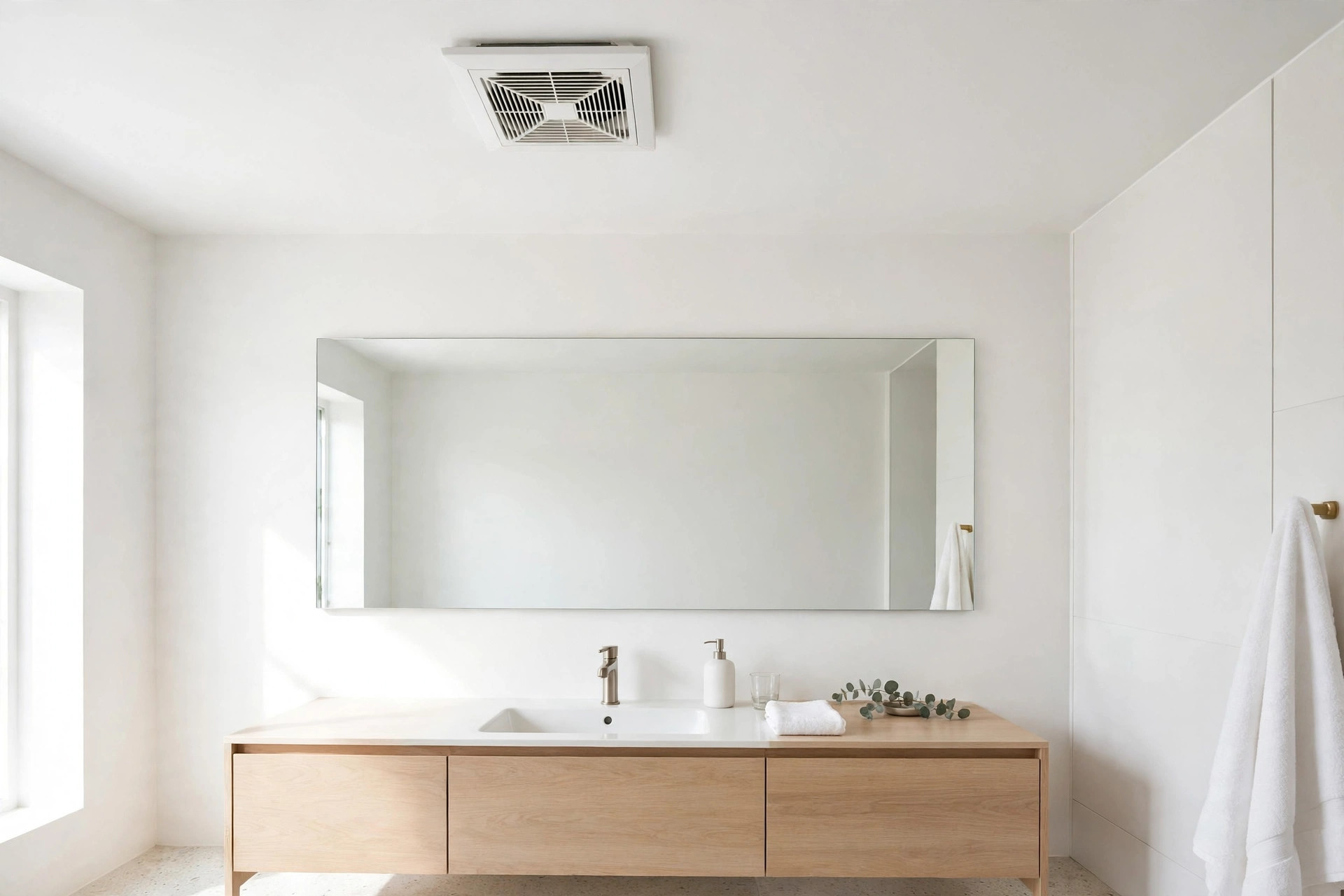
A ceiling exhaust fan and clear mirror in a well-ventilated bathroom. Illustration: AI-generated for Rive News.
Image Credits: AI-generated (Rive News)
Frequently asked questions
Why does my bathroom mirror fog but my bedroom mirror doesn't?
The bedroom air is not saturated with hot water vapor. Fog needs humidity plus a surface below the dew point, and only the bathroom supplies both after a shower.
Do anti-fog sprays damage the mirror?
No, when used as directed. Clean the glass first, apply thinly, and buff dry. Damage comes from abrasive cleaners and over-application, which leaves streaky residue, not from the anti-fog chemistry itself.
How long does shaving cream keep a mirror fog-free?
A few days to a week in practice. It washes off with the next proper mirror cleaning, so it needs reapplying regularly. Treat it as a trial before committing to a spray or a demister pad.
Are heated demister pads expensive to run?
No. They draw very little power (typically less than a nightlight), and they only run while the bathroom light is on. The $30 to $60 unit cost and a one-time electrician visit are the real expenses.
Can I put a demister pad on any mirror?
On most flat wall-mounted mirrors, yes, as long as you can access the back during installation. Very large or irregularly shaped mirrors may need two pads, and the pad should cover at least 70% of the area you want kept clear.
The bottom line
Mirrors fog when glass meets steamy air below its dew point. Ventilate the moisture away, warm the glass above the dew point, or coat the surface so water cannot bead, and the morning reflection stays clear.
Start tonight: run the fan for 20 minutes after your next shower and see how much less fog forms. If the mirror still whites out, a demister pad is the permanent fix that ends the daily wipe-down for good.
Rive News is a research desk that tests bathroom fixes against building-science guidance and manufacturer specifications before writing about them.
Related
- How to Get Rid of Mould on Bathroom Walls Safely
- How to prevent bathroom mold without an exhaust fan as a renter
- How to stop your car windows from fogging up
- Why Does Paint Peel Off Bathroom Walls and How to Fix It
Subscribe to the Rive News newsletter for one practical home fix every week.
Published by Rive News. Information is for general purposes only.
Related stories
Why Your Faucet Keeps Dripping After You Turn It Off
A dripping faucet is usually a worn washer, O-ring, or cartridge that can no longer seal. One drip per second wastes over 3,000 gallons
How to fix a running toilet without a plumber in 30 minutes
A running toilet can waste 200 gallons of water a day. Diagnose the flapper, float, or fill valve in two minutes, then fix it yourself
How to hang heavy shelves on drywall safely
Studs first, toggle bolts second, plastic anchors never for heavy loads. Weight ratings, installation steps, and mistakes that bring