
Why Is the Center of the Earth Hot While the Surface Is Cold
Key takeaways
- Earth's core likely reaches about 5,700 C, close to the Sun's surface temperature, while the ground under your feet stays cool.
- Two sources supply the heat: primordial heat left over from Earth's formation and ongoing radioactive decay.
- The surface stays cold because rock conducts heat very slowly and sunlight rules the skin of the planet.
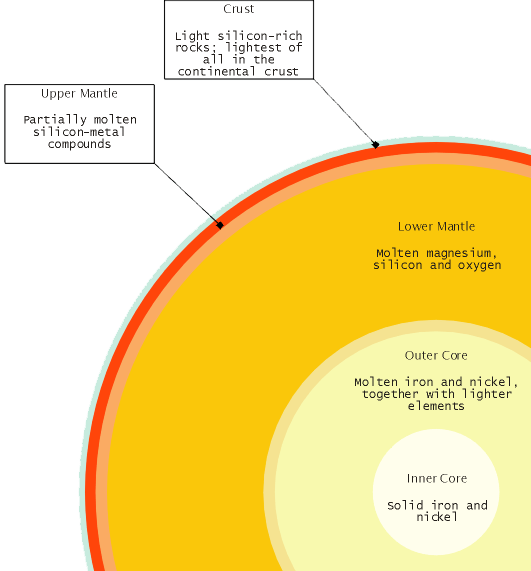
Earth's layered interior: thin crust, thick mantle, liquid outer core, and solid inner core. Diagram: Wikimedia Commons
Image Credits: Wikimedia Commons / uploader
The ground beneath your feet is cool to the touch, yet just a few dozen kilometers down, rock is hot enough to melt. At the center of the planet, 6,371 kilometers below the surface, temperatures likely reach about 5,700 C, roughly the temperature of the surface of the Sun. It is one of the strangest facts in Earth science: a planet that is still cooling from a fire it lit 4.5 billion years ago, while its surface behaves as if none of that heat exists.
This article explains where Earth's internal heat comes from, why the center stays hot after billions of years, and why almost none of that heat reaches the surface you stand on.
Two sources keep the center hot
Earth's internal heat comes from two main sources, and geologists estimate that each contributes roughly half of the total. The first is primordial heat: leftover energy from the planet's formation.
When Earth coalesced from gas, dust, and colliding planetesimals about 4.5 billion years ago, gravitational energy converted into thermal energy. Accretion was a violent process, and the collisions, compression, and sinking of dense iron to form the core all generated enormous heat. That heat has been leaking away ever since, but the planet is so large that the process is still going on.
The second source is radiogenic heat: energy released by the radioactive decay of unstable atoms inside the Earth. The major heat-producing isotopes are uranium-238, uranium-235, thorium-232, and potassium-40. According to Penn State's geoscience course materials, most of Earth's heat comes from this radioactive decay, though some is left over from formation. A 2011 analysis from experiments deep inside a Japanese mountain, led by physicist Itaru Shimizu of Tohoku University using geoneutrinos, found that only about half of the planet's internal heat stems from natural radioactivity, with the rest being primordial heat from the planet's violent birth.
The numbers are striking. Geologists estimate that about 44 terawatts, or 44 trillion watts, of heat constantly flows out of Earth's interior into space. To break the radiogenic share down, models suggest roughly 8 terawatts from uranium-238, 8 terawatts from thorium-232, and 4 terawatts from potassium-40. Heat contributed by radioactivity today is roughly a quarter of what it was when Earth formed, because the more decay that has happened, the fewer radioactive atoms remain.
How hot is it down there, really
Nobody has been to the center of the Earth, so temperatures are estimated from seismic waves, laboratory experiments, and computer models. The accepted range for the inner core is about 5,200 to 6,000 C, with a most likely value near 5,700 C. The outer core, a liquid layer surrounding the solid inner core, runs about 4,000 to 5,000 C.
Temperature rises with depth, but not evenly. The geothermal gradient in the upper crust is about 25 to 30 C per kilometer, and physical geology textbooks put the temperature at about 1,000 C at the base of the crust, around 3,500 C at the base of the mantle, and around 5,000 C at Earth's center.
Miners have known this firsthand for centuries. The TauTona gold mine in South Africa reaches 3.9 kilometers below sea level, where rock temperatures hit 60 C and heavy cooling keeps miners alive. The Kola Superdeep Borehole in Russia, the deepest hole ever drilled at 12.2 kilometers, found temperatures of 180 C.
The inner core presents a famous paradox: it is as hot as the surface of the Sun, about 5,500 C, yet it is solid. The reason is pressure.
The inner core sits under more than 3 million atmospheres of pressure, which raises the melting point of its iron-nickel alloy so high that it stays solid despite the extreme heat. Diamond anvil cell experiments, which squeeze iron alloys to core-like pressures in the lab, suggest the inner core solidifies at around 5,700 K.
Why the surface stays cold
If the center is so hot, why doesn't the surface warm up? Three reasons, all working together.
First, rock is a terrible conductor of heat. Penn State's geoscience materials put it vividly: the distance from the center to the surface is roughly 10,000,000,000,000,000 atoms, and the Earth is not old enough for much of the heat trapped at its center when it formed to have been conducted to the surface by this neighbor-bumps-neighbor mechanism.
Conduction, the transfer of heat by atomic collisions, is simply too slow through trillions of atomic layers. Estimates suggest the core's heat takes tens of thousands of years to move significant distances.
Second, the surface is dominated by the Sun, not by the interior. The 44 terawatts flowing from inside Earth sounds enormous, but it is tiny compared with the roughly 174,000 terawatts of sunlight that strike the planet. Surface temperature is set by the balance between incoming sunlight and outgoing radiation, which is why deserts and polar regions differ so wildly while sitting on the same hot planet.
Third, the heat that does move through the mantle moves by convection, not by rushing to the surface. The mantle convects at rates of centimeters per year, carrying heat upward slowly, where it drives plate tectonics, volcanoes, and earthquakes. Volcanoes are the visible exceptions that prove the rule: they are narrow channels where interior heat breaks through, while the rest of the surface radiates its modest internal heat away unnoticed.
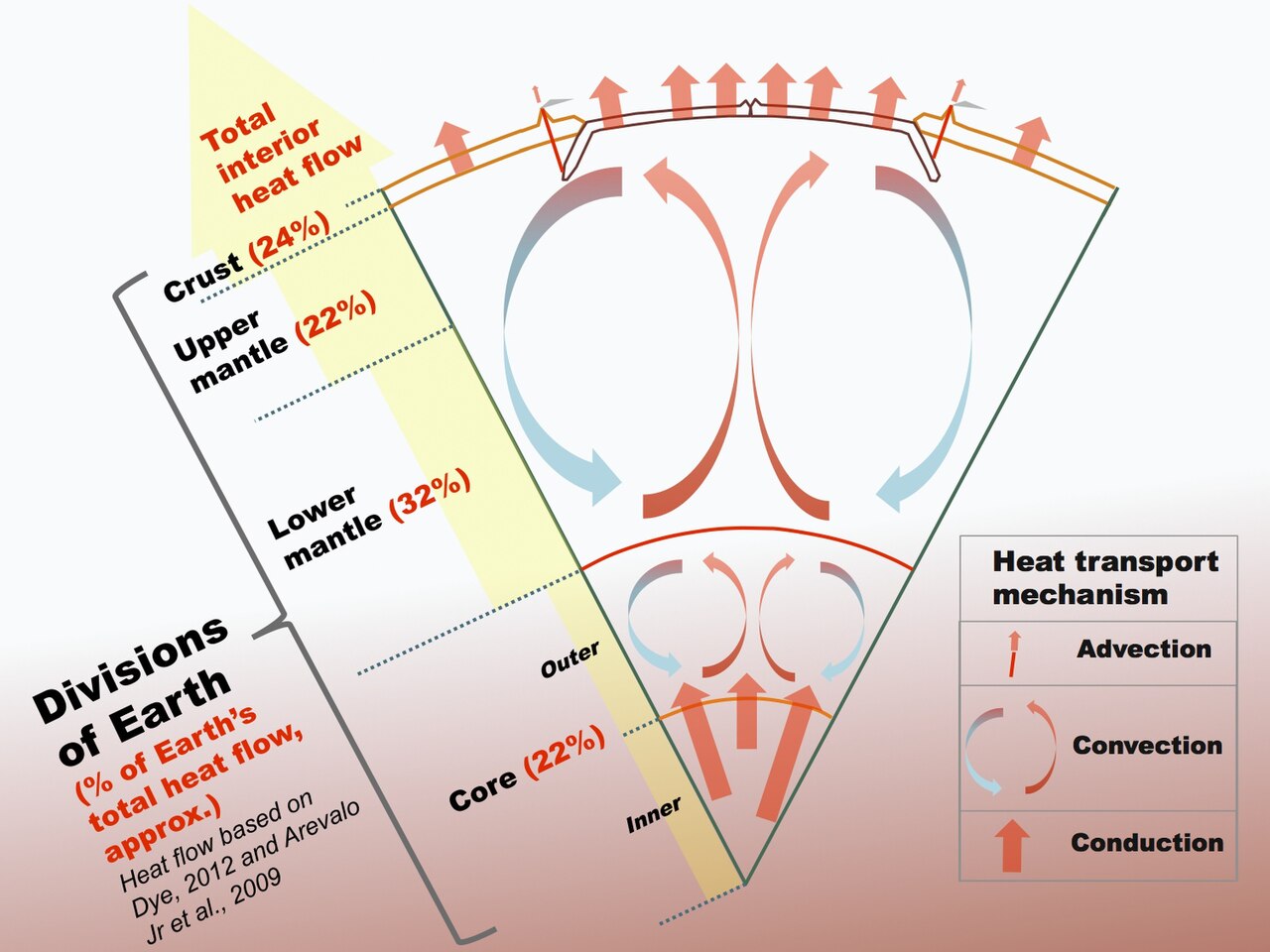
Heat flowing out of Earth's interior comes from primordial formation heat and ongoing radioactive decay. Diagram: Wikimedia Commons
Image Credits: Wikimedia Commons / uploader
What the heat does for the planet
Earth's internal heat is not just a curiosity; it runs the planet's geology. Mantle convection drives plate tectonics, which builds mountains, opens ocean basins, and recycles the crust.
The flowing liquid outer core generates the magnetic field that shields the atmosphere and life from solar radiation. Volcanoes, earthquakes, and the drifting of continents are all surface expressions of the deep heat engine.
The heat also has a slow future. Radioactive isotopes decay and are not replaced, so the internal heat engine is winding down.
Very early in Earth's history, before short-lived isotopes had decayed away, heat production was much higher. Over billions of years, the planet will cool further, though on any human timescale the core remains effectively as hot as ever.
FAQ
Is the Earth's core hotter than the Sun?
The core is about as hot as the surface of the Sun, which is roughly 5,500 C. The Sun's own core, where nuclear fusion happens, is far hotter, at around 15 million C.
So Earth's core matches the Sun's skin but is nowhere near the Sun's heart. Read more about why the Earth has seasons that have nothing to do with distance from the Sun.
Will the Earth's core ever cool down completely?
Eventually, on cosmic timescales. Radioactive decay produces less heat over time because the supply of unstable atoms shrinks, and primordial heat keeps leaking into space. But the process is so slow that the core will remain hot for billions of years to come.
Does the heat from the core warm the oceans or the climate?
Barely. The 44 terawatts of geothermal heat flow is less than one-thousandth of the solar energy absorbed by the planet.
Climate is controlled by sunlight and the atmosphere. The exception is local: volcanic regions and deep-sea hydrothermal vents are warmed directly by interior heat.
Curious about why some metals stick to magnets? The core's liquid iron is part of that story too.
How do scientists know the core's temperature if nobody has been there?
Through indirect evidence: seismic waves from earthquakes reveal density and state, laboratory diamond-anvil experiments recreate core pressures and measure melting points, and neutrino detectors measure radiogenic heat production. The estimates converge around 5,200 to 6,000 C.
Why is the inner core solid but the outer core liquid?
Pressure increases with depth faster than temperature rises. At the inner core's depth, the pressure exceeds 3 million atmospheres, which forces iron to stay solid even at 5,700 C. The outer core is under less pressure, so the same iron-nickel alloy melts and flows.
The bottom line
Earth's center is hot because the planet was born hot and because radioactive atoms in its rocks and mantle keep producing heat as they decay. The surface stays cold because rock conducts heat at a glacial pace, the Sun overwhelms the interior's contribution by a factor of thousands, and only narrow volcanic channels let deep heat escape. The result is a planet with a Sun-hot heart and a cool skin, and the slow leak of that heart's heat is what keeps continents moving and the magnetic field alive.
Latest in Science
- Why the Earth has seasons that have nothing to do with distance from the Sun
- Why magnets attract some metals but ignore others
- How planes stay in the air
- Why shadows have blurry edges
Subscribe for weekly explainers on the science behind everyday mysteries.
Related stories

Why diamond is hard and graphite is soft when both are carbon
Diamond and graphite are both pure carbon, yet diamond is 10 on the Mohs scale and graphite is 1 to 2. The difference is not the atoms;

Why Hot Water Can Freeze Faster Than Cold: The Mpemba Effect Explained
Hot water can freeze faster than cold under specific conditions. The Mpemba effect, named for a 1963 schoolboy experiment, still divides

How Magnets Work at the Atomic Level: Spins, Domains, and Iron
Magnetism comes from electrons: their spin and orbits make each atom a tiny magnet. In iron, quantum forces align these atomic magnets into