
Why Do Shadows Get Blurry at the Edges?
Key takeaways
- Shadow edges blur because the Sun is an extended light source spanning 0.53 degrees, not a single point of light.
- The fuzzy border is called the penumbra, a zone where only part of the Sun is blocked; the fully dark core is the umbra.
- The blur widens with distance: a shadow cast far from the object can be almost entirely soft-edged penumbra.
Stand in bright sunlight and look at the edge of your shadow. It is not a crisp line. The darkness fades gradually into the lit ground over a soft band several centimeters wide.
Move closer to a wall and the edge sharpens; step back and it melts away. The same light, the same body, yet the shadow's edge changes with distance.
This article explains why shadow edges are blurry, what the penumbra and umbra are, how the Sun's apparent size creates the effect, and how you can demonstrate the whole thing with a desk lamp and your hand.
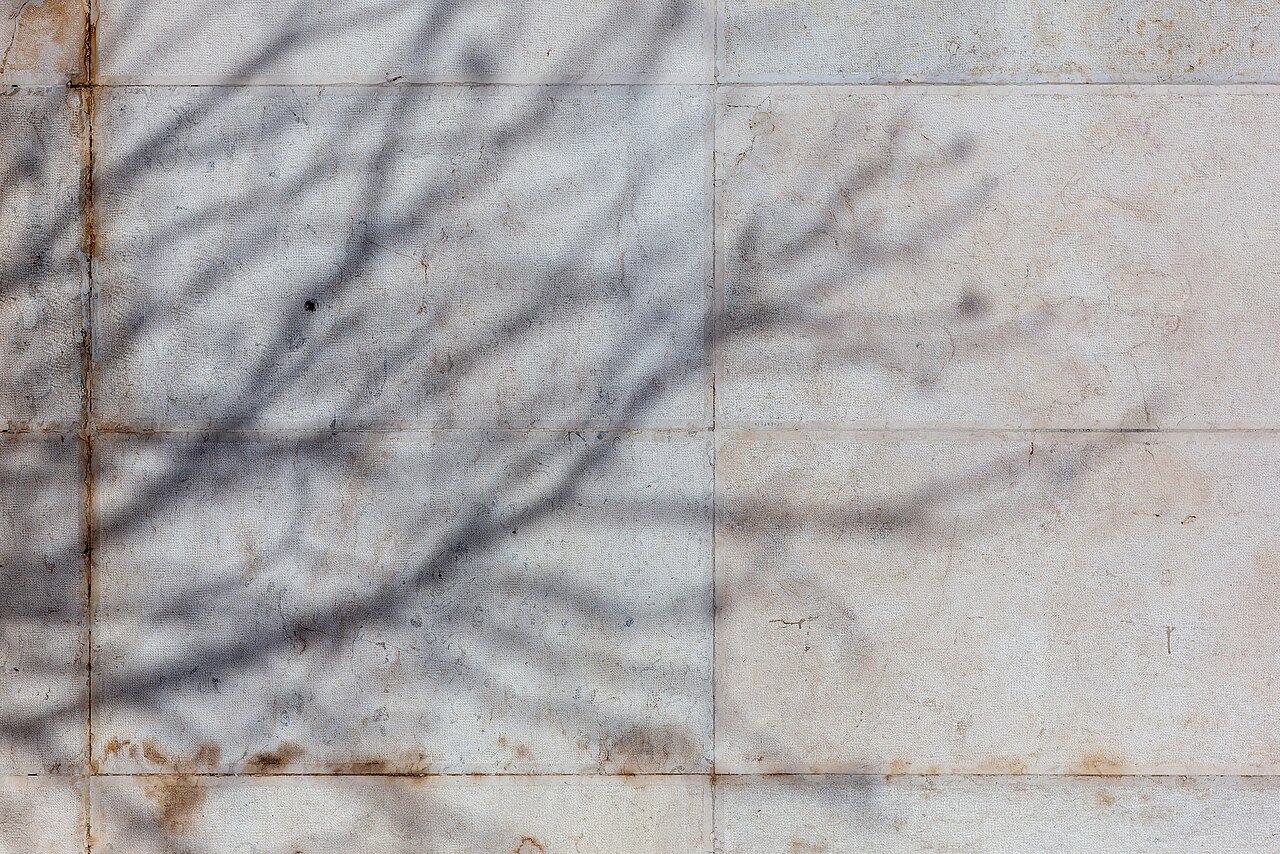
A tree's shadow on a wall in Lisbon. The edges are soft because the Sun is a broad light source, not a point. Photograph: Jules Verne Times Two / Wikimedia Commons
The Sun is not a point of light
Most diagrams draw light as rays coming from a single point. Real sunlight does not work that way. The Sun is a disc with real width, and from Earth it spans about 0.53 degrees of sky, roughly the width of your pinky finger held at arm's length.
Light reaches you from every point across that disc at once: from its top edge, its bottom edge, and everywhere in between.
That width is the entire reason shadow edges blur. A point source of light casts a razor-sharp shadow because there is exactly one line of sight to block. An extended source like the Sun casts a shadow with structure, because blocking the light becomes a partial affair.
Some points on the solar disc are hidden behind the object while others peek around it.
A lecture on eclipses from the National Radio Astronomy Observatory states the rule plainly: "The shadow cast by an opaque screen in front of a point-like light source is always sharp. However, the shadow cast by a body eclipsing an extended light source like the Sun is fuzzy." Everything that follows is geometry built on that one distinction.
Umbra and penumbra: the two parts of a shadow
Every shadow cast by sunlight has up to two regions. The umbra, from the Latin word for shadow, is the dark core where the object blocks the entire solar disc. Stand in the umbra and the Sun is completely hidden.
The penumbra, from the Latin "paene" meaning almost, is the borderland where the object blocks only part of the disc. Stand in the penumbra and you see a partial eclipse of the Sun: a crescent of blinding disc still visible past the edge of the object.
The penumbra is the blur you see. Within it, the darkness is not uniform. Near the umbra, almost the whole Sun is blocked and the shadow is deep.
Toward the outer edge, only a sliver is covered and the ground is nearly fully lit. The gradient between those extremes is what your eye reads as a soft edge. There is no line where the shadow ends; there is a slope of light.
The same structure scales up to eclipses. The Moon's umbra is a cone only about 383,000 kilometers long, barely reaching Earth's surface 384,000 kilometers away, which is why total solar eclipses are so marginal and rare. Earth's own umbra stretches 1.4 million kilometers into space, and the Moon sails through it during lunar eclipses.
Your body's shadow on the pavement is the same physics at human scale: a small umbra wrapped in a penumbra you can see with your eyes.
Why the blur gets wider with distance
Here is the part most explanations skip: the penumbra is not a fixed width. It grows as the shadow travels farther from the object, and the geometry is simple enough to picture.
Because the Sun has angular width, rays from its top edge and bottom edge leave the object's edge at slightly different angles. Those two ray bundles spread apart as they travel, and the spreading zone between "fully blocked" and "fully lit" is the penumbra. The farther the screen, the more room the bundles have to separate.
Roughly speaking, the penumbra's width equals the shadow's travel distance multiplied by the Sun's angular width in radians, about 0.0093. A shadow landing 1 meter from the object has a penumbra roughly 9 millimeters wide. At 10 meters, it is about 9 centimeters.
This is why your shadow looks crisp against a nearby wall and fuzzy on distant pavement, and why tree shadows on the ground are soft blobs while the leaves themselves are sharp. It also explains the classic cloudy-day observation: when clouds scatter sunlight into a broad, diffuse glow, every direction becomes a light source, the penumbra swallows the umbra entirely, and shadows vanish.
The University of Virginia's physics teaching lab demonstrates exactly this with a desk lamp and a marker. Move the marker close to the lamp and the shadow is mostly dark umbra. Move it farther away and the shadow becomes dominantly penumbra, lighter and softer at every edge.
The Sun does the same experiment continuously, with your body as the marker.
Everyday proof you can test in a minute
You do not need equipment to verify any of this. Hold your hand a few centimeters above a table under a ceiling light and look at the shadow's edge: fairly sharp. Raise your hand half a meter and watch the edge dissolve into a gray gradient.
The light did not change; only the distance did, and the penumbra widened exactly as the geometry predicts.
Try it outdoors with a friend on a sunny day. Compare the shadow of a nearby fence post, crisp, with the shadow of a distant rooftop edge, soft. Same Sun, same physics, different travel distance.
Plants growing toward light are responding to this same directional sunlight, just on a slower timescale.
One more test: look at shadows under a single small LED, which is close to a point source, versus under a broad fluorescent panel. The LED gives hard edges; the panel gives soft ones. You have just reproduced the difference between a point source and an extended source, the same distinction that separates a sharp laboratory shadow from every sunlit shadow you have ever seen.
Why are some shadows sharp and others blurry?
Sharpness depends on the light source's angular size and the shadow's travel distance. Small, distant sources like a single LED give sharp edges. The broad Sun gives soft edges, and the softness grows with distance from the object.
What is the difference between umbra and penumbra?
The umbra is the region where the light source is completely blocked; the penumbra is where it is only partially blocked. The penumbra forms the visible blurry border around every sunlit shadow.
Why do shadows disappear on cloudy days?
Clouds scatter sunlight so it arrives from all directions at once. With light coming from everywhere, there is no region where the source is fully blocked, so the umbra disappears and only a faint, directionless dimming remains.
Does the penumbra explain solar eclipses?
Yes. A total solar eclipse happens when you stand in the Moon's umbra; a partial eclipse is the penumbra sweeping over you. The Moon's umbra barely reaches Earth, which is why totality is so brief and geographically narrow.
The bottom line
Shadows blur at the edges because the Sun is a disc 0.53 degrees wide, not a point. That width creates a penumbra, a borderland of partial shadow between full darkness and full light, and the penumbra widens the farther the shadow travels. Hold your hand near a table and far from it under the same lamp, and you can watch the geometry happen live.
Image Credits: Wikimedia Commons / Jules Verne Times Two, Wikimedia Commons / Basile Morin, Wikimedia Commons / Mycomp

A long tree shadow in Laos. The farther the shadow falls from the tree, the wider and softer its penumbra becomes. Photograph: Basile Morin / Wikimedia Commons

Tree shadows in a park, all penumbra at this distance. Photograph: Mycomp / Wikimedia Commons
Latest in Science
- Why a compass needle points north
- Why you can only see stars at night
- Why stars appear to move across the sky overnight
- Why plants grow towards light
Subscribe to the Rive News newsletter for one clear science explainer every morning.
Related stories
Why diamond is hard and graphite is soft when both are carbon
Diamond and graphite are both pure carbon, yet diamond is 10 on the Mohs scale and graphite is 1 to 2. The difference is not the atoms;

Why Hot Water Can Freeze Faster Than Cold: The Mpemba Effect Explained
Hot water can freeze faster than cold under specific conditions. The Mpemba effect, named for a 1963 schoolboy experiment, still divides
How Magnets Work at the Atomic Level: Spins, Domains, and Iron
Magnetism comes from electrons: their spin and orbits make each atom a tiny magnet. In iron, quantum forces align these atomic magnets into