
Why Is the Deep Ocean Pitch Black but the Surface Blue
Key takeaways
- The ocean surface looks blue because water absorbs red light first and scatters blue light back to our eyes.
- Red and orange light vanish within the first 10 meters; only blue light reaches about 200 meters down.
- Below 1,000 meters lies the aphotic zone, where no sunlight penetrates and the only light is biological.

The ocean's surface glows blue because water molecules absorb longer wavelengths and scatter blue back upward. Photograph: Lionello DelPiccolo
Image Credits: Wikimedia Commons / Lionello DelPiccolo
From a boat, the ocean stretches out in every shade of blue. But send a camera down a few hundred meters and the world turns dim and blue-green, then grey, then nothing at all.
Below 1,000 meters, there is no sunlight whatsoever. It is the largest dark place on Earth, and it exists for the same physical reason the surface is blue: water treats different colors of light differently.
This article traces a single beam of sunlight from the surface to the abyss, explaining why the top glows blue and the bottom is pitch black, with the exact depth boundaries scientists use.
Why the surface looks blue
Sunlight is white: a mix of every color of the rainbow. When it hits the ocean, water molecules begin absorbing it immediately, but not evenly.
Water absorbs longer, lower-energy wavelengths first. Red light is almost completely absorbed within the first few meters of the surface, which is why a red object held underwater quickly appears black to a descending diver. Orange and yellow follow soon after.
Blue light, with its shorter wavelength and higher energy, survives the longest. It penetrates the deepest and is scattered back up by water molecules to the observer's eyes.
That is the blue you see from the boat. The UC Santa Barbara Science Line explains that water preferentially absorbs light at longer wavelengths, and as water gets deeper, it becomes a deeper blue until it is essentially black. Pure water, without many particles, appears deep blue for exactly this reason.
Sky reflection plays a smaller role than most people assume. The ocean looks blue even on overcast days, and it photographs blue from satellites for the same absorption reason.
Turbidity can change the color: coastal waters rich in sediment or plankton look green, brown, or grey because particles scatter and absorb light differently. But in the open ocean, the blue is the water itself.
The depth-by-depth disappearance of light
Light does not fade gradually into blackness; it gets filtered color by color. NOAA Ocean Exploration divides the water column into three zones based on how much sunlight they receive.
The euphotic, or sunlight, zone runs from the surface to about 200 meters (656 feet). This is where sunlight penetrates strongly enough to support phytoplankton and plant growth, and it provides the bulk of ocean primary production. Most of the abundant marine life is crowded into this thin top slice.
The dysphotic, or twilight, zone runs from 200 to 1,000 meters (656 to 3,280 feet). Light intensity is severely reduced here.
The Australian Museum notes that by about 10 meters below the surface, most red and orange wavelengths are already gone, and by about 150 meters, even in the clearest water, human eyes can only see blue light. One marine optics analysis puts the general rule starkly: sunlight decreases in intensity by a factor of 10 for roughly every 75 meters of descent, citing NOAA data.
The aphotic, or midnight, zone begins below 1,000 meters (3,280 feet). No sunlight from the surface reaches this realm.
It includes the bathypelagic midnight zone from 1,000 to 4,000 meters, the abyssopelagic abyss from 4,000 to 6,000 meters, and the hadopelagic hadal zone below 6,000 meters, down to the Mariana Trench at about 11,000 meters. The average depth of the seafloor is about 4,250 meters, so most of the ocean floor sits in permanent darkness.
Why the deep is pitch black, not dim blue
Two processes combine to kill the light: absorption and scattering. As light travels through water, water molecules absorb photons and convert their energy to heat.
Particles and organisms scatter photons off in random directions. Each effect compounds with depth, which is why the drop-off is exponential rather than linear.
By 800 meters, the Australian Museum reports, the human eye can detect no visible light from the surface. Some deep-sea fishes have eyes 15 to 30 times more light-sensitive than human eyes and can detect light down to about 1,300 meters. Below 1,000 meters, the only visible light is made by living organisms themselves: bioluminescence.
Most deep-sea bioluminescence glows blue, which is no accident. Blue is the wavelength water absorbs least, so a blue flash travels farthest through dark water. Evolution tuned deep-sea signals to the physics of the medium.
The darkness shapes the deep-sea community. With no sunlight, there is no photosynthesis and therefore no plants below the photic zone.
Animals adapt to the dark with huge light-sensitive eyes, or with no eyes at all. Many twilight-zone animals are colored with red pigments, because without red light available, red appears black, and they become nearly invisible against the dark backdrop.
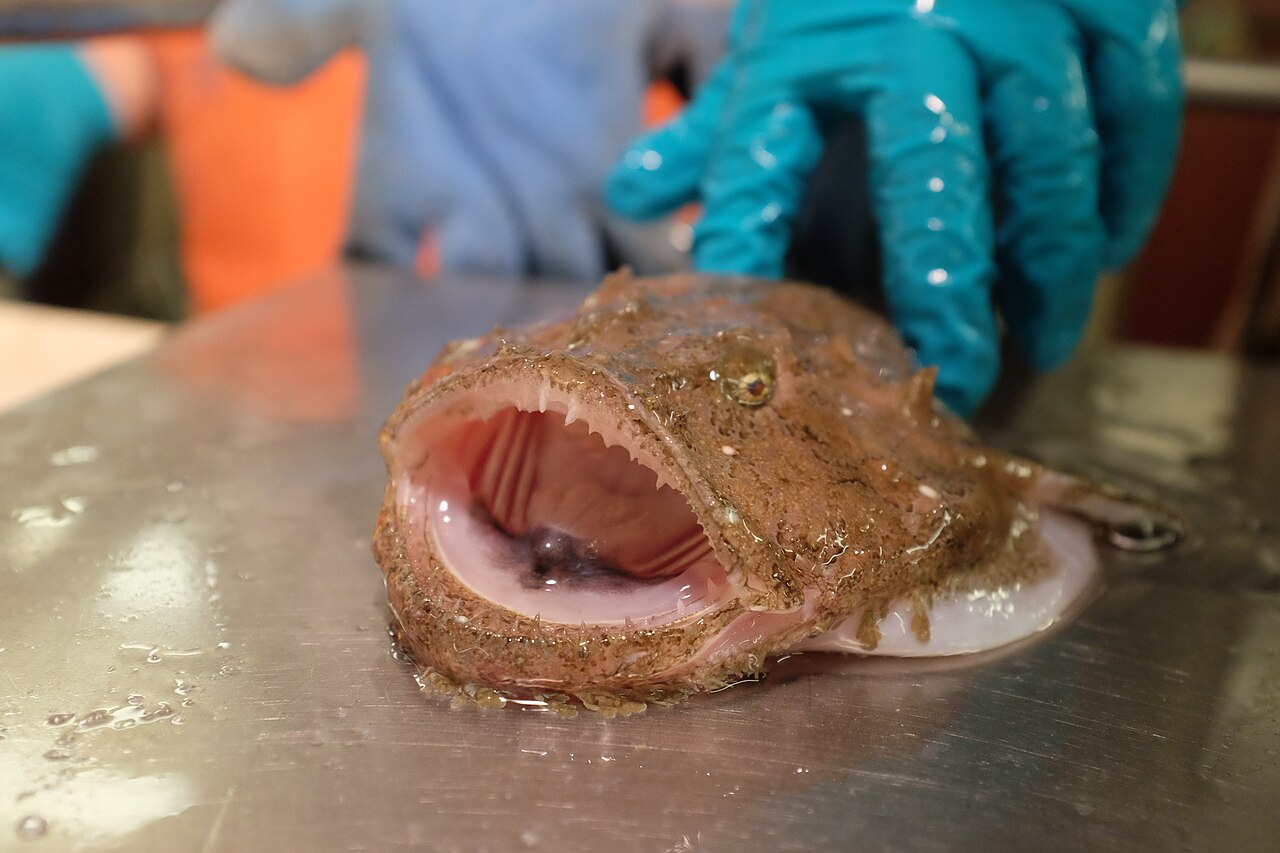
A deep-water anglerfish. Below 1,000 meters, the only light comes from organisms like this one. Photograph: Randel Kreitsberg
Image Credits: Wikimedia Commons / Randel Kreitsberg
The blue surface and the black deep are one story
It helps to see the two colors as one process running to completion. At the surface, water strips the red from sunlight and throws the blue back at us, which is why the ocean looks blue.
Descend, and the water keeps stripping: orange gone by 10 meters, yellow and green fading through the twilight zone, blue surviving to about 200 meters. Below 1,000 meters, the stripping is total. Nothing is left to scatter back, so there is no color at all, only black.
The same physics explains everyday observations. Divers watch red vanish first from their wetsuits and equipment.
Photographers carry strobes because natural reds disappear within a few meters. And the deep ocean's famous creatures, from anglerfish to vampire squid, evolved in a world where the only photons are the ones they make themselves.
FAQ
Why is the ocean blue instead of clear like a glass of water?
A glass of water is too thin for the effect to show. In a thin layer, absorption differences between colors are negligible.
Across meters and kilometers of ocean, the cumulative absorption of red light and scattering of blue light becomes overwhelming, and the water glows blue. Related reading: why sunscreen blocks UV light, another case of wavelengths being filtered selectively.
How deep can sunlight reach in the ocean?
Some light can be detected as far as 1,000 meters down, but useful light for photosynthesis rarely passes 100 to 200 meters. Light of sufficient intensity to support plant growth is usually thought to be about 1 percent of surface intensity, which in the clearest open ocean sits around 200 meters.
Is it completely dark at the bottom of the ocean?
To human eyes, yes. Below 1,000 meters no sunlight penetrates.
The only light comes from bioluminescent organisms, and deep-sea submersibles like Alvin carry their own floodlights. When the lights are off, the deep ocean is darker than a moonless night on land.
Why do deep-sea animals glow blue?
Blue light is absorbed least by water, so a blue signal travels the farthest. Deep-sea organisms tuned their bioluminescence to blue because physics gave them no better option, and their eyes are typically most sensitive to blue for the same reason.
Does the darkness affect ocean temperature?
Indirectly. Sunlight warms the surface layers, and because light can't reach the deep, the abyss stays near freezing, around 4 C, year-round. The deep ocean is a cold, dark, high-pressure world shaped entirely by the absence of light.
The bottom line
The ocean's surface is blue because water absorbs red light within meters and scatters blue back to our eyes. The same absorption, compounding with depth, erases every color in turn: red by 10 meters, blue by about 200, and all sunlight by 1,000 meters, where the aphotic zone begins. The pitch-black deep and the glowing blue surface are not opposites; they are the start and the end of the same beam of light being swallowed by water.
Latest in Science
- How planes stay in the air
- Why shadows have blurry edges
- Why the Earth has seasons that have nothing to do with distance from the Sun
- What to wear kayaking in cold water
Subscribe for weekly explainers on the science behind everyday mysteries.
Related stories

Why diamond is hard and graphite is soft when both are carbon
Diamond and graphite are both pure carbon, yet diamond is 10 on the Mohs scale and graphite is 1 to 2. The difference is not the atoms;

Why Hot Water Can Freeze Faster Than Cold: The Mpemba Effect Explained
Hot water can freeze faster than cold under specific conditions. The Mpemba effect, named for a 1963 schoolboy experiment, still divides

How Magnets Work at the Atomic Level: Spins, Domains, and Iron
Magnetism comes from electrons: their spin and orbits make each atom a tiny magnet. In iron, quantum forces align these atomic magnets into