
What Is DNA and How It Stores Your Body's Instructions
Key takeaways
- DNA is a chemical code written in four bases, A, T, C, and G, and the order of those bases holds the instructions.
- Human DNA holds about 3 billion base pairs, packed into 46 chromosomes in nearly every cell.
- Genes are the instruction sections, and cells read them to build proteins, which do most of the work in the body.
Every living thing carries a set of instructions for building and running itself. In humans and almost all other organisms, those instructions are written in a molecule called DNA. DNA stands for deoxyribonucleic acid.
It sits inside nearly every cell in your body, and it tells your cells how to make the parts that keep you alive.
The remarkable part is how simple the system is. DNA uses an alphabet of just four chemical letters. The order of those letters spells out everything from your eye color to the enzymes that digest your food.
This article explains what DNA is and how it stores instructions for your body, including its structure, the code itself, how cells read it, and how the whole archive fits inside a cell far too small to see.
What DNA is made of
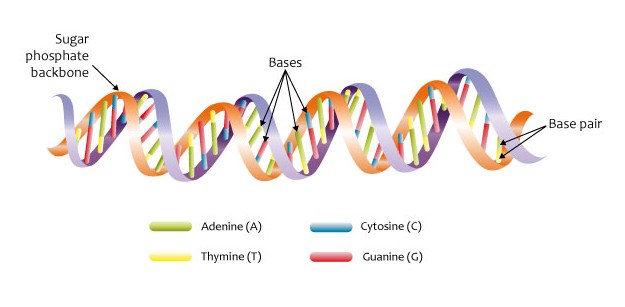
DNA is built from small units called nucleotides. Each nucleotide has three parts: a sugar molecule, a phosphate group, and one of four chemical bases. The four bases are adenine (A), thymine (T), cytosine (C), and guanine (G).
The sugar and phosphate parts link together to form long chains, and the bases stick out from the chain like tabs.
Two of these chains pair up to make the famous double helix. The structure looks like a twisted ladder. The sugar and phosphate parts form the two side rails, and the bases pair across the middle to form the rungs.
The pairing follows a strict rule: A always pairs with T, and C always pairs with G.
That rule is what makes DNA such a good storage system. If you know the sequence of bases on one strand, you automatically know the sequence on the other. Each strand is a backup copy of the same information, written in complementary form.
An important property of DNA is that it can copy itself. When a cell divides, the two strands separate, and each one serves as a template for building a new partner strand. The result is two identical DNA molecules, so each new cell gets a full copy of the instructions.
Most DNA lives in the cell nucleus, where it is called nuclear DNA. A small amount also lives in the mitochondria, the structures that produce energy for the cell. That mitochondrial DNA is passed down only from the mother.
How four letters store instructions
The information in DNA is stored as a code made up of the four bases. Human DNA holds about 3 billion bases, and more than 99 percent of those bases are the same in all people. The order, or sequence, of the bases is what carries the information.
The US National Library of Medicine's Genetics Home Reference describes it with a simple comparison: the order of bases determines the information available for building and maintaining an organism, similar to the way letters of the alphabet appear in a certain order to form words and sentences.
The code is read in groups of three bases, called codons. Each codon stands for one amino acid, or for a start or stop signal. Amino acids are the building blocks of proteins.
String the right amino acids together in the right order, and you get a working protein.
There are 64 possible three-letter codons, built from four bases. That is more than enough to cover the 20 amino acids the human body uses to build proteins, plus the start and stop signals that tell the cell where an instruction begins and ends.
A gene is a stretch of DNA that carries the instructions for making one product, usually a protein. Genes are the basic physical and functional units of heredity. The human genome, the complete set of DNA in a person, is estimated to contain about 25,000 genes, according to the US Department of Energy's Biological and Environmental Research program.
Here is the surprise: genes make up only about 2 percent of the human genome. The rest consists of noncoding regions. Some of those regions control when and where genes switch on.
Others help hold the chromosomes together. The old idea that noncoding DNA is junk has faded as researchers keep finding jobs for it.
How the code becomes a working body
DNA never leaves the nucleus to do its work directly. Instead, the cell copies a gene's instructions into a related molecule called RNA, in a step called transcription. The RNA copy then travels out of the nucleus to the cell's protein-building machinery, where it is translated into a protein.
Proteins do most of the work in the body. Some become structural parts, such as the collagen in skin and bone. Some become enzymes, which speed up the chemical reactions that keep cells alive.
Some become signals, such as hormones, that coordinate activity across the body. Although genes get a lot of attention, it is the proteins that perform most life functions and make up the majority of cellular structures.
The chain from DNA to protein explains how a code written in four letters can produce a human being. The DNA holds the recipe. Transcription copies the recipe.
Translation builds the dish. Change one letter in the recipe, and the protein can change too, which is how small genetic differences produce visible traits or, sometimes, disease.
How 3 billion letters fit in a cell
DNA faces a packing problem. A human cell is a few thousandths of a millimeter across, yet it holds about 2 meters of DNA if you stretch it out. The molecule has to be folded with extreme care.
The first level of folding wraps DNA around proteins called histones, like thread around a spool. This spool-and-thread structure coils further into a fiber called chromatin. The chromatin then folds and loops into dense packages called chromosomes.
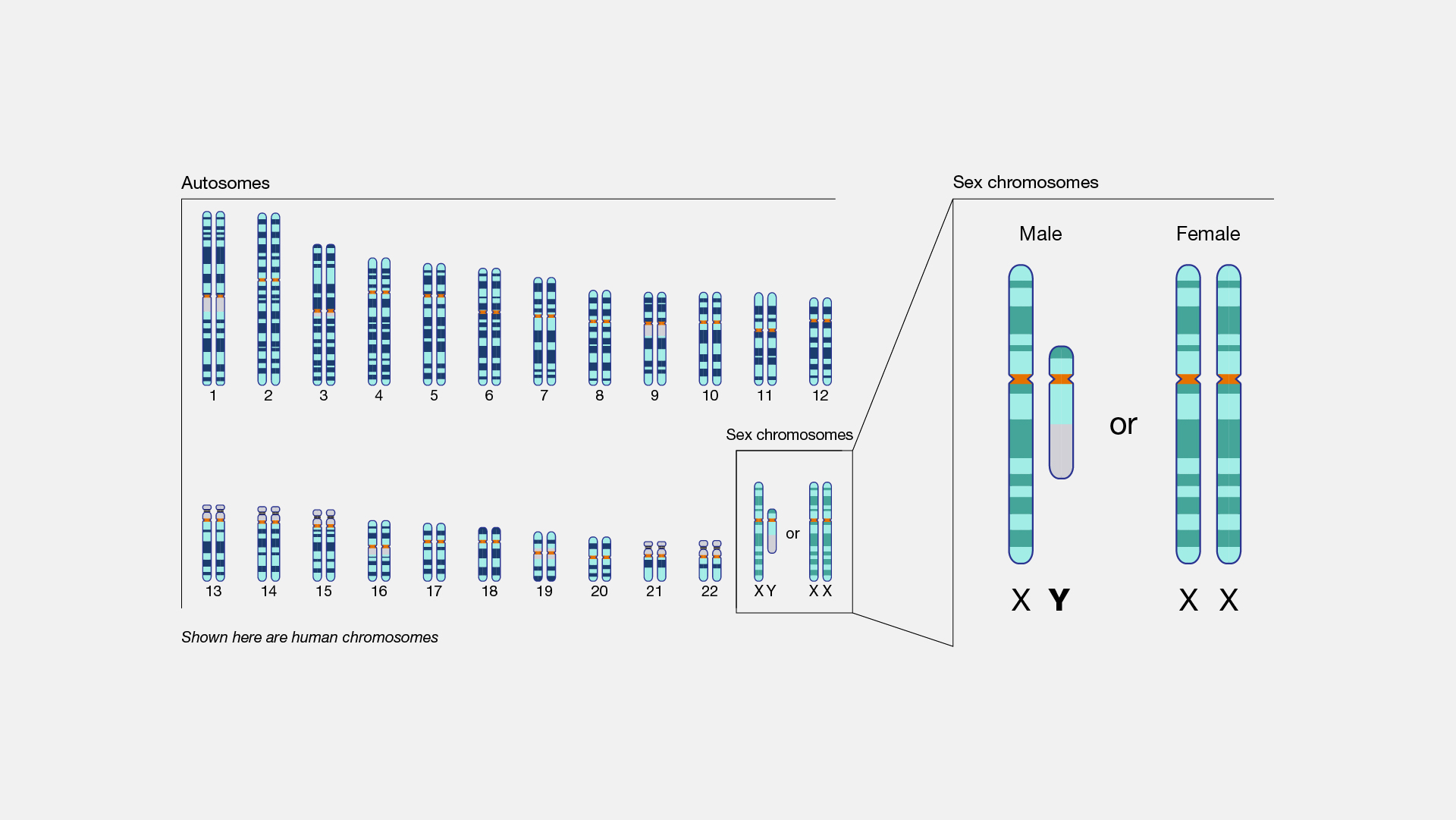
Human DNA is arranged into 46 chromosomes in most cells: 23 from each parent. The chromosomes range in length from about 50 million to 250 million base pairs. When a cell is not dividing, the chromosomes sit loosely in the nucleus.
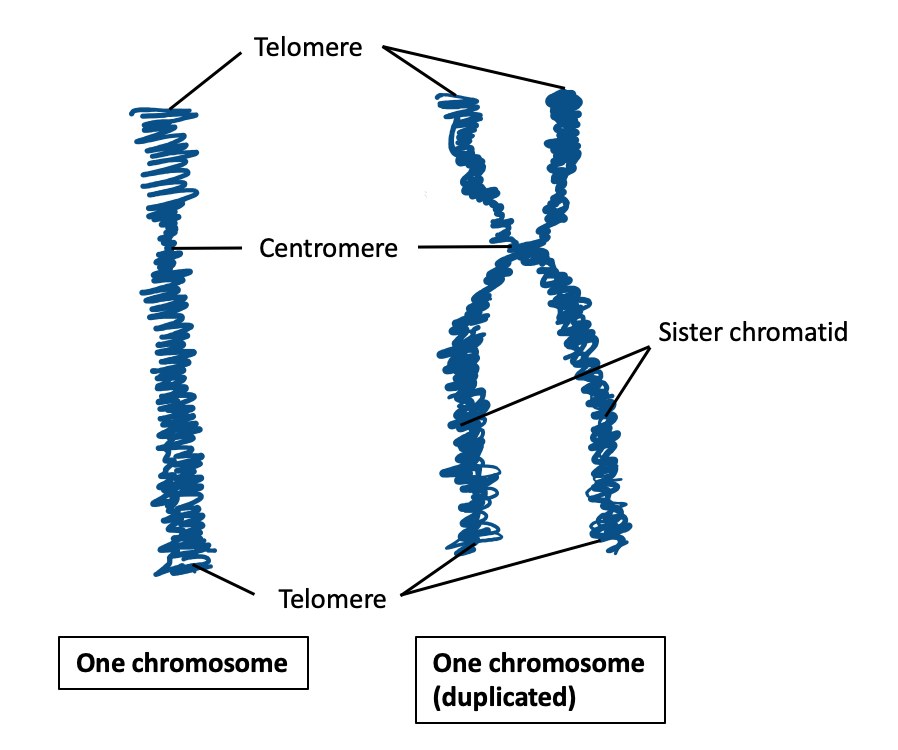
When the cell divides, they condense into the compact X-shaped structures seen in textbook pictures.
The 1953 discovery
The structure of DNA was worked out in 1953 by James Watson and Francis Crick, working at Cambridge University. Their paper, "Molecular Structure of Nucleic Acids: A Structure for Deoxyribose Nucleic Acid," appeared in the journal Nature on April 25, 1953. It was about 900 words long, and it changed biology.
Their model drew on several lines of evidence. Erwin Chargaff had shown in 1949 that the amount of adenine in DNA roughly equals the amount of thymine, and the amount of cytosine roughly equals the amount of guanine. X-ray diffraction patterns from Rosalind Franklin and Maurice Wilkins showed that DNA was a helix with great symmetry.
Watson and Crick built physical models with paper cutouts of the bases and metal scraps from a machine shop until the pieces fit.
The paper closed with one of the most famous understatements in science. "It has not escaped our notice," Watson and Crick wrote, "that the specific pairing we have postulated immediately suggests a possible copying mechanism for the genetic material." The pairing rule meant that each strand could serve as a template for a new partner, which is exactly how DNA copies itself.
Watson, Crick, and Wilkins received the Nobel Prize in Physiology or Medicine in 1962.
Why the code is not destiny
DNA shapes a great deal about a person, but it is not a fixed script. The same genome can produce different outcomes depending on the environment, the timing of gene activity, and plain chance.
Identical twins share nearly all of their DNA, yet they are not identical people. Their fingerprints differ. Their tastes, habits, and health histories diverge over a lifetime.
The genome sets the starting conditions, not the final result.
Some traits are strongly genetic. Eye color and blood type are close to fixed by DNA. Most traits are not.
Height, weight, mood, and disease risk all emerge from a mix of genes, environment, and behavior. Even for conditions with a genetic component, such as type 2 diabetes, lifestyle and environment play large roles.
The genome is best thought of as a recipe book written in a four-letter code. The book matters enormously, but the cook, the kitchen, and the ingredients matter too. DNA stores the instructions.
Life does the rest.
FAQ
How much DNA do humans share with each other?
More than 99 percent of the DNA bases are the same in all people. The remaining fraction, less than 1 percent of 3 billion bases, still adds up to millions of differences, which is why every person is genetically distinct.
Is DNA the same in every cell?
Nearly every cell carries the same full genome, with a few exceptions. Mature red blood cells lose their nuclei, and with them their DNA. Immune cells rearrange parts of their DNA as they develop.
Apart from those cases, a skin cell and a brain cell hold the same instruction book, but they read different chapters.
What is the difference between DNA and a gene?
DNA is the whole molecule and the whole archive. A gene is one instruction section within that archive. A single chromosome carries many genes, and the full set of DNA, genes plus noncoding regions, is called the genome.
The bottom line
DNA is a four-letter code that stores the instructions for building and running a body. Its double helix keeps two complementary copies of the code, which makes copying reliable. Genes carry the recipes for proteins, and proteins do most of the work.
The whole archive, about 3 billion base pairs, folds into 46 chromosomes inside nearly every cell.
Watson and Crick's 1953 paper revealed the structure in about 900 words. The decades since have filled in the details, and the picture that emerges is a code that is simple to describe and deep in its consequences. Four letters, read in groups of three, spell out every protein a human body can make.
Tags: DNA, genetics, biology, genome
Latest in Science
- Why Some Animals Glow in the Dark
- How Does Photosynthesis Work and Why Does All Life Depend on It?
- How Do Bees Make Honey, Step by Step?
- Why Does Water Expand When It Freezes?
Subscribe for one clear explainer a day, with sources you can check.
Related stories

Why diamond is hard and graphite is soft when both are carbon
Diamond and graphite are both pure carbon, yet diamond is 10 on the Mohs scale and graphite is 1 to 2. The difference is not the atoms;

Why Hot Water Can Freeze Faster Than Cold: The Mpemba Effect Explained
Hot water can freeze faster than cold under specific conditions. The Mpemba effect, named for a 1963 schoolboy experiment, still divides

How Magnets Work at the Atomic Level: Spins, Domains, and Iron
Magnetism comes from electrons: their spin and orbits make each atom a tiny magnet. In iron, quantum forces align these atomic magnets into