
Why Does Water Expand When It Freezes? The Full Answer
Key takeaways
- Water expands on freezing because hydrogen bonds lock molecules into an open lattice.
- Ice takes up about 9% more space than the same water, so it floats.
- Floating ice insulates lakes and keeps aquatic life alive in winter.

Water expands when it freezes because its molecules lock into an open crystal pattern. In liquid water, molecules slide past each other and pack close. In ice, hydrogen bonds hold each molecule apart from its neighbors in a hexagonal lattice, and that open structure takes up more space.
This article explains why water expands when it freezes, including the density peak at 4 degrees Celsius, the hydrogen-bond lattice, the 9 percent volume change, and what the expansion means for pipes, rocks, and lakes.
Most substances shrink when they freeze
Most substances behave in a familiar way. As they cool, their atoms and molecules slow down and move closer together. That packing raises density, so the solid takes up less space than the liquid it came from.
BCcampus states the rule plainly in its chemistry text for biology students: for most substances, the solid state is denser than the liquid state of the same substance. As atoms and molecules slow their movement at low temperature, they get closer together, which generally increases density.
Water breaks that rule. BCcampus calls water one exception. In liquid water, some molecules are bound together by hydrogen bonds, but some move freely.
As liquid water freezes and hydrogen bonds form between water molecules, those bonds form a geometrical pattern called a lattice. The fixed geometry of the lattice prevents water molecules from packing close together, so water expands upon freezing instead of shrinking.
That single exception shapes daily life. Ice cubes float in a glass. Lakes freeze from the top down.
Pipes burst in cold snaps. Each case traces back to the same open lattice.
Water is densest at 4 degrees Celsius
Water does not expand steadily as it cools. It first shrinks, like other liquids, until it reaches its maximum density at about 4 degrees Celsius (39.2 degrees Fahrenheit). Only below that point does it start to expand.
The United States Geological Survey (USGS) publishes the numbers. Water at 4.0 degrees Celsius has a density of 1.00000 grams per cubic centimeter. Water at 0 degrees Celsius, just before freezing, has a density of 0.99987 grams per cubic centimeter.
That small drop marks the start of the expansion.
The USGS explains the lake effect that follows. Since water at about 39 degrees Fahrenheit (4 degrees Celsius) is denser than water at 32 degrees Fahrenheit (0 degrees Celsius), the denser water sinks below the less dense water in lakes and other water bodies. If water were most dense at the freezing point, then in winter the very cold water at the surface of lakes would sink, and the lake could freeze from the bottom up.
That turnaround at 4 degrees is the key to the whole story. Cooling shrinks water down to 4 degrees, then cooling expands it from 4 degrees to 0 degrees and into ice.
Hydrogen bonds build an open lattice
The cause sits at the molecular level. A water molecule holds two hydrogen atoms bonded to one oxygen atom, at an angle that gives the molecule a lopsided charge. The oxygen end carries a slight negative charge, and the hydrogen ends carry slight positive charges.
Those opposite charges attract neighboring molecules. The attraction is called a hydrogen bond. It is weaker than the bonds inside a molecule, but it is strong enough to organize molecules when they slow down.
In liquid water, hydrogen bonds form and break constantly. Penn State's course notes that water molecules in the liquid state keep moving, with bonds forming and breaking in a disordered fashion. Molecules stay close, but they slide past each other, so the liquid packs fairly tight.
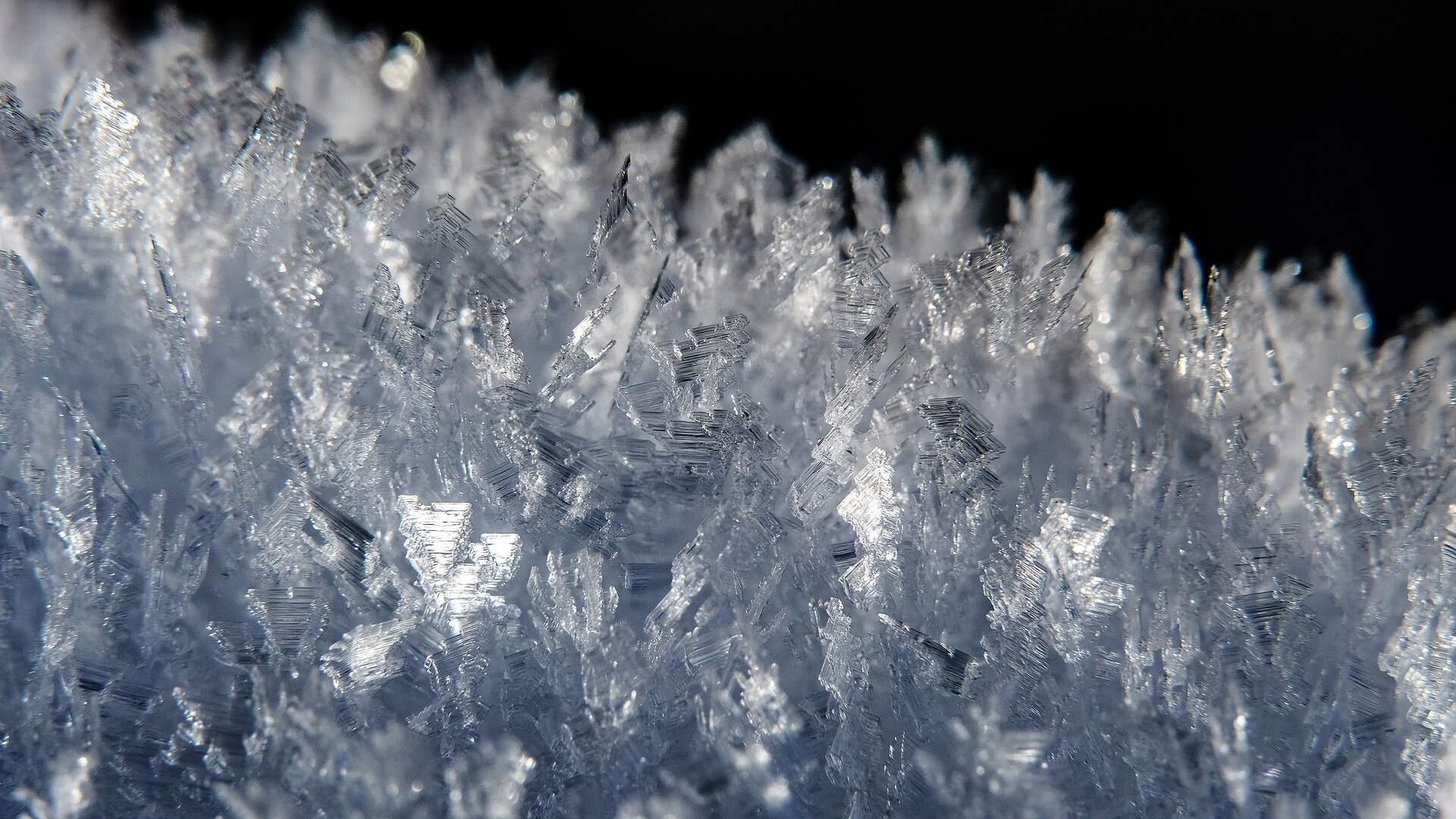
Freezing changes the balance. As water cools toward 0 degrees Celsius, molecular motion slows enough for stable hydrogen bonds to form. Each water molecule links to four neighbors through hydrogen bonds, and those links lock into a hexagonal lattice with wide gaps between molecules.
BCcampus describes the result: the fixed geometry of the lattice prevents water molecules from packing close together, so water expands upon freezing. The lattice holds molecules at arm's length, and the empty space inside the hexagons adds volume.
Ice takes up about 9 percent more space
The expansion is large enough to measure in a kitchen. When water freezes, its volume grows by about 9 percent, and its density drops by about the same share.
The USGS states the number directly: upon freezing, the density of ice decreases by about 9 percent. The density of ice is about 90 percent that of water, though the exact figure can vary because ice can contain air. That means about 10 percent of an ice cube or iceberg sits above the water line, while about 90 percent stays below.
Penn State's course gives the same figure from the volume side. It notes that ice volume is a little over 9 percent greater, or density about 9 percent lower, than in the liquid state. Ten cups of water put into a freezer turn into about eleven cups of ice.
Why ice floats, and why that matters
Ice floats because it is less dense than liquid water. A floating object displaces its own weight in water, and ice needs less water to balance its weight than the same mass of liquid water would occupy.
The USGS makes the point with icebergs. Almost all of an iceberg's volume sits below the water line, not above it, because ice is less dense than liquid water. In most substances, solids are more dense, so an ice-like solid would sink.
Water's exception keeps ice on top.
That floating layer matters for life. When a lake surface freezes, the ice sheet insulates the water below against colder air. BCcampus explains that the diverse marine life in polar oceans can survive cold seasons because ice floats on top and insulates deeper water against colder atmospheric air.

Burst pipes, cracked rocks, and potholes
The same force that saves lakes breaks pipes. Water trapped in a pipe has nowhere to expand when it freezes, so the ice presses outward with great force. Pipes split, joints fail, and the leak often shows only when the ice thaws.
Penn State's course names the culprit directly: the force of crystallization of ice is capable of bursting water pipes and causing expansions of cracks in rocks, thus accelerating the erosion of mountains. A small crack in a rock fills with water in autumn, freezes in winter, and widens a little. Over many winters, that cycle splits boulders and crumbles cliffs.
Homeowners can cut the risk with a few steps. Insulate pipes in cold spaces such as basements, crawl spaces, and exterior walls. Let a tap drip during a hard freeze, so water keeps moving and pressure has somewhere to go.
Drain outdoor hoses and shut off exterior taps before winter. Empty containers left outside, or leave them open, so expanding ice has room.
A common confusion: heavy ice
Some readers ask whether any ice sinks. The USGS answers with a special case called heavy ice. Heavy ice is 10.6 percent denser than normal water because it is made from heavy water, in which both hydrogen atoms are replaced with deuterium, an isotope of hydrogen containing one proton and one neutron.
Heavy-water ice will sink in normal water.
That case is a laboratory curiosity, not a kitchen result. Normal ice, made from ordinary water, always floats in ordinary water. The heavy-ice example confirms the rule rather than breaking it: density decides floating, and normal ice is less dense than liquid water.
How to see the expansion yourself
A safe kitchen test shows the expansion without any special equipment. Fill a small plastic bottle about nine-tenths full with water, mark the water level with a pen, and leave the cap off. Put the bottle in the freezer for a few hours.
When the water freezes, the ice will rise above the mark. The rise shows the extra volume the lattice needs.
A second test shows floating directly. Drop an ice cube into a glass of water and mark the water level. Let the cube melt completely, then check the level again.
The level stays nearly the same, because the floating ice already displaced its own weight. The result surprises many people, but it follows straight from the density numbers.
FAQ
Why does water expand when it freezes?
Water expands because hydrogen bonds lock its molecules into an open hexagonal lattice when it freezes. BCcampus explains that the fixed geometry of the lattice prevents water molecules from packing close together, so water expands upon freezing instead of shrinking like most substances.
How much does water expand when it freezes?
By about 9 percent. The USGS reports that upon freezing, the density of ice decreases by about 9 percent. Penn State's course gives the volume side: ice volume is a little over 9 percent greater than the liquid water it came from.
At what temperature is water densest?
At about 4 degrees Celsius (39.2 degrees Fahrenheit). The USGS lists water density at 1.00000 grams per cubic centimeter at 4.0 degrees Celsius, and 0.99987 at 0 degrees Celsius. Cooling shrinks water down to 4 degrees, then expands it below that point.
Why does ice float?
Ice floats because it is less dense than liquid water. The USGS notes that ice density is about 90 percent that of water, so about 10 percent of an ice cube or iceberg sits above the water line. A floating object displaces its own weight, and ice needs less water to balance its weight than the same mass of liquid water.
Can expanding ice really burst pipes?
Yes. Penn State's course states that the force of crystallization of ice can burst water pipes and widen cracks in rocks. Water trapped in a pipe has nowhere to expand, so the ice presses outward until the pipe splits.
Insulating pipes and letting a tap drip during a hard freeze cut the risk.
The bottom line
Water expands when it freezes because hydrogen bonds hold its molecules apart in an open lattice. The expansion adds about 9 percent to the volume, drops the density, and lets ice float. That floating ice insulates lakes, cracks rocks, and bursts pipes, all from the same chemistry.
The rule is simple to remember. Cooling shrinks water until 4 degrees Celsius, then cooling expands it. The open lattice of ice is the reason, and the floating ice on a winter lake is the proof.
Tags: water, ice, chemistry, science
Latest in Science
- What causes thunder, and why do you see lightning first?
- How do bees make honey, step by step?
- Why do clouds stay up in the sky if they are made of water?
- Why do some animals glow in the dark?
Subscribe for weekly science explainers from the Rive News research desk.
Related stories

Why diamond is hard and graphite is soft when both are carbon
Diamond and graphite are both pure carbon, yet diamond is 10 on the Mohs scale and graphite is 1 to 2. The difference is not the atoms;

Why Hot Water Can Freeze Faster Than Cold: The Mpemba Effect Explained
Hot water can freeze faster than cold under specific conditions. The Mpemba effect, named for a 1963 schoolboy experiment, still divides

How Magnets Work at the Atomic Level: Spins, Domains, and Iron
Magnetism comes from electrons: their spin and orbits make each atom a tiny magnet. In iron, quantum forces align these atomic magnets into