
Why Doesn't the Moon Crash Into the Earth Despite Gravity
Key takeaways
- The Moon is constantly falling toward Earth, but its sideways motion bends the fall into an endless orbit.
- Gravity acts as the centripetal force that curves the Moon's path, keeping it at an average distance of 384,400 km.
- Lunar laser ranging shows the Moon is actually drifting 3.8 cm farther away each year.
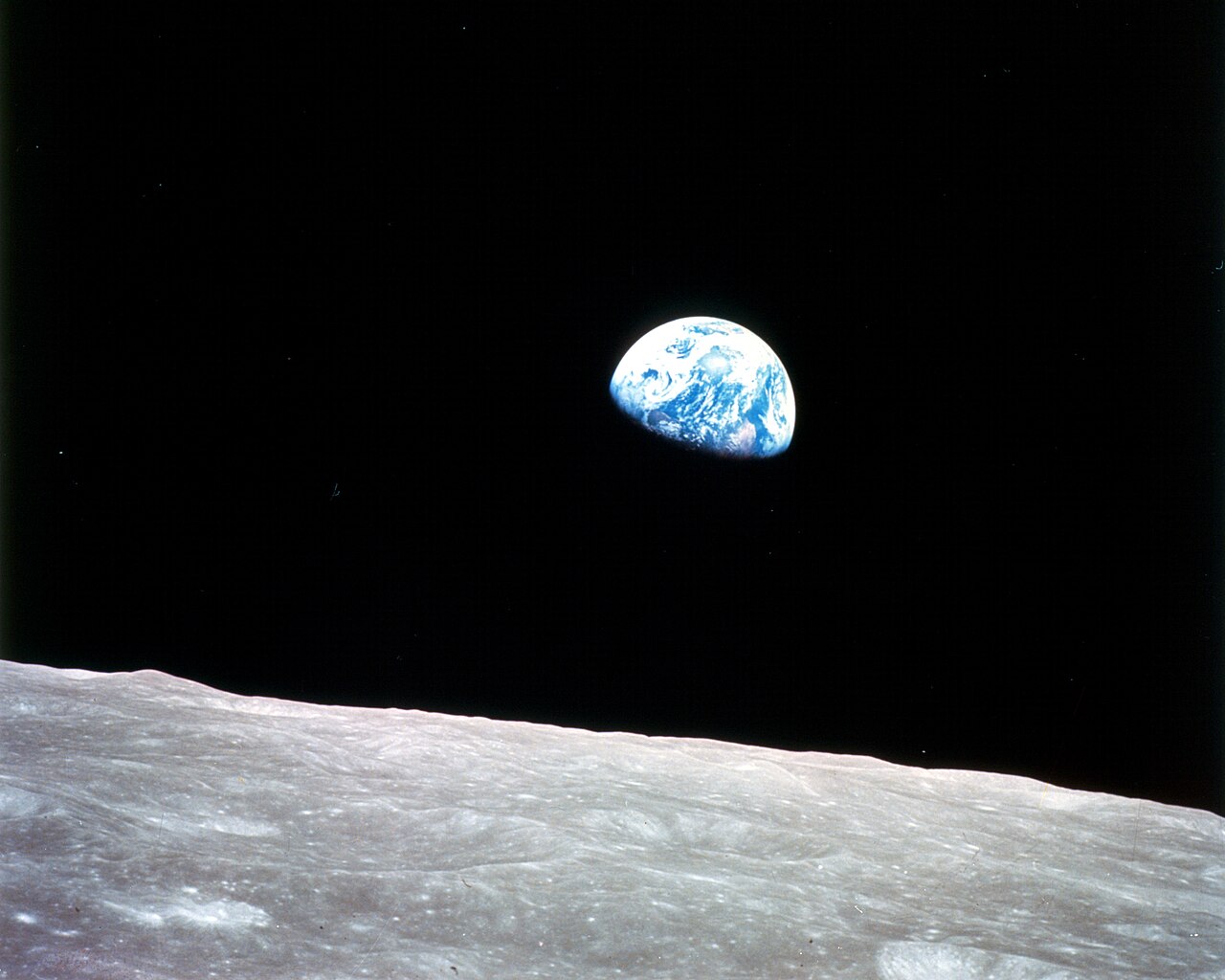
Earth rising over the Moon's horizon, photographed by Apollo 8 astronaut Bill Anders in December 1968. Photograph: NASA / Bill Anders
Image Credits: Wikimedia Commons / NASA
Earth's gravity pulls on the Moon every second of every day, and the Moon has obeyed that pull for about 4.5 billion years. So why hasn't it crashed into us?
The answer is one of the most elegant in physics: the Moon is falling toward Earth right now, and it always has been. It simply keeps missing, because it is moving sideways so fast that its fall curves around the planet instead of ending on it. That endless, curving fall is what an orbit is.
This article explains the mechanics that keep the Moon aloft, why the sideways motion never wears off, and what precise laser measurements reveal about where the Moon is actually heading: slowly away from us.
The Moon is falling, and it keeps missing Earth
To understand the Moon, forget the image of something hanging motionless in the sky. Nothing in space hangs.
The Moon moves around Earth at enormous speed, and Earth's gravity constantly tugs it inward. Without that inward tug, the Moon's inertia would carry it in a straight line off into space. Without the sideways motion, gravity would pull the Moon straight down to the surface in a catastrophic collision.
An orbit is what happens when both are present at once. Gravity bends the Moon's path inward while its forward speed carries it onward, and the combination is a closed curve.
As one explainer puts it, the Moon doesn't avoid crashing because it isn't falling. It avoids crashing because its direction of fall and its direction of travel never line up.
Each moment, the Moon falls toward Earth, and each moment, it has moved forward enough that the ground it was falling toward is no longer beneath it. The fall becomes a circle, or more precisely, a slightly elliptical orbit.
Physicists describe the same situation in the language of forces. In the Moon's reference frame, Earth's gravity acts as the centripetal force that continuously changes the Moon's direction, bending its path into a stable orbit.
Newton's law of gravitation gives the size of that force from Earth's mass, the Moon's mass, and the distance between them. For a circular orbit, the inward gravitational acceleration must equal v-squared over r, where v is the orbital speed and r is the distance.
The Moon's speed and distance satisfy that equation, so the orbit persists. There is no balancing outward force in an inertial frame; there is only gravity redirecting motion.
NASA lists the Moon's average distance as about 384,400 kilometers. At that distance, the gravitational pull is weak compared with what we feel at Earth's surface, but it is exactly the right size to keep the Moon's particular speed curving at exactly the right rate.
If the Moon moved slower, gravity would win and the orbit would shrink. If it moved faster, the Moon would fly off into space.
Why the sideways motion never runs out
A natural question follows: doesn't the Moon's forward motion get used up, the way a thrown ball slows down? In space, there is no air to slow the Moon.
A ball thrown on Earth arcs back to the ground because air resistance and friction steal its speed. The Moon flies through near-vacuum, so its sideways velocity has nothing to wear it down. The orbit is a stable arrangement that has persisted for 4.5 billion years precisely because there is almost no friction to disturb it.
The orbit is not perfectly fixed, though. Small effects from the Sun, the planets, and the shape of Earth and Moon change the details of lunar motion over time.
Tidal forces exchange energy between Earth's rotation and the Moon's orbit. But the orbit itself does not spiral inward.
In Newtonian mechanics, any bound orbit with negative total energy stays a closed curve. If the orbit is large enough that it doesn't hit Earth, it stays that way.
The twist: the Moon is actually moving away
Here is the surprise that precise measurement revealed. The Moon is not inching toward Earth at all.
It is drifting away, at about 3.8 centimeters, or 1.5 inches, per year. That figure comes from decades of lunar laser ranging: firing laser pulses from observatories on Earth at reflectors left on the lunar surface by the Apollo missions and timing the round trip.
The reflectors, the first of which Apollo 11 astronauts placed in the Sea of Tranquillity in 1969, let scientists measure the Earth-Moon distance to an accuracy of about 3 centimeters. Repeated measurements over decades show the average separation increasing by roughly 3.8 centimeters each year.
The cause is tidal friction. Earth's oceans bulge under the Moon's gravity, but because Earth rotates faster than the Moon orbits, the bulge gets dragged slightly ahead of the Moon.
That offset bulge pulls the Moon forward along its path, adding a touch of orbital energy, which slides the Moon into a wider track. The same exchange steals a sliver of Earth's spin: ancient eclipse records and laser ranging put the lengthening of the day at roughly 1.7 milliseconds per century.
At 3.8 centimeters per year, the drift is far too slow to matter on any human timescale. But it is real, measured, and it makes the premise of the question beautifully backwards.
The Moon doesn't crash into Earth for the same reason a satellite doesn't: it is falling around us, not into us. And the measured long-term trend points outward, not inward.
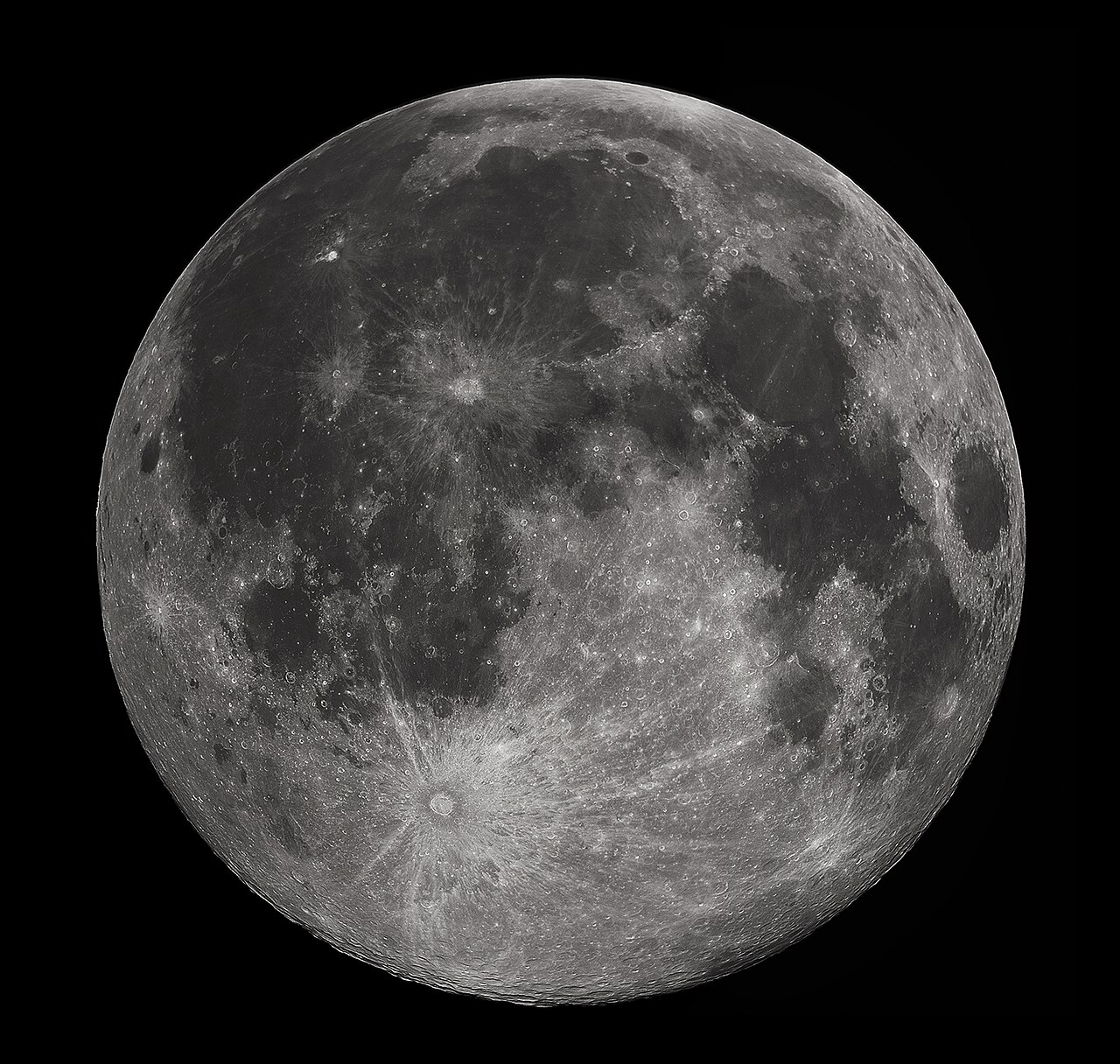
The full Moon photographed from Madison, Alabama, in October 2010. Photograph: Gregory H. Revera
Image Credits: Wikimedia Commons / Gregory H. Revera
FAQ
Would the Moon crash if it stopped moving sideways?
Yes. If the Moon's forward velocity dropped to zero, Earth's gravity would pull it straight in.
The orbit exists only because the sideways motion and the inward pull are in balance. Take away the speed, and the falling that gravity causes would end in a collision instead of a curve.
How fast does the Moon travel around Earth?
The Moon completes one orbit in about 27.3 days at an average distance of 384,400 kilometers. Its average orbital speed is about 1.02 kilometers per second, which combined with the inward pull of gravity traces out the stable orbit we see. Related reading: how planes stay in the air, another case of speed and forces finding balance.
Is the Moon's drift away from Earth constant?
The 3.8 centimeters per year figure is a present-day rate, not a fixed schedule. Over Earth's history, tidal conditions, ocean configurations, and rotation rates have all changed, so the recession rate was different in the past. Researchers study ancient rock and coral layers to reconstruct how the distance evolved over hundreds of millions of years.
What would happen if the Moon moved much farther away?
On timescales of billions of years, a more distant Moon would weaken its stabilizing effect on Earth's tilt, potentially leading to chaotic swings in the planet's axial tilt and more volatile climates. That is a far-future scenario, far beyond anything humans will experience.
Why don't satellites fall out of the sky the same way?
They would, and they do, without correction. Low satellites experience faint atmospheric drag that bleeds off speed, so their orbits decay and they eventually fall. The Moon has no meaningful atmosphere to drag against at its distance, so its orbit does not decay.
The bottom line
The Moon doesn't crash into Earth because it is not standing still. It is falling toward us continuously while racing sideways fast enough that its fall bends into an orbit, with gravity supplying the centripetal force that keeps curving its path.
The same gravity that could destroy it is what holds it up, and precise laser measurements from Apollo-era reflectors show the system is drifting slowly outward, not inward. An orbit is a fall that never lands.
Latest in Science
- Why the Earth has seasons that have nothing to do with distance from the Sun
- Why magnets attract some metals but ignore others
- Why shadows have blurry edges
- Why airport codes look nothing like their city names
Subscribe for weekly explainers on the science behind everyday mysteries.
Related stories
Why diamond is hard and graphite is soft when both are carbon
Diamond and graphite are both pure carbon, yet diamond is 10 on the Mohs scale and graphite is 1 to 2. The difference is not the atoms;

Why Hot Water Can Freeze Faster Than Cold: The Mpemba Effect Explained
Hot water can freeze faster than cold under specific conditions. The Mpemba effect, named for a 1963 schoolboy experiment, still divides
How Magnets Work at the Atomic Level: Spins, Domains, and Iron
Magnetism comes from electrons: their spin and orbits make each atom a tiny magnet. In iron, quantum forces align these atomic magnets into