
How fireflies make light without heat at all
By Rive News / Research desk | Rive News / Published October 27, 2026 at 9:00 AM PKT
Key takeaways
- Fireflies make light through bioluminescence, a chemical reaction in cells in the lower abdomen, not through burning or electricity.
- The reaction needs luciferin, the enzyme luciferase, oxygen, and ATP, and it releases energy as light.
- Oxygen supply acts as the switch, so the firefly can flash on and off in patterns other fireflies can read.
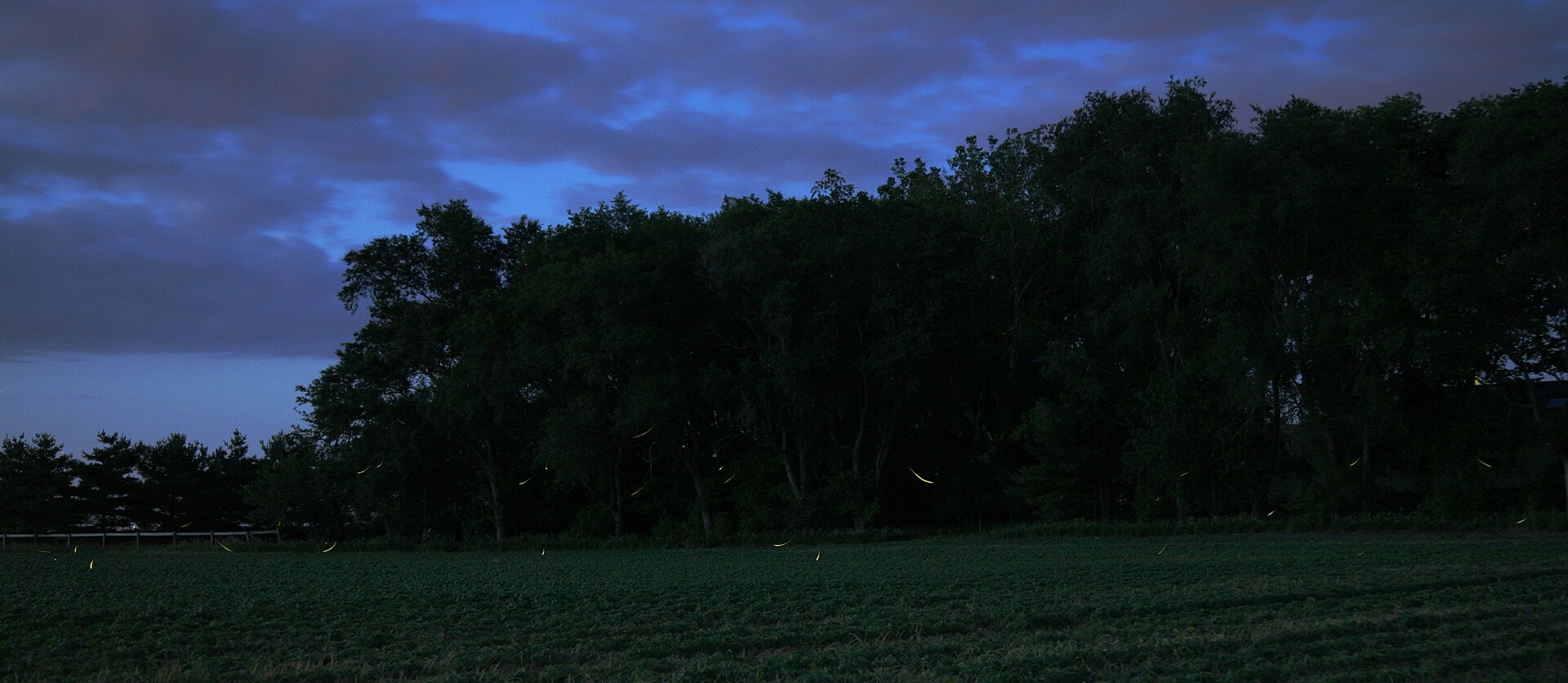
[Fireflies glowing in the dark.] Photograph: fireflies at night
Image Credits: Wikimedia Commons
Bioluminescence is light made by a living thing through a chemical reaction inside its body. In fireflies, that reaction happens in special light-producing cells in the lower abdomen, in an organ often called the lantern.
This article explains how fireflies make light without heat, including the chemicals involved, the oxygen switch that controls flashing, and why the glow stays cool.
What cold light means
Cold light does not mean the firefly is literally cold. It means the light-producing reaction gives off very little heat compared with a filament bulb, which wastes most of its energy as heat.
Marc A. Branham, an assistant professor of entomology and nematology at the University of Florida, explained the point to Scientific American, saying, "Unlike a lamp, which creates a good deal of heat, a firefly generates cold light."
That distinction matters for survival. If the light organ reached the temperature of a lit bulb, the insect would not survive the experience, as Branham also noted in the same explanation.
Popular accounts sometimes claim the reaction turns nearly all its energy into light. Laboratory work puts the light yield at roughly 40 percent of the reacting molecules for the firefly reaction, which is still far more efficient than an old filament bulb, but not perfect.
The four ingredients
The reaction needs four main ingredients working together. Luciferin is the light-making chemical, called the substrate, and luciferase is the enzyme that guides the reaction.
ATP, or adenosine triphosphate, supplies energy from the cell, and magnesium ions help the first step along. Oxygen is the final ingredient, and it is also the control that starts and stops the flash.
First, luciferin reacts with ATP to form an activated intermediate called luciferyl adenylate. Then oxygen joins the process under the guidance of luciferase, and the molecule becomes an excited form of oxyluciferin.
When that excited molecule returns to its stable state, it releases its extra energy as a photon, a particle of light. The light then shines through the abdomen, which is transparent enough in that region to let it out.

[Fireflies at a firefly park at night.] Photograph: fireflies at a park
Image Credits: Wikimedia Commons
Oxygen is the switch
A firefly does not carry a light switch on its back. It controls light by controlling oxygen, and that control is what makes flashing possible.
Insects do not have lungs. They move oxygen from outside the body to inner cells through a network of ever smaller tubes called tracheoles, which end near the light-producing cells.
When oxygen reaches the light organ, the reaction runs and light appears. When oxygen stops reaching it, the reaction runs out of fuel in a fraction of a second and the light goes dark.
Branham explained that the muscles controlling oxygen flow out of the tracheoles work relatively slowly, which once made fast flashing hard to explain. Later research found that nitric oxide plays a key role, because it frees oxygen held by mitochondria inside the cells.
The brain signals nitric oxide production, the mitochondria release oxygen, and the light organ can use that oxygen for the reaction. Because nitric oxide breaks down quickly, oxygen is soon bound up again and light production ends.
Why flashes have patterns
Flash patterns are signals, not random blinking. Different firefly species use different flash lengths, gaps, and flight paths, and those patterns help males and females of the same species find each other in the dark.
A male often flies and flashes a species pattern while a female, resting on vegetation, answers with a timed flash of her own. That exchange narrows the search in a field full of other glowing insects.
Some fireflies do not flash at all. Female glow-worms, for example, stay on the ground and glow steadily instead of blinking, waiting for a flying male to notice them.
Flashing also serves as a warning in some species. Fireflies taste bad to many predators, and a clear glow can advertise that fact, which helps explain why the signal stays bright and visible.
How firefly light differs from a bulb
A filament bulb makes light by heating a wire until it glows. Most of the electrical energy becomes heat, and only a small share becomes visible light, which is why a bulb feels hot to touch.
A firefly reaction is a form of chemiluminescence, meaning light comes from a chemical change rather than from heat. The energy moves directly into a photon instead of first heating a material.
That is why a child can watch a firefly in a jar without the insect burning itself, and why researchers study the reaction for efficient lighting and medical markers. The luciferase system is now used in laboratories as a way to track biological processes, because its light is easy to detect.
Other living things glow too, but they do not all use the same chemicals. Bacteria, fungi, and marine animals each use their own versions of luciferin, which suggests bioluminescence evolved independently more than once.
What fireflies do not do
Fireflies do not store light during the day and release it at night. The glow is made on demand, each time the reaction runs, and it stops when oxygen stops reaching the light organ.
Fireflies also do not glow by burning fuel in the way a candle does. There is no flame, no combustion, and no hot surface inside the abdomen.
Finally, not every glowing insect is a firefly. Click beetles glow from the thorax, glow-worms are close relatives with different habits, and many marine animals glow for reasons that have nothing to do with finding a mate on land.
The bottom line
Fireflies stay cool because their light is chemistry, not heat. Luciferin, luciferase, ATP, and oxygen react in the lantern cells, and the excited product releases a photon as it settles.
Oxygen control turns that chemistry into a signal. Open the oxygen path and the firefly flashes, close it and the dark returns, and the pattern in between is how one firefly talks to another.
Tags: fireflies, bioluminescence, insects
Rive News is a research desk that explains natural science from published research and expert explanations, without claiming first-hand laboratory work.
Related
- How Do Bees Make Honey Step by Step
- How Do Birds Navigate During Long Migrations?
- What Is Photosynthesis and Why All Life Depends on It
- Why Do Flocks of Birds Fly in V Formation?
Subscribe to Rive News for one plain-English explainer each day.
Rive News publishes research-based explainers; facts are attributed to named sources, and corrections are welcomed.
Related stories
Why diamond is hard and graphite is soft when both are carbon
Diamond and graphite are both pure carbon, yet diamond is 10 on the Mohs scale and graphite is 1 to 2. The difference is not the atoms;

Why Hot Water Can Freeze Faster Than Cold: The Mpemba Effect Explained
Hot water can freeze faster than cold under specific conditions. The Mpemba effect, named for a 1963 schoolboy experiment, still divides

How Magnets Work at the Atomic Level: Spins, Domains, and Iron
Magnetism comes from electrons: their spin and orbits make each atom a tiny magnet. In iron, quantum forces align these atomic magnets into