
How Do We Know the Earth Is Round Without Going to Space
Key takeaways
- A Greek librarian measured Earth's circumference in 240 BC using shadows, sticks, and geometry.
- Ships disappear hull-first over the horizon, and the Moon's eclipse shadow is always curved.
- A pendulum in Paris proved in 1851 that the ground beneath it is spinning.
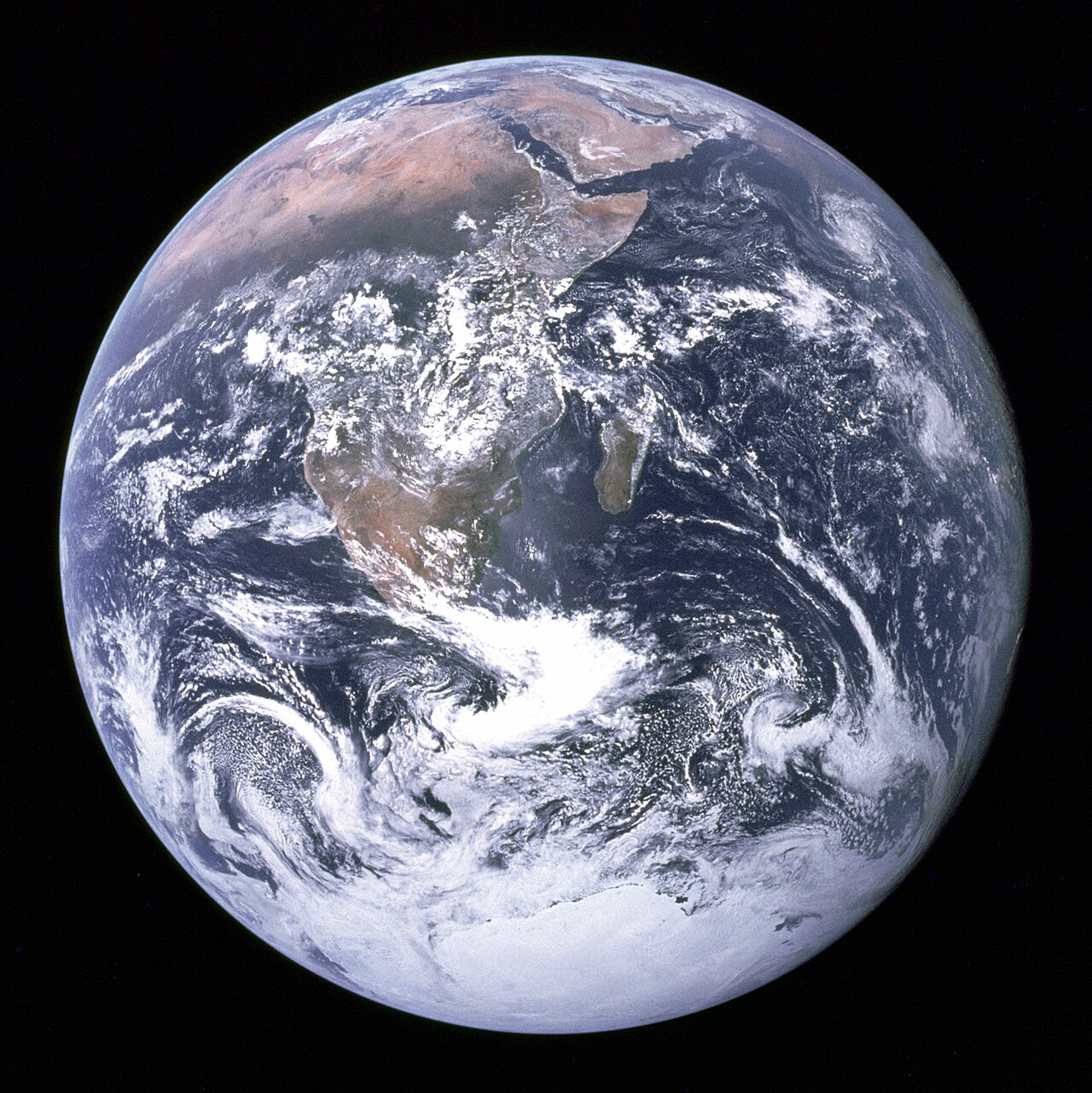
The Blue Marble, photographed December 7, 1972, by the Apollo 17 crew. Long before such photos existed, Earth's shape was already proven from the ground. Photograph: NASA
Image Credits: Wikimedia Commons / NASA
Nobody needed a rocket to prove the Earth is round. More than two thousand years before the first photograph of Earth from space, Greek scholars had already worked out that the planet is a sphere, and one of them measured its size with surprising accuracy using nothing more than shadows, a well, and a long walk. Since then, sailors, astronomers, and physicists have piled up independent proofs that anyone can check without leaving the ground.
This article walks through the four strongest ground-level proofs: the shadow experiment of Eratosthenes, the hull-first disappearance of ships, the curved shadow of lunar eclipses, and the pendulum that made Earth's rotation visible. Each one is a complete argument on its own.
Eratosthenes and the well that measured a planet
Around 240 BC, Eratosthenes, the chief librarian of the Great Library of Alexandria, noticed something curious in the scrolls he read. In Syene, a city in southern Egypt now called Aswan, the Sun shone straight down a deep well at noon on the summer solstice.
A person could look into the well and see the Sun's reflection at the bottom, with no shadow on the walls. The Sun was directly overhead.
But in Alexandria, several hundred kilometers to the north, the same Sun at the same moment cast shadows. Vertical poles still threw short shadows at noon on that day.
Eratosthenes saw the implication immediately: if the Earth were flat, the Sun's rays would strike both cities at the same angle, and both would see the same shadows. The difference could only mean the surface itself was curved.
His measurement method was elegantly simple. Assuming the Sun was so far away that its rays arrived essentially parallel, Eratosthenes measured the shadow angle in Alexandria and found the Sun sitting about 7.2 degrees from directly overhead, which is 1/50 of a full circle.
Geometry then says that the distance between Alexandria and Syene must be 1/50 of Earth's total circumference. He took that distance to be about 5,000 stadia, an ancient unit, multiplied by 50, and arrived at 250,000 stadia for the planet's circumference.
The exact length of a stadium is uncertain, but most conversions put his answer between 24,000 and 29,000 miles. The modern measurement of Earth's equatorial circumference is 24,901 miles.
Eratosthenes was off by somewhere between about 1 and 16 percent, an extraordinary achievement with sticks and shadows. Some historians place his error under 10 percent, and the ClassicHistory account notes his result was within roughly 100 miles by one common conversion. With one stick, a well he had only heard about, and a walking estimate of a distance, he had measured the world.
Ships that vanish hull-first
You can watch the next proof yourself from any shoreline. When a ship sails away from port, it does not simply shrink into the distance.
It disappears from the bottom up: the hull goes first, then the deck, and finally the mast and smokestack sink below the horizon. On a flat surface, the whole ship would stay visible, getting smaller until it faded. The hull-first disappearance happens because the ship is sailing over a curve, and the curved water blocks the lower part from view.
The reverse is equally telling. From shore, the masts of an approaching ship appear first, rising over the horizon before the hull.
Sailors in the ancient world noticed this, and it became one of the earliest everyday proofs of curvature. The effect works at every scale: stand on a beach and watch distant cargo ships, and the sequence is always the same.
The Moon always wears a curved shadow
Lunar eclipses offer a proof written across the sky. When the Earth passes between the Sun and the Moon, the planet's shadow falls across the lunar surface.
During every lunar eclipse, no matter where the Moon sits in the sky or what time it happens, that shadow's edge is always curved. The only shape that always casts a circular shadow, from every angle and at every time, is a sphere.
Aristotle pointed this out in the 4th century BC, centuries before Eratosthenes. A flat disc could cast a curved shadow sometimes, but not always.
Only a ball guarantees a round shadow in every eclipse. The stars tell a related story: travel north or south, and the constellations visible above the horizon change.
On a flat plane, the same stars would be visible from everywhere. On a sphere, the horizon cuts the sky differently at different latitudes, so new stars rise into view as you move.
The pendulum that showed the ground moving
The fourth proof came in 1851, and it is the most dramatic. French physicist Leon Foucault hung a 28-kilogram brass-coated lead bob from a 67-meter wire beneath the dome of the Pantheon in Paris.
A free-swinging pendulum keeps swinging in the same plane; nothing twists its direction. But hour after hour, visitors watched the pendulum's plane of swing rotate. It swept around at about 11.3 degrees per hour, completing a full rotation every 31.8 hours.
The pendulum was not turning. The floor was.
Foucault had found a way to see Earth's rotation from inside a room, without looking at the sky. The first public demonstration on February 3, 1851, at the Paris Observatory was followed by the famous Pantheon installation, and Foucault sent his invitation to scientists with the line: "You are invited to see the Earth turn. "
The latitude dependence clinches the spherical argument. The swing plane's rotation rate is proportional to the sine of the latitude: it completes a full circle in about a day at the poles and does not rotate at all at the equator.
Physicists have shown that Foucault's pendulum experiments performed around the world don't just prove rotation; the pattern of rates across latitudes only makes sense on a sphere. A flat, spinning disc would not produce the observed latitude gradient.
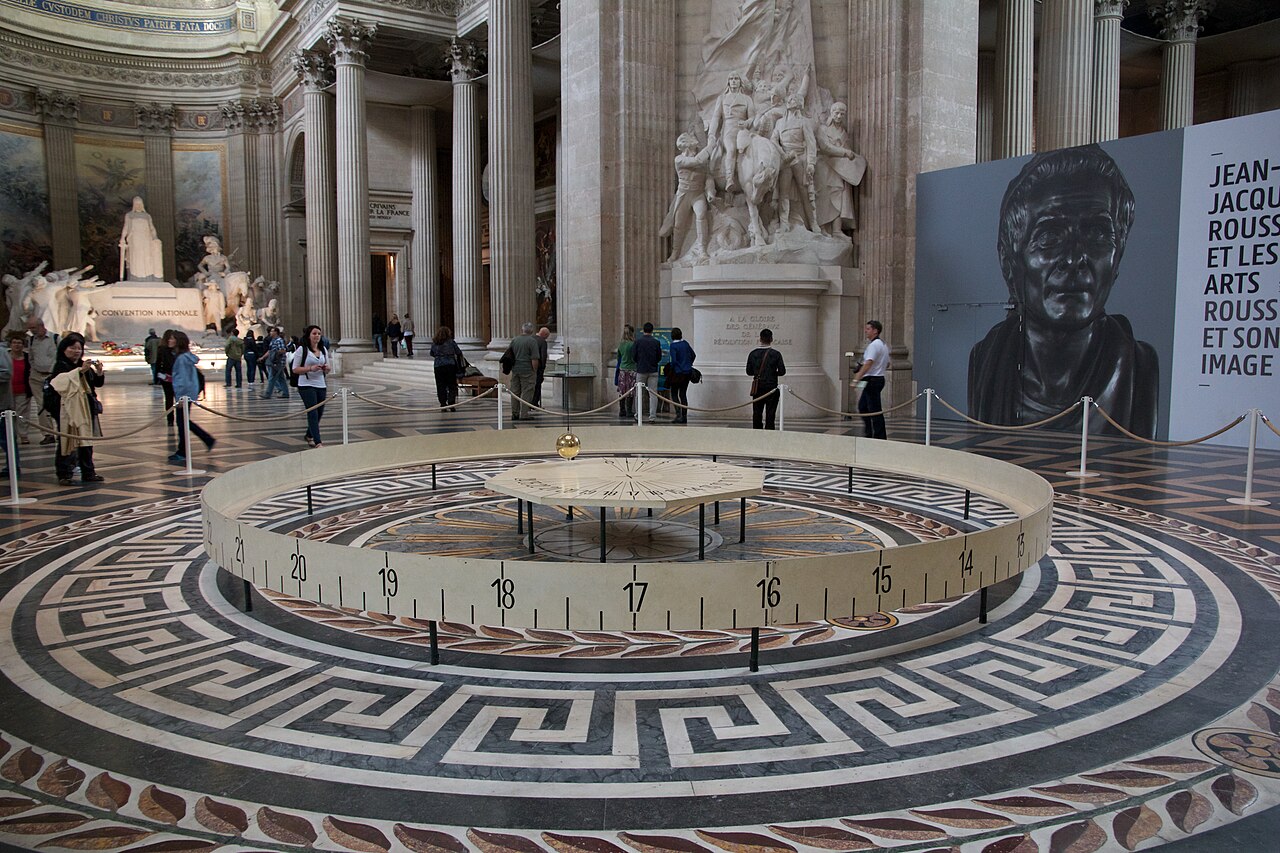
Foucault's pendulum at the Pantheon in Paris, the 1851 experiment that made Earth's rotation visible. Photograph: Marko Kudjerski
Image Credits: Wikimedia Commons / Marko Kudjerski
Why these proofs still matter
Each of these arguments stands alone, and together they are airtight. Eratosthenes gave a number.
Sailors gave an observation anyone can repeat. Eclipses gave a shadow that never lies.
Foucault gave a moving demonstration of rotation on a sphere. None of them required leaving the ground, trusting an authority, or taking anyone's word.
Modern life adds more: time zones exist because the spherical Earth rotates different regions into sunlight at different times, and GPS satellites work only because their orbital math assumes a round planet. Related reading: why the Earth has seasons that have nothing to do with distance from the Sun and how planes stay in the air.
FAQ
Who first proved the Earth was round?
Greek philosophers including Pythagoras and Aristotle argued for a spherical Earth in the 6th to 4th centuries BC, citing the curved eclipse shadow and changing constellations. Eratosthenes then measured its size around 240 BC. The idea predates spaceflight by more than two millennia.
How accurate was Eratosthenes really?
Depending on which ancient stadium he used, his circumference of 250,000 stadia converts to between about 24,000 and 29,000 miles. The true equatorial circumference is 24,901 miles, so his error was roughly 1 to 16 percent, most likely under 10 percent.
Can I repeat Eratosthenes' experiment myself?
Yes. Measure the Sun's shadow angle at local noon on the same day in two places at different latitudes, find the north-south distance between them, and apply the same 360-degree proportion. Schools around the world do exactly this every year.
What did the Foucault pendulum prove?
It proved Earth's rotation directly, in a laboratory, without astronomical observations. The swing plane of a free pendulum stays fixed while the Earth rotates beneath it, so the plane appears to turn. The rate of turning depends on latitude, which also demonstrates the spherical geometry of the planet.
If Earth is round, why does the horizon look flat?
Because the planet is enormous relative to a human observer. At 24,901 miles in circumference, the curvature over a few miles of visible horizon is far too gentle for the eye to detect. Ships disappearing hull-first are the visible proof that the curve is there.
The bottom line
The Earth was proven round long before anyone could photograph it. Eratosthenes measured it with shadows, sailors watched hulls sink below the horizon, astronomers read the curved shadow in every lunar eclipse, and Foucault's pendulum made the planet's spin visible from a Parisian floor. Four independent arguments, four different centuries, one conclusion: the ground beneath us is the surface of a sphere.
Latest in Science
- Why the Earth has seasons that have nothing to do with distance from the Sun
- Why shadows have blurry edges
- How planes stay in the air
- Why your ears pop on planes, and how to stop it
Subscribe for weekly explainers on the science behind everyday mysteries.
Related stories
Why diamond is hard and graphite is soft when both are carbon
Diamond and graphite are both pure carbon, yet diamond is 10 on the Mohs scale and graphite is 1 to 2. The difference is not the atoms;

Why Hot Water Can Freeze Faster Than Cold: The Mpemba Effect Explained
Hot water can freeze faster than cold under specific conditions. The Mpemba effect, named for a 1963 schoolboy experiment, still divides
How Magnets Work at the Atomic Level: Spins, Domains, and Iron
Magnetism comes from electrons: their spin and orbits make each atom a tiny magnet. In iron, quantum forces align these atomic magnets into