
How scientists measure the temperature of the sun
By Rive News / Research desk | Rive News / Published October 27, 2026 at 9:00 AM PKT
Key takeaways
- Nobody puts a thermometer in the sun; its temperature is calculated from light measured far away.
- The surface, or photosphere, comes out at about 5,772 kelvin, roughly 5,500 degrees Celsius.
- Three measurements do the work: how bright the sun is, how big it is, and which colours its light peaks in.
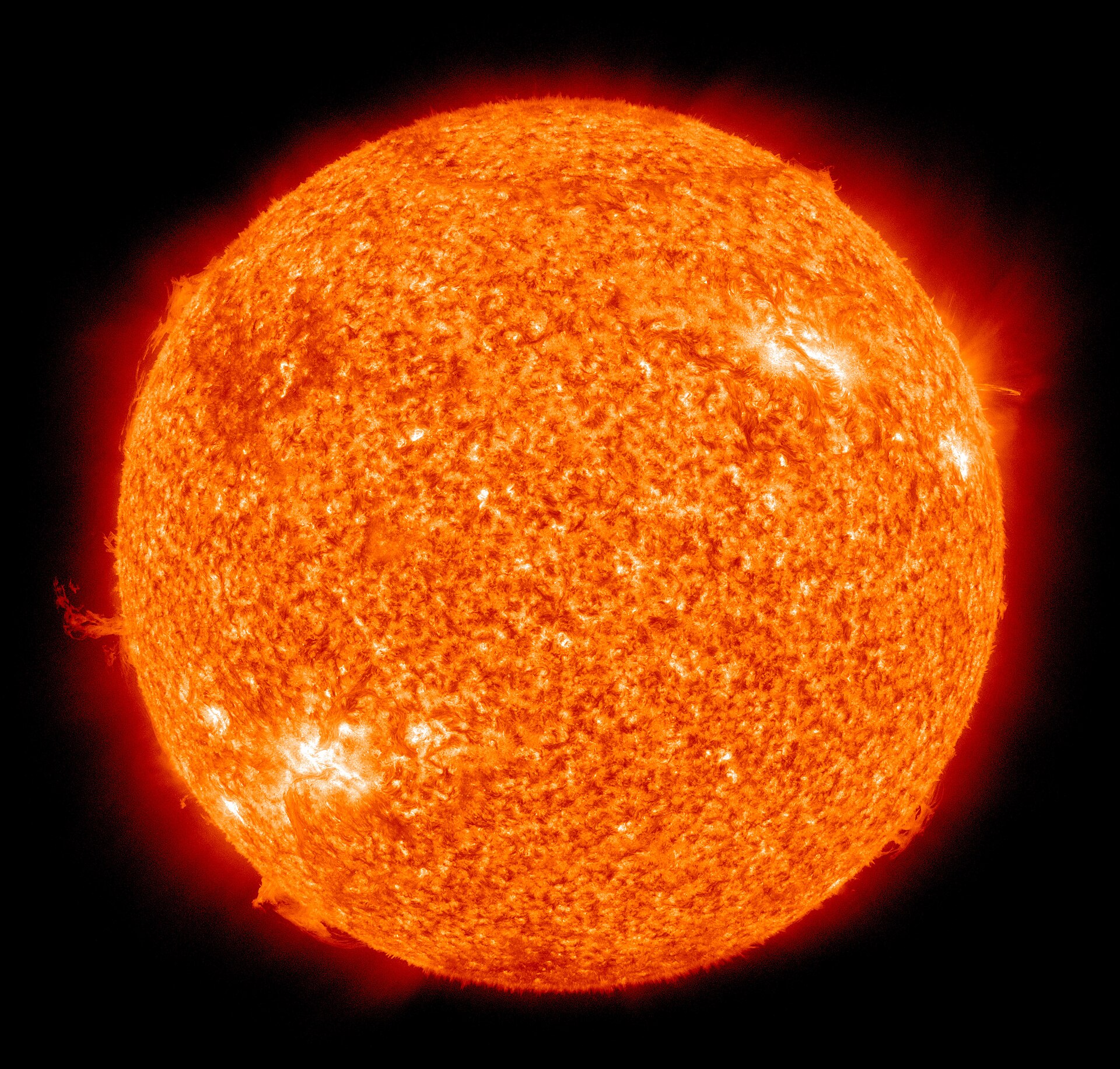
[The sun in extreme ultraviolet light, as seen by NASA's Solar Dynamics Observatory.] Photograph: NASA Solar Dynamics Observatory
Image Credits: Wikimedia Commons
Scientists measure the temperature of the sun by reading its light, not by touching it. Every method used comes back to the same idea: hot objects glow in a pattern that depends on their temperature, and the sun's glow can be measured precisely from Earth and from space. The result is a surface temperature of about 5,772 kelvin, which is roughly 5,500 degrees Celsius.
This article explains how scientists measure the temperature of the sun, including the brightness calculation, the colour method, and the way deeper layers are modelled. It also covers why the core is far hotter than the surface, and why the outer atmosphere breaks the simple pattern.
No thermometer can survive the trip
The obvious method fails immediately, since no material survives anywhere near the sun's surface, let alone its core. Spacecraft that study the sun, such as NASA's Parker Solar Probe, fly through the outer atmosphere but stay millions of kilometres from the visible surface. They measure particles and magnetic fields, not surface temperature with a probe.
The workaround is remote sensing: measuring light and working backwards. Light carries information about the object that emitted it, including how hot that object is. Astronomers have spent more than a century turning that information into temperatures, and the sun is the best-tested case because it is close and bright.
The key point is that "the temperature of the sun" is not one number. The visible surface is about 5,772 kelvin, the core is about 15 million kelvin, and the outer corona reaches millions of kelvin despite being thin and faint. Each layer needs its own method, and each answer comes with its own uncertainty.
Method one: brightness plus size
The main method for the surface uses the Stefan-Boltzmann law, a physics rule linking how much energy a hot object radiates to its temperature. The law says that the energy radiated per square metre rises with the fourth power of the temperature in kelvin. Double the temperature, and the radiated energy goes up sixteen times.
To use it, scientists need two measurements. The first is the sun's total power output, called luminosity, which is about 3.828 x 10^26 watts. That figure comes from the solar constant, the power falling on one square metre at Earth's distance, which is about 1,361 watts per square metre, scaled up over a sphere with Earth's orbit as its radius.
The second measurement is the sun's size. The sun's radius is about 696,000 kilometres, giving a surface area of about 6.09 x 10^18 square metres. Dividing luminosity by that area gives the energy leaving each square metre of the surface, and the Stefan-Boltzmann law then turns that figure into a temperature of about 5,772 kelvin.
Harvard University's astronomy lab teaches the same calculation as a student experiment, comparing the sun's brightness with a lamp of known power. The lab notes that the sun's distance, one astronomical unit or about 1.5 x 10^8 kilometres, is what lets a local brightness measurement scale up to total output. The method works because the inverse-square law, which describes how light dims with distance, is well tested.
Method two: the colour of sunlight
A second, independent method uses the colour of sunlight. Hot objects emit light across a range of wavelengths, and the wavelength where the light is brightest shifts toward blue as temperature rises. This rule is called Wien's displacement law, and it links peak wavelength to temperature with a single constant.
Sunlight peaks in the visible range, near green-yellow wavelengths of about 500 nanometres. Applying Wien's law to that peak gives a temperature close to the Stefan-Boltzmann result, which is a useful cross-check. If the two methods disagreed sharply, scientists would know that one of the assumptions, such as treating the sun as a near-perfect radiator, was wrong.
The spectrum also contains dark absorption lines, which are fingerprints of elements in the sun's atmosphere. Those lines confirm the composition, mostly hydrogen and helium, and their shapes carry extra temperature information. Spectroscopy, the study of those lines, is the tool that turned the sun from a bright disc into a measurable physical object.
Why the core is measured differently
The core cannot be measured by either surface method, since its light takes thousands of years to escape and is reprocessed many times on the way out. Instead, scientists model the core using physics: the sun's mass, about 330,000 times Earth's mass, squeezes hydrogen so hard that nuclei fuse into helium. That fusion only runs at the required rate if the core is about 15 million kelvin.
Neutrinos provide a check on that model. Fusion in the core releases neutrinos, ghostly particles that escape the sun almost immediately and reach Earth in about eight minutes.
Detectors on Earth count those neutrinos, and the numbers match the fusion rates predicted by the core-temperature model. The agreement between a particle count and a temperature model is one of the stronger tests in solar physics.
The corona, the sun's outer atmosphere, is a puzzle rather than a confirmation. It reaches temperatures above one million kelvin, far hotter than the surface below it, even though it is much thinner. Magnetic heating is the leading explanation, but the details are still an active research question, and it shows that "hotter higher up" is not a mistake in the measurements.
What can go wrong
Both surface methods assume the sun radiates roughly like an ideal black body, an object that absorbs and emits perfectly. The sun is close to that ideal but not exact, so the calculated temperature is called an effective temperature, not a reading from a single spot. Sunspots, which are cooler patches, and bright granules, which are hotter, mean the real surface varies around the average.
Earth's atmosphere adds error too, since it absorbs some wavelengths and scatters others. Space-based measurements avoid most of that problem, which is why modern solar-constant figures come from satellites. Ground-based student versions of the experiment accept larger errors and still land in the right range, which is a sign the method is robust rather than fragile.
The photosphere itself is only about 500 kilometres thick, a thin skin on a star 1.39 million kilometres across. Its temperature also varies with depth, from about 6,400 kelvin at the bottom to about 4,400 kelvin at the top. The 5,772 kelvin figure is therefore an average that reproduces the total light output, not a claim that every point on the surface sits at one temperature.
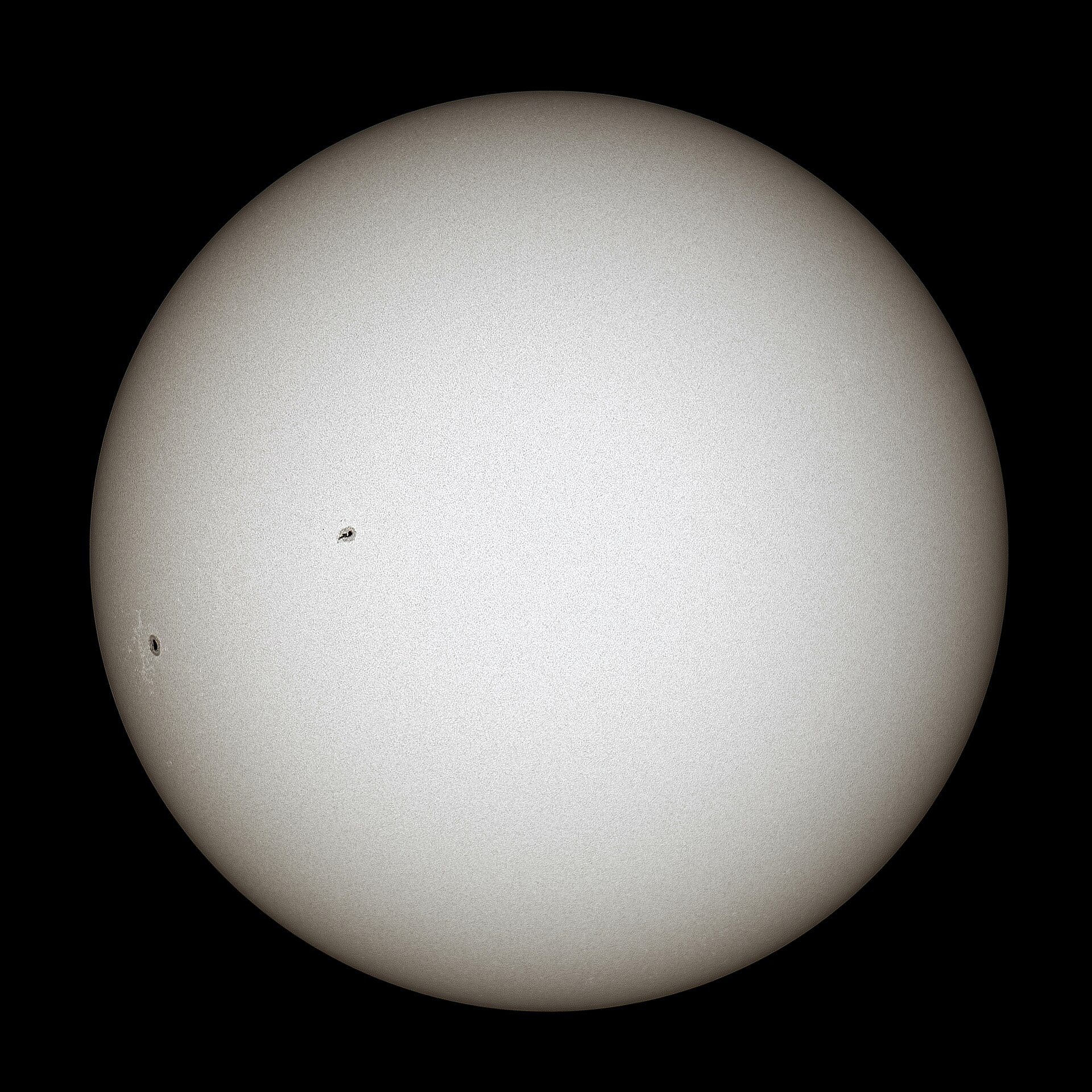
[The sun in white light, with dark sunspots visible on its surface.] Photograph: NASA
Image Credits: Wikimedia Commons
Frequently asked questions
Why is the sun's temperature given in kelvin?
Kelvin is the scale used in physics because it starts at absolute zero, the point where molecular motion stops. The Stefan-Boltzmann law needs absolute temperature, so a Celsius figure would give the wrong answer if plugged in directly. Subtracting 273 converts kelvin to Celsius, which is how 5,772 kelvin becomes about 5,500 degrees Celsius.
How do we know the core temperature if we cannot see the core?
The core temperature comes from a model of fusion under the sun's own gravity, checked against neutrino counts measured on Earth. Fusion at lower temperatures would produce too few neutrinos and too little energy to match the sun's observed brightness. The model and the measurements agree, which is why the figure is trusted despite being indirect.
Is the sun white or yellow?
The sun's light is close to white, since it emits across the visible spectrum with a peak near green-yellow. It looks yellow or orange from Earth because the atmosphere scatters blue light away, especially near the horizon. Astronauts above the atmosphere see a whiter sun.
Why is the corona hotter than the surface?
The corona is heated by magnetic energy, not by direct heat rising from the surface, though the full mechanism is still debated. Its low density means it holds little total heat despite its high temperature, so it glows faintly. This is why the corona only becomes visible during a total eclipse, when the bright surface is blocked.
The bottom line
The sun's surface temperature is not guessed or measured with a probe, but calculated from light in two independent ways that agree. Brightness plus size gives about 5,772 kelvin through the Stefan-Boltzmann law, and the peak colour of sunlight points to the same range through Wien's law. Deeper layers rely on models checked by neutrinos, and the corona's extreme heat remains a live research question rather than a settled fact.
Tags: sun, astronomy, physics
The Rive News research desk writes plain-language explainers from published sources, with no invented experts or first-hand claims.
Related
- Why does the Earth have seasons if distance is not the cause?
- Why is the sky blue but space black?
- How do scientists measure the age of the universe?
- What causes the northern lights to appear?
Subscribe for one plain-language explainer a day, drawn from published sources.
Rive News publishes explainers from public sources; corrections are noted on the article when a sourced fact changes.
Related stories

Why diamond is hard and graphite is soft when both are carbon
Diamond and graphite are both pure carbon, yet diamond is 10 on the Mohs scale and graphite is 1 to 2. The difference is not the atoms;

Why Hot Water Can Freeze Faster Than Cold: The Mpemba Effect Explained
Hot water can freeze faster than cold under specific conditions. The Mpemba effect, named for a 1963 schoolboy experiment, still divides

How Magnets Work at the Atomic Level: Spins, Domains, and Iron
Magnetism comes from electrons: their spin and orbits make each atom a tiny magnet. In iron, quantum forces align these atomic magnets into