
Why the sea looks blue from above but clear in a glass
By Rive News / Research desk | Rive News / Published October 28, 2026 at 9:00 AM PKT
Key takeaways
- The sea looks blue mainly because water absorbs red light and leaves blue light to reach your eyes.
- A glass looks clear because the light path through it is far too short for that absorption to show.
- Sky reflection adds a little color at low viewing angles, but it is not the main cause of the blue.
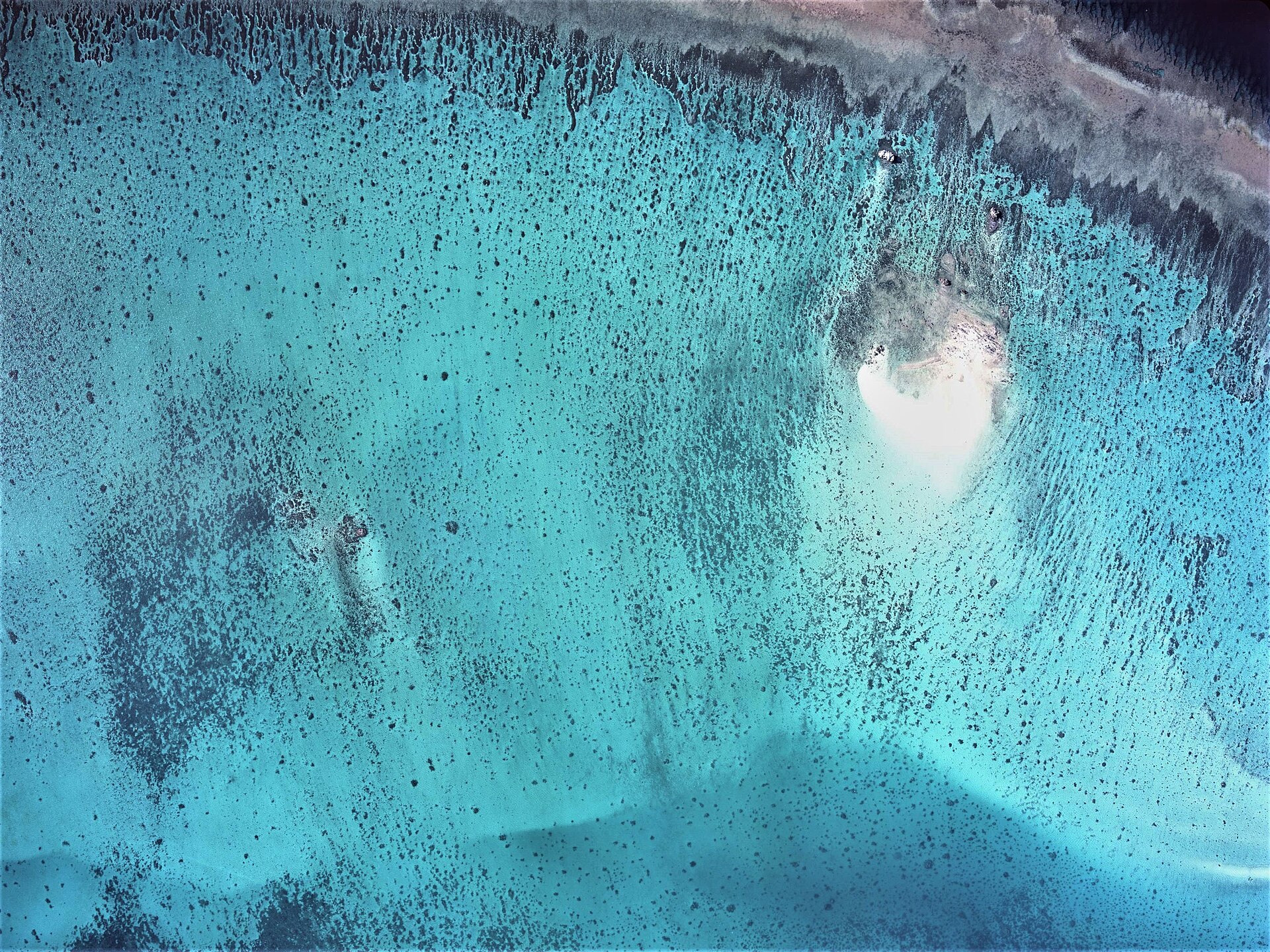
[Aerial view of deep blue sea water with wave patterns.] Photograph: the open sea from above
Image Credits: Wikimedia Commons
The sea is not dyed blue, and a glass of seawater does not carry a hidden blue tint waiting to be noticed. Water itself has a faint intrinsic blue color, as physicist Christopher S Baird of West Texas A&M University explains, citing a Journal of Chemical Education paper by Charles L Braun and Sergei N Smirnov. The effect is simply too weak to see in a small volume.
This article explains the glass test, what sunlight does in deep water, why the sky is not the main answer, why some seas look green or brown, and what changes the shade.
Why the glass stays clear
Pour water into a glass and hold it up to the light, and it looks clear because the light crosses only a few centimeters of water before it reaches your eye. Absorption is a cumulative effect, so a short path removes almost nothing from the light. Baird notes that sensitive laboratory equipment can detect water's faint blue color even in a cupful, but the human eye cannot.
The glass is not failing to show something obvious. It is showing exactly how weak the effect is at that scale.
Think of it like a very pale filter stacked in layers. One layer changes almost nothing you can see. Stack the layers until they are meters deep, and the change becomes unmistakable.
The sea is that stack. The glass is a single layer, and one layer is not enough for your eyes to register.
What sunlight does in deep water
Sunlight contains the full spread of visible colors, from red at the long-wavelength end to blue and violet at the short end. When that light enters the sea, water molecules absorb the longer wavelengths first, starting with red, orange, and yellow. The US National Oceanic and Atmospheric Administration (NOAA) describes the ocean as acting like a sunlight filter for exactly this reason.
Blue light is absorbed least, so it survives the journey and scatters back toward the surface, where your eyes pick it up.
Depth makes the filter stronger. NOAA reports that hardly any light penetrates deeper than 656 feet (200 meters), and no light penetrates deeper than 3,280 feet (1,000 meters). Red light vanishes first, within the upper meters, which is why underwater photographs taken without artificial light look so blue.
The deeper the light travels, the more thoroughly the red end of the spectrum is stripped away, leaving blue dominant.
Scattering plays a supporting role alongside absorption. The Library of Congress explains that blue wavelengths travel to greater depths while red wavelengths are absorbed quickly, and water molecules scatter blue wavelengths by absorbing and rapidly re-emitting the light in different directions. That scattered blue light is what returns to an observer looking down at the sea.
Absorption decides which colors survive, and scattering helps deliver the survivors back to your eyes.
Why the sky is not the main answer
The popular explanation says the sea is blue because it mirrors the blue sky, but measurements do not support that as the main story. If reflection were the whole answer, the sea would turn grey under a grey sky, yet Baird points out that the ocean stays blue even when the sky is grey. A mirror explanation also fails for a glass of water, which sits under the same sky and still looks clear.
The water itself must be doing most of the work.
Reflection does contribute in specific conditions. Baird notes that when the surface is calm and you look at it from a low angle, some of the blue you see is reflected sky. That is why the sea can look grey on a cloudy day when viewed almost horizontally, or orange at sunset when the sky itself is orange.
From above, though, you look through the surface into the water column, and the filter effect dominates what you see.
Why some seas look green or brown
Not every sea is the same blue, and the exceptions prove the rule rather than breaking it. NOAA notes that the ocean may take on green, red, or other hues as light bounces off floating sediments and particles in the water. In coastal shallows, sand and sediment stirred up from the bottom can turn the water milky or brown.
Rivers add their own load of particles, which is why water near a river mouth often looks murkier than water far offshore.
Living things shift the color too. The Library of Congress explains that abundant plant life can make parts of the ocean look green, because yellow pigments from plants mix with blue light to produce green. Shallow tropical water often looks turquoise for a related reason: light reflects off a pale sandy bottom through clear water, mixing the blue of the water with the brightness of the sand below.
None of these cases mean the water changed its nature. They mean something was added to the water, and that addition changed which wavelengths came back.
What changes the shade
Four things decide the exact shade you see on any given day. The first is depth, since deeper water gives the filter more material to work with and produces a darker blue. The second is clarity, since particles scatter light in all directions and can wash the blue out toward white or brown.
The third is what lives in the water, since algae and other organisms add their own pigments to the mix. The fourth is your viewing angle, since a low angle catches more reflected sky and a steep angle looks deeper into the water column.
Time of day matters through the same logic. At noon, sunlight enters the water steeply and travels a shorter path to a given depth, which keeps colors cleaner. Near sunset, light slants across the surface and reflects more, so the sea borrows more of the sky's color.
Season and weather matter too, because storms stir sediment and plankton blooms peak at certain times of year. The blue is never one fixed paint color. It is the result of light, water, and whatever else is floating in it, meeting your eye.

[A clear glass of water beside a laptop, looking colorless in a small volume.] Photograph: a glass of clear water
Image Credits: Wikimedia Commons
Why does water in a swimming pool look blue?
A pool looks blue for a mix of reasons, and the water itself is only part of the story. Many pools have blue tiles or liners, and those surfaces reflect blue light back through the water. The water also contributes its own faint blue through the same absorption effect as the sea, but a pool is shallow, so that contribution is small.
If you filled the same pool with a white liner, the water would look far paler.
Is the sea blue on a cloudy day?
Yes, the open sea usually keeps a blue cast even under cloud, because the filter effect does not depend on a blue sky. What changes is the brightness and the surface sheen, which can look grey when the surface reflects a grey sky at a low angle. Looking down from above on a cloudy day, you still see the blue that the water column returns.
The sky changes the lighting, not the underlying physics.
Why does the sea look turquoise near the beach?
Turquoise appears where clear, shallow water sits over pale sand. Blue light from the water mixes with bright light reflected off the sand, and the combination reads as turquoise to the eye. The water is clearer there, so less sediment interferes, and the bottom is close enough to contribute.
Move offshore into deeper water and the sand drops out of the picture, leaving the deeper blue behind.
Can water ever look red?
Open ocean water essentially never looks red from absorption alone, because red light is what water removes first. Reddish water usually means something else is present, such as sediment, a particular plankton bloom, or reflected sunset light on the surface. NOAA notes that floating particles can give the ocean red or other hues.
Those colors come from what is in or on the water, not from the water molecule itself.
The bottom line
The sea looks blue from above because a deep column of water strips red light out of sunlight and returns the blue that survives. A glass looks clear because a few centimeters of water cannot strip enough light for your eyes to notice. Next time you stand on a shore, remember that you are not looking at a blue surface.
You are looking into a filter many meters deep, and the blue is what that filter lets through.
Tags: ocean color, light, physics, seawater
Rive News's research desk writes plain-language explainers from public sources, with every key claim tied to a named document or institution.
Related
- Why the ocean is salty but lakes are not
- How clouds stay up in the sky if they are made of water
- Why transparent glass lets light through but metal stops it
- Why do we see lightning before we hear thunder
Subscribe for one plain-language science explainer in your inbox each morning.
Rive News publishes explainers from public sources; corrections are welcomed and noted on the article.
Related stories

Why diamond is hard and graphite is soft when both are carbon
Diamond and graphite are both pure carbon, yet diamond is 10 on the Mohs scale and graphite is 1 to 2. The difference is not the atoms;

Why Hot Water Can Freeze Faster Than Cold: The Mpemba Effect Explained
Hot water can freeze faster than cold under specific conditions. The Mpemba effect, named for a 1963 schoolboy experiment, still divides

How Magnets Work at the Atomic Level: Spins, Domains, and Iron
Magnetism comes from electrons: their spin and orbits make each atom a tiny magnet. In iron, quantum forces align these atomic magnets into