
Why Do Football Players Wear Eye Black? The Evidence
Key takeaways
- A 2003 Yale study found traditional eye black grease measurably improved contrast sensitivity in bright sunlight.
- Peel-and-stick strips showed only marginal benefit, and petroleum jelly showed none in the same tests.
- Eye black does not protect against UV rays or improve night vision, despite persistent myths.
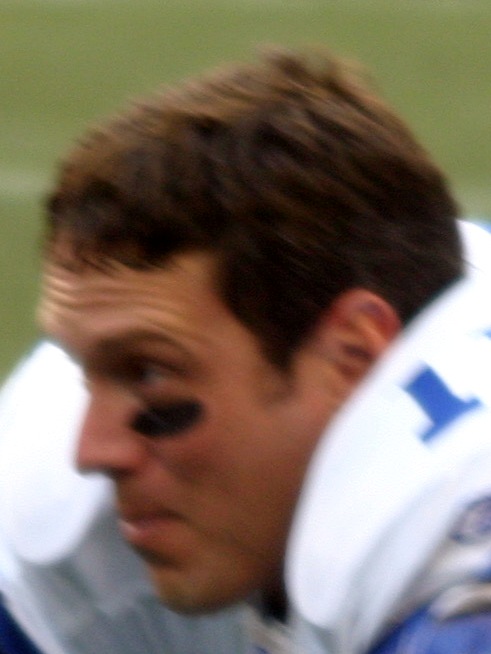
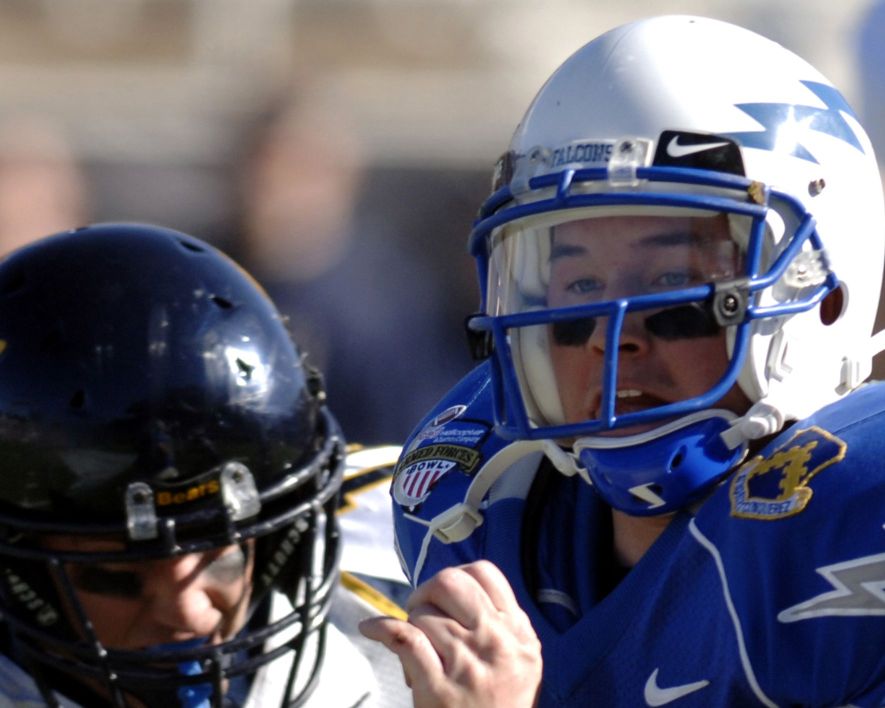
Image Credits: Wikimedia Commons / Chad Riley (CC BY-SA 2.0), Mike Kaplan, Chris Hunkeler (CC BY-SA 2.0)
Those dark streaks under a football player's eyes look like war paint, and plenty of fans assume that is all they are. But the smears have a claimed job: cutting glare so athletes can track a fast-moving ball against a bright sky. Players have sworn by the effect for decades, skeptics have called it superstition, and at least one research team decided to settle the question with eye charts and sunlight.
This article explains what eye black is supposed to do, walks through the 2003 Yale study that tested it, compares grease against stickers, busts the persistent myths, and traces the smear from baseball's burnt cork to modern custom strips.
What eye black is supposed to do
The claim is rooted in simple optics. Human cheekbones naturally catch and reflect bright overhead light.
When direct sunlight or stadium floodlights bounce off oily skin, they create what vision scientists call veiling glare, a wash of stray light that lowers the eye's contrast sensitivity. Contrast sensitivity is the ability to tell objects apart from their background, and it is exactly what a receiver needs to pick a spiraling football out of a bright sky.
Traditional eye black grease is a matte mixture of beeswax, paraffin, and carbon pigment, as described by the South Florida Reporter. A dark matte surface absorbs surrounding light rays instead of reflecting them upward into the eyes.
By dampening that stray light, the theory goes, receivers and defensive backs can track flying balls more reliably. It is the same principle behind the blackened inside of a telescope tube.
Athletes also report psychological effects. Some players say the look makes them feel tougher or more intimidating at the line of scrimmage, a confidence edge on top of any optical one. Others use the strips as a canvas, writing short messages or awareness slogans, though leagues regulate what can appear.
The Yale study that tested it
In 2003, ophthalmologist Dr. Brian DeBroff and Patricia Pahk at Yale University put the practice to a controlled test, as reported by Huff Sports. They tested participants with standard contrast eye charts under bright natural sunlight, comparing three groups: traditional eye black grease, anti-glare stickers, and petroleum jelly as a control.
The results surprised many skeptics. Traditional eye black grease produced a statistically significant improvement in contrast sensitivity under direct sun. The anti-glare stickers showed only marginal improvement.
Petroleum jelly, the control, showed none at all. The finding suggested that the matte grease genuinely changes the light environment around the eyes, while stickers, which sit on the skin rather than blending into it, do less.
The popular television show MythBusters later explored the same claim. Its hosts concluded that grease noticeably sharpens an athlete's ability to differentiate light and dark, while the strip versions did not measure up, according to the South Florida Reporter.
Sports medicine summaries of later experiments report generally supportive results in bright conditions, with measured contrast sensitivity improvements in the single-digit to low double-digit percent range across studies. The effect shrinks or vanishes in overcast or indoor light, which makes sense: less glare means less glare to cut.
Grease versus stickers: not the same product
Modern players choose between two main forms, and the Yale results say the choice matters. Grease-based sticks use carbon-based compounds in a petroleum or wax base.
They are messy to apply and can smudge or run with heavy sweating, but the matte, skin-hugging finish is what delivered the measurable benefit in testing. Over three-quarters of NCAA players still prefer grease for optimal performance, according to SportsSurge.
Adhesive strips are pre-cut decals placed under each eye. They are cleaner, look consistent on television, and allow customization with messages, team logos, or causes.
The tradeoff is optical: the Yale team found stickers only marginally effective, and MythBusters found no measurable vision improvement from them. For a player choosing strips, the honest version is that the benefit is mostly cosmetic and psychological, which is still a benefit, just not the one the grease delivers.
League rules allow both forms. The NFL permits short personal messages on strips, while the NCAA has banned political, religious, and commercial content on eye black since 2015. Both leagues require the markings to stay non-reflective.
Myths worth retiring
Several claims about eye black refuse to die. The big ones:
It blocks UV rays. False. Eye black reduces glare but offers no sun protection for the skin. Players still need sunscreen for long outdoor games.
It improves night vision. False, or at least beside the point. The benefit appears in bright light. Under low light there is little stray glare to absorb, so the grease adds nothing measurable.
It is purely cosmetic. Overstated. Style and intimidation are real factors for some players, but the Yale data shows the grease has a genuine optical effect in sunlight. Calling it pure fashion ignores the evidence. Separate from glare, if you notice drifting spots in your own vision, here is what eye floaters actually are.
It makes players more aggressive. No scientific basis. Any edge here comes from confidence and ritual, which matter in sports but do not change hormones.
All types work the same. False. Grease outperforms stickers in every controlled comparison reported so far.

Does eye black actually work?
Yes, with a qualifier. Traditional grease improved contrast sensitivity in bright sunlight in a controlled Yale study. Strips show only marginal benefit.
Is eye black only used in football?
No. Baseball players started the tradition, and lacrosse, softball, and outdoor track athletes also use it wherever bright sun meets visual tracking.
Can eye black protect against UV rays?
No. It cuts glare but does not block ultraviolet radiation. Sunscreen is still required.
Why do players write messages on eye black?
Personal expression and awareness campaigns, within league rules. The NFL allows short slogans; the NCAA restricts content.
Where did eye black come from?
Early 20th-century baseball players like Babe Ruth used burnt cork. NFL adoption grew through the 1970s and 1980s, and adhesive strips arrived in the 2000s.
The bottom line
Eye black survives because, in its original greasy form, it does something real. The Yale study showed that matte black grease under the eyes improves contrast sensitivity in bright sun, while stickers barely register and plain jelly does nothing.
That makes the tradition a small, honest piece of sports technology rather than pure superstition, with the usual human extras layered on top: ritual, intimidation, and self-expression. The evidence also draws a clean line for players deciding what to smear on before kickoff.
If the goal is seeing the ball better in daylight, reach for the grease. If the goal is looking sharp and carrying a message, the strips will do that job just fine.
The broader lesson crosses sports: the gear that works is the gear matched to the conditions, whether that means grease in bright sun or reading a river's current before you swim or kayak. Just do not expect any of it to substitute for sunscreen or sunglasses, because the honest answer beats the myth every time.
Latest in Sports & Outdoors
- How to read a river current before swimming or kayaking
- Progressive overload in simple terms
- What eye floaters really are
Subscribe to the Rive News newsletter for one curious explainer every morning.
Related stories

Why Is Altitude Sickness Worse for Some People?
Altitude sickness hits some people harder because of genetics, ascent speed, and prior history, not fitness level. Here is what raises risk

Why Do You Get Blisters When Hiking and How to Prevent Them
Friction plus moisture plus heat equals a blister. Learn why hiking breeds all three, and the boots, socks, and tape system that keeps
How to choose hiking boots for beginners: fit, features, and break-in
Beginners should buy for fit first: snug everywhere, tight nowhere, with a thumb's width at the toes. Here is how to size, test,