
Why Golf Balls Have Dimples: The Science of Longer Drives
Key takeaways
- Dimples cut a golf ball's aerodynamic drag roughly in half by shrinking the low-pressure wake behind it, nearly doubling flight distance.
- Each dimple trips the thin layer of air around the ball into turbulence, which clings to the surface longer before peeling away.
- Most balls carry 300 to 500 dimples, and the USGA sets no rules on their count, shape, or pattern.
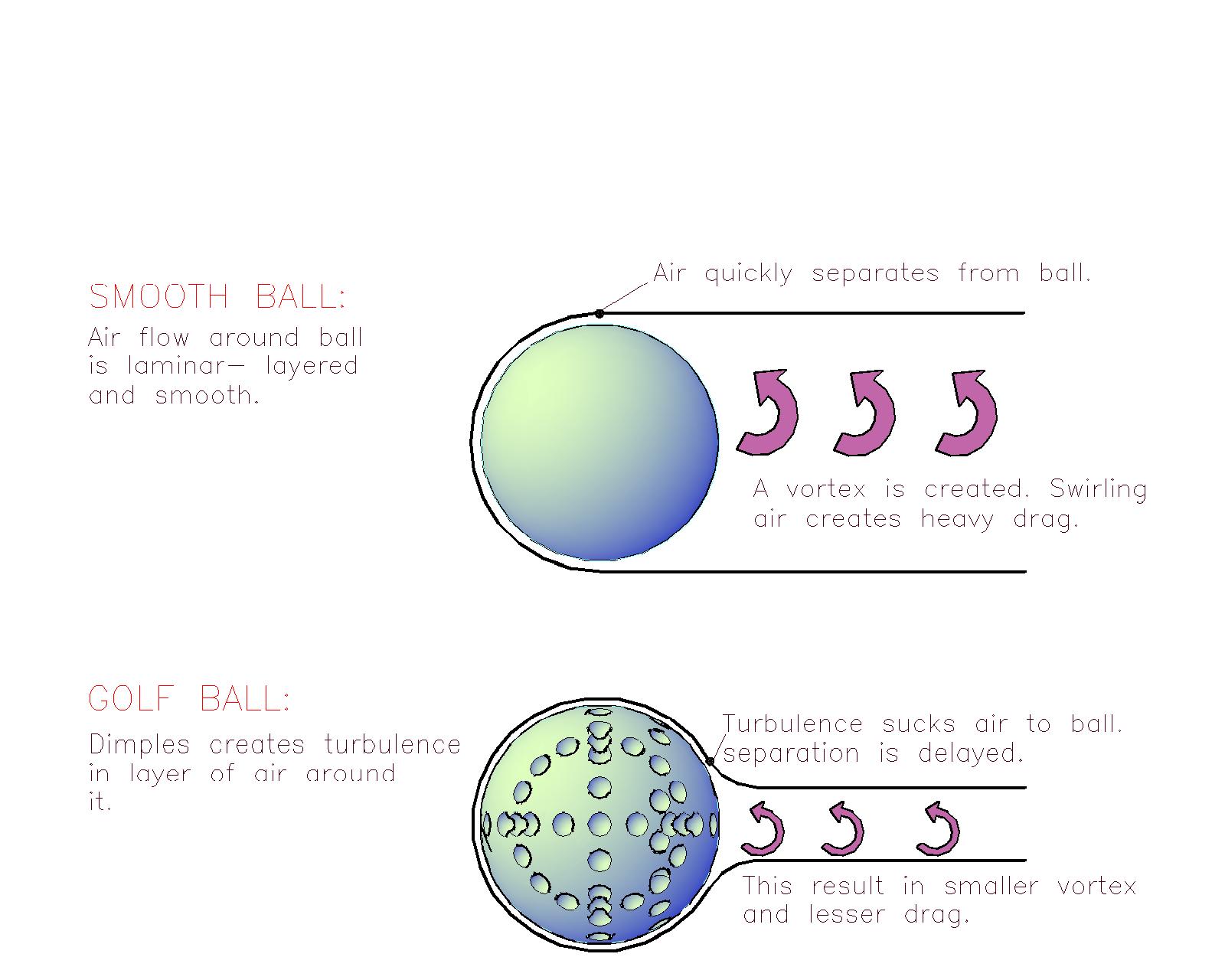
Air separates early from a smooth ball and leaves a large, draggy wake, while dimples delay separation and shrink the wake. Diagram: Prakul Varshney via Wikimedia Commons.
Golf balls carry hundreds of small dents pressed into their covers, and the dents are no decoration. Each dimple reshapes how air flows around the ball in flight, cutting resistance and adding lift so the ball travels far beyond what a smooth sphere could manage.
Those little craters turned golf into a game of distance, not just direction. This article explains how the dimple was discovered, how it cuts drag, how it shares the credit for lift, and what manufacturers vary to fine-tune flight.
The discovery: scuffed balls flew farther
In the early days of golf in Scotland, players noticed something odd: their old, beat-up balls sailed farther than brand-new smooth ones.
"In the early days of golf in Scotland, golfers discovered that their old golf balls went farther than the new, smooth ones," said Mark Maughmer, a professor of aerospace engineering at Penn State, in a Phys.org interview. The nicks and scratches were reacting differently to the air.
Ball makers took the hint. They began hammering deliberate marks into the surface of gutta-percha balls, the dried gum resin that had replaced feather-stuffed leather balls by the mid-1800s.
Then in 1905, English engineer William Taylor patented the now-familiar dimple pattern, according to the BYU Design Review's history of the design. Golf balls have been manufactured with dimples ever since.
The pattern spread fast. By the 1930s dimpled balls were the standard, and their surfaces have changed only in the details since then. What started as a curiosity on a windy Scottish links is now precision engineering.
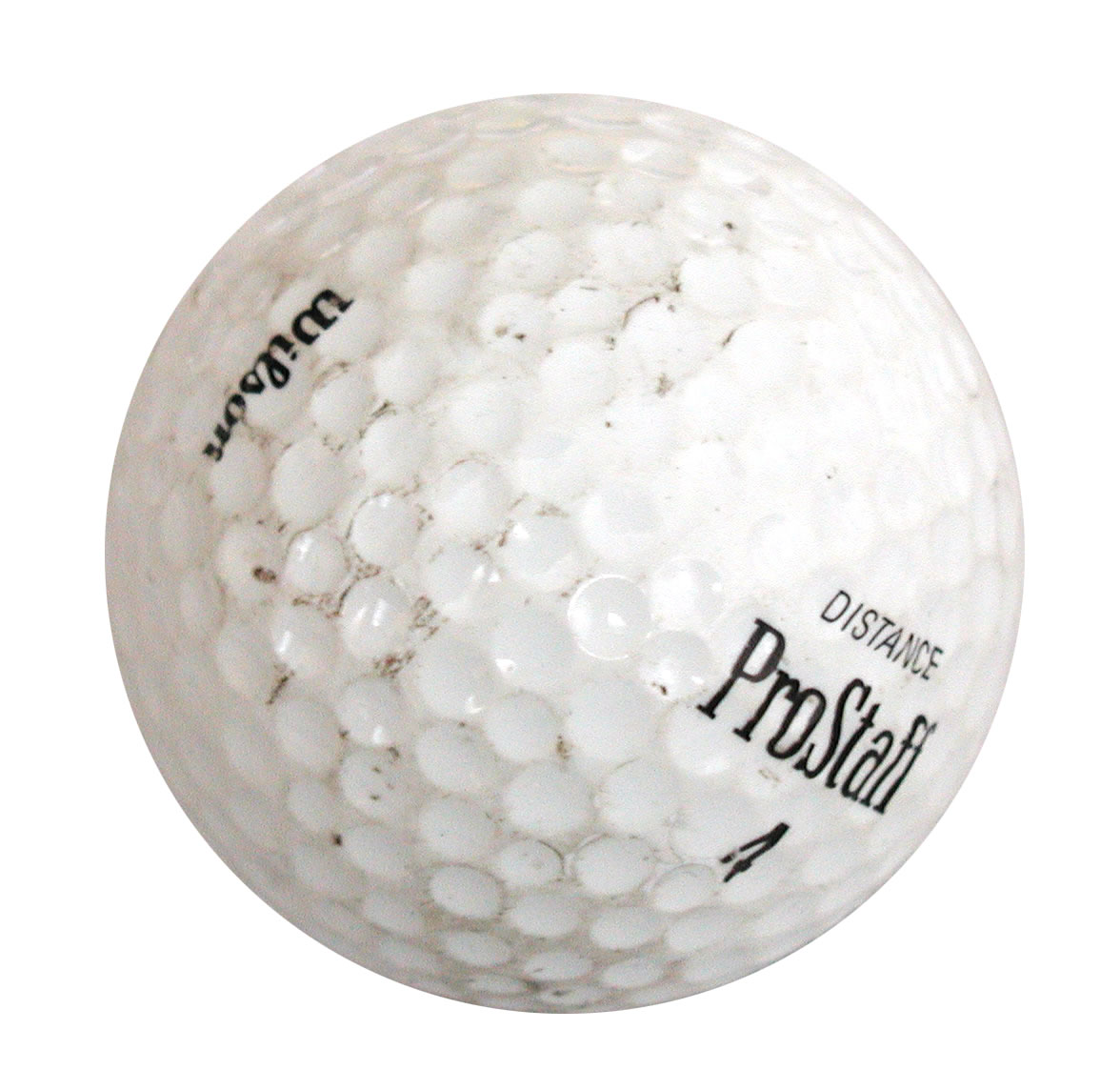
A modern dimpled ball. Every indentation is a turbulator, nudging the airflow into the turbulent regime. Photograph: Paolo Neo via Wikimedia Commons.
How dimples cheat the air
Everything that moves through air faces drag, and drag comes in two main flavors. Skin friction is air simply rubbing on the surface. Pressure drag comes from the low-pressure wake that forms behind the object when airflow peels away from its surface, as Scientific American explains in its breakdown by Top-Flite's aerodynamic researchers.
Here is the paradox at the heart of the dimple: each dimple adds a little turbulence and therefore a little skin friction, but it buys something much more valuable. The dimples trip the thin boundary layer of air around the ball from smooth laminar flow into turbulence. A turbulent boundary layer carries more energy, so it clings to the curved surface longer and separates much later, near the back of the ball instead of near the middle.
The payoff is dramatic: the delayed separation shrinks the low-pressure wake behind the ball, and a smaller wake means less pressure pulling backward. "A dimpled ball thus has about half the drag of a smooth ball," Scientific American reports. Steve Quintavalla, the USGA's Senior Director of Equipment Research and Testing, puts it in distance terms: a dimpled ball will travel almost twice as far as a smooth one, according to a GolfLink profile of his research.
That is why the dimple looks like a mistake but works like a wing. Adding roughness to beat resistance feels wrong until you see the wake.
Lift: why backspin and dimples share the credit
Drag is only half the story. A well-struck drive also climbs, and it climbs because the ball makes lift while it flies. Backspin warps the airflow so pressure builds higher on the underside of the ball than on top, pushing the ball upward as it moves forward, like a stubby airplane wing.
Scientific American's numbers split the credit neatly. Ball spin contributes about half of a golf ball's lift, and the other half comes from the dimples, which optimize the lift force.
Dimples alone, even without spin, lift nothing much; backspin alone on a smooth ball lifts far less. Together they keep the ball airborne noticeably longer, which is distance you cannot buy with swing speed alone. Even great golf swing tempo cannot rescue a ball that refuses to fly.
This is why ball fitting matters as much as the driver in your hands. Dimple depth tunes the flight: deeper dimples generally produce a lower flight, while shallower ones produce a higher flight, according to OnCore Golf's technical explainer. Small geometry changes steer a real trajectory.
Manufacturers experiment with dimple size, depth, and pattern to tune spin and flight. Wikimedia Commons.
How many dimples does a ball need?
Most golf balls carry between 300 and 500 dimples, with 336 a common count on tour-level balls, according to Scientific American. Their average depth is only about 0.010 inch, and the tolerance is brutally tight: "a depth change of 0.001 inch can produce a radical change to the ball's trajectory and the overall distance it can fly."
The USGA, famously strict about almost everything in the sport, has no restrictions on dimple count, size, shape, or pattern, Quintavalla notes via GolfLink. That freedom explains the variety on shelves. Titleist's famous Pro V1 has used counts around 388, while other brands experiment with counts near 322 or 332. Some manufacturers have even tried hexagonal dimples instead of round ones, notes Scientific American.
Symmetry, however, is non-negotiable: the rules require a symmetrical ball, so every design must perform identically whichever side faces forward, and the distance records owe plenty to all this tinkering. The longest drive on record, Mike Austin's astonishing 515-yard shot, got a large part of its distance from dimples, according to the BYU Design Review. That is more than a quarter of a mile from a standing tee.
Frequently asked questions
Do all golf balls have the same number of dimples?
No. Counts range from 300 to 500, with most premium balls in the 310 to 399 range. The exact number depends on the brand, model, and the flight characteristics the designers targeted, so two balls from the same company can differ by dozens of dimples.
Why not just make the ball smooth and hit it harder?
A smooth ball hit by a professional travels only about half as far as a dimpled one, because its airflow separates early and leaves a large draggy wake. No amount of extra clubhead speed recovers that lost efficiency. The dimple is doing work that raw power cannot.
Do dimples help on the green?
Barely. Dimples pay off at high speed, when aerodynamic forces dominate the flight.
A putt rolls at low speed over a short distance, so the cover material and feel matter far more than the dimple pattern. Choose your putter ball for touch, not turbulence.
Who invented dimpled golf balls?
No single inventor. Scottish golfers discovered by accident in the 1800s that scuffed gutta-percha balls flew farther. English engineer William Taylor secured the first dimple patent in 1905, and ball makers refined the pattern through the 1920s until it became the standard.
The bottom line
Dimples turn air against itself: they add a whisper of turbulence to erase a large pocket of drag, and they help backspin hold the ball up. The result is roughly twice the distance from the same swing.
Next time you stand on the tee, remember the flight you are about to watch was designed in a wind tunnel and proved on Scottish links. Pick a ball whose flight fits your swing, not just the brand you recognize.
Image Credits: Wikimedia Commons / Prakul Varshney, Paolo Neo
Latest in Sports
- The science behind a perfect golf swing tempo
- Cyclists ride in a peloton to save energy the way dimples save distance
- Why runners get a second wind
- Mountain bike suspension: hardtail vs full suspension
Subscribe to the Rive News newsletter for one sharp science explainer every morning.
Related stories

Why Is Altitude Sickness Worse for Some People?
Altitude sickness hits some people harder because of genetics, ascent speed, and prior history, not fitness level. Here is what raises risk
Why Do You Get Blisters When Hiking and How to Prevent Them
Friction plus moisture plus heat equals a blister. Learn why hiking breeds all three, and the boots, socks, and tape system that keeps
How to choose hiking boots for beginners: fit, features, and break-in
Beginners should buy for fit first: snug everywhere, tight nowhere, with a thumb's width at the toes. Here is how to size, test,