
Why runners still pin race numbers with safety pins
By Rive News / Research desk | Rive News / Published October 28, 2026 at 9:00 AM PKT
Key takeaways
- Race rules require the bib to stay flat, fully visible and unmodified, and four pins do that job on any shirt.
- Timing chips made pins unnecessary for timing, but not for identification by officials, photographers and announcers.
- Pins are cheap, universal and disposable, which is why organisers still hand them out at packet pickup.
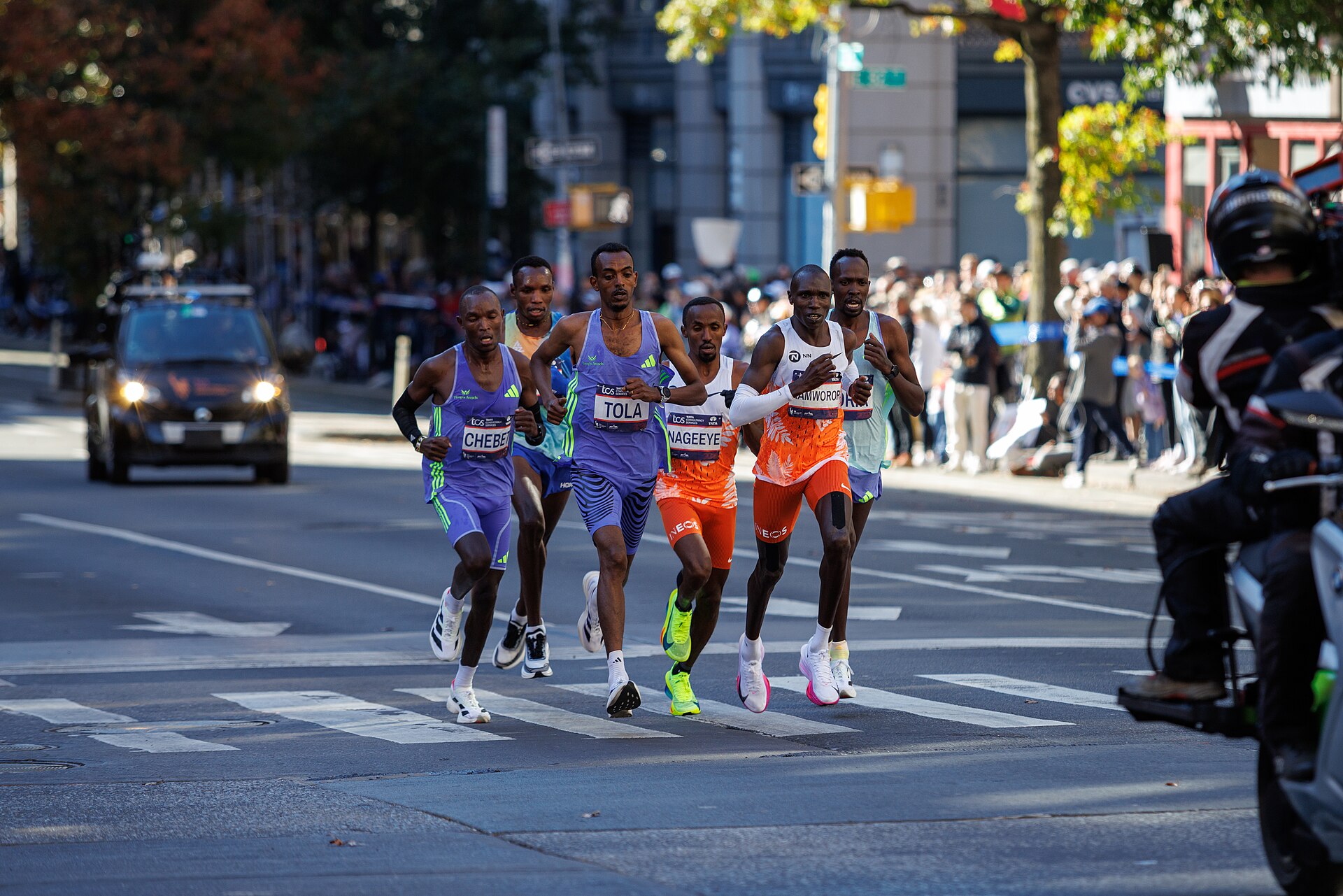
[Elite marathon runners in a race, bib numbers on display.] Photograph: Wikimedia Commons contributor
Image Credits: Wikimedia Commons
Runners still pin race numbers with safety pins because the pin is the simplest tool that satisfies the rules. A bib must sit flat on the front of the runner, stay fully visible for the whole race, and never be folded, cut or covered. Four safety pins, one per corner, hold it exactly that way on almost any shirt.
Timing chips changed how races are timed, but they did not change what a bib is for. The chip records a time, while the bib identifies the runner to everyone watching, judging and photographing the race. That identification job still needs a flat, visible number.
This article explains what the rules require, why pins beat the alternatives, and why the pinned bib survives in an age of chip timing.
What the rules require of a bib
World Athletics Technical Rules state that every athlete shall be provided with two bibs, worn visibly on the front of the torso and back, except in jumping events where one bib may be worn on the front or back only. The same rules state that bibs must be worn as issued and may not be cut, folded or obscured in any way.
Road race organisers apply the same logic. New York Road Runners' rules of competition require the official race bib to be worn on the front of the participant's outermost garment, with the race number always fully visible. Runners who run without the bib properly attached and displayed may not have finish times recorded, may not appear in results, and may not receive credit for finishing.
United States Track and Field technical instructions for cross-country championships repeat the point: bibs are to be worn as issued, pinned on the front of the outermost layer, and should not be crinkled, folded or cut. The Rotterdam Marathon's race regulations go further, specifying that the bib number must be attached to the chest using the safety pins distributed by the organiser.
Pins satisfy all of this at once. They keep every corner down, so the bib cannot flap, fold or rotate. They work on cotton, polyester and singlets alike, and they leave the number fully uncovered.
Why chips did not kill the bib
Modern bibs often carry a timing chip, usually a thin tag on the back of the bib or a small transponder attached to it. When the runner crosses mats at the start, splits and finish, the chip records the time automatically, replacing the old manual system of officials reading numbers at the line.
That solved timing, but timing was never the bib's only job. Officials use bibs to spot bandits, runners on the course without an entry. Photographers use bib numbers to match photos to runners.
Announcers read names and numbers at the finish. Medical staff use bibs to identify a runner who collapses.
A chip is invisible to all of those people. A pinned number is readable from metres away, in rain, without any device. That is why races kept the bib even after they adopted chips.
Elite track meets now use tags that attach to the bib and track athletes with ultrawide-band Bluetooth to centimetre precision, alongside photo-finish cameras. Those tags still ride on the bib, because the bib remains the one visible identifier every system shares.
Why pins beat belts and clips
Race belts thread through holes in the bib and hold it at the waist without pins. They work well for triathletes and for runners who dislike pin holes in expensive shirts. Yet they have drawbacks that keep pins ahead for most races.
A belt lets the bib swing and fold in the wind, which can break the fully-visible rule. Belts also sit lower than the chest, where a number is harder for cameras and officials to read in a crowd. Some races ban belts or require the bib on the chest regardless.
Magnetic clips avoid holes but can slip, cost more, and may interfere with the timing tag if placed badly. Adhesive bibs peel off with sweat. Pins cost almost nothing, weigh nothing, and hold through rain, sweat and a marathon distance.
Packet pickup reflects that logic. Running guides note that bibs are usually picked up at the expo along with 4 safety pins for attaching the bib to a race top or bottoms. The organiser supplies the pins because the organiser needs every runner's bib to behave the same way.
The sprinter who could not find pins
The pinned bib even intrudes on elite sport. At the 2021 United States Olympic track and field trials, sprinter Trayvon Bromell found himself searching for four safety pins to attach his bib before a race that would decide Olympic qualification.
Bromell later said that all he wanted to think about was the race, and that something as small as a piece of paper became the biggest distraction. He went on to win the 100 metres by five hundredths of a second, with the gap between an Olympic qualifier and fourth place decided by three hundredths.
The story shows both sides of the pinned bib. It is a fiddly, old-fashioned ritual, and it still matters enough that a world-class sprinter stops to get it right before the biggest race of his season.
What bibs are made of
Most modern bibs are not paper at all. They are made of Tyvek, a plastic formed from high-density polyethylene fibres, which flexes with the runner and resists tearing. That toughness is part of why pins work: a Tyvek bib holds a pin hole without ripping across a long race.
Older paper bibs tore in rain and sweat, which made pin placement fussy. Tyvek solved the material problem while leaving the attachment method unchanged, because the method was never the problem.
For runners building toward a first 5K, the practical lesson is simple: pin all four corners, keep the bib on the front, and do not fold it under a belt or jacket.

[Runners in a marathon with bib numbers pinned to their fronts.] Photograph: Wikimedia Commons contributor
Image Credits: Wikimedia Commons
FAQ
How many pins should I use on a race bib?
Four, one per corner. Fewer pins let the bib flap or fold, which can hide the number and break race rules. Some runners add extra pins in heavy rain, but four is the standard.
Can I wear my bib on my back instead?
Road races usually require the bib on the front, where officials and cameras can see it. Track athletes may wear a second bib on the back, but the front bib is the one that counts for identification.
Do pins damage running shirts?
Pins leave tiny holes, which usually close up in the wash on technical fabrics. Runners who want to protect an expensive top can use a race belt where the race allows it, or pin through a seam.
Will I be disqualified for a lost bib?
A lost bib can mean no recorded time and no result, and some races pull runners whose numbers are not visible. If a bib comes off mid-race, the usual advice is to report to an official at the finish so the time can be verified.
The bottom line
Runners still pin race numbers with safety pins because rules demand a flat, visible, unmodified bib, and pins deliver that on any garment for almost no cost. Chips took over timing, but identification still belongs to the visible number.
Until races find a visible identifier that works as cheaply and universally, the four safety pins handed out at packet pickup will keep showing up at start lines everywhere.
Tags: running, races, race gear
Rive News's research desk covers outdoor skills and everyday science explainers.
Related
Subscribe to Rive News for one practical explainer each week.
Rive News publishes researched explainers with named sources. Corrections are welcome at any time.
Related stories

Why Is Altitude Sickness Worse for Some People?
Altitude sickness hits some people harder because of genetics, ascent speed, and prior history, not fitness level. Here is what raises risk
Why Do You Get Blisters When Hiking and How to Prevent Them
Friction plus moisture plus heat equals a blister. Learn why hiking breeds all three, and the boots, socks, and tape system that keeps
How to choose hiking boots for beginners: fit, features, and break-in
Beginners should buy for fit first: snug everywhere, tight nowhere, with a thumb's width at the toes. Here is how to size, test,