
Why Table Tennis Balls Spin So Much: RPM, Physics, and Technique
Key takeaways
- Elite players generate up to 9,000 to 10,000 RPM, about four times a major league curveball's spin.
- The Magnus effect turns spin into a sideways or downward force that bends the ball's flight.
- The ball weighs just 2.7 grams, so a small aerodynamic force produces a dramatic curve.
A table tennis ball can leave a professional's paddle spinning at up to 9,000 or 10,000 revolutions per minute. That is roughly four times the spin of a major league curveball, which tops out near 2,500 RPM. The spin is what lets players smash the ball at full power and still land it on a table barely longer than a dining table.
Three things combine to make it possible: a ball light enough to react to tiny forces, a paddle surface grippy enough to grab it, and a stroke technique built around brushing rather than hitting. This article explains where the spin comes from, why the physics hits so hard at this scale, and how the main spin types behave in the air.
Where the spin comes from
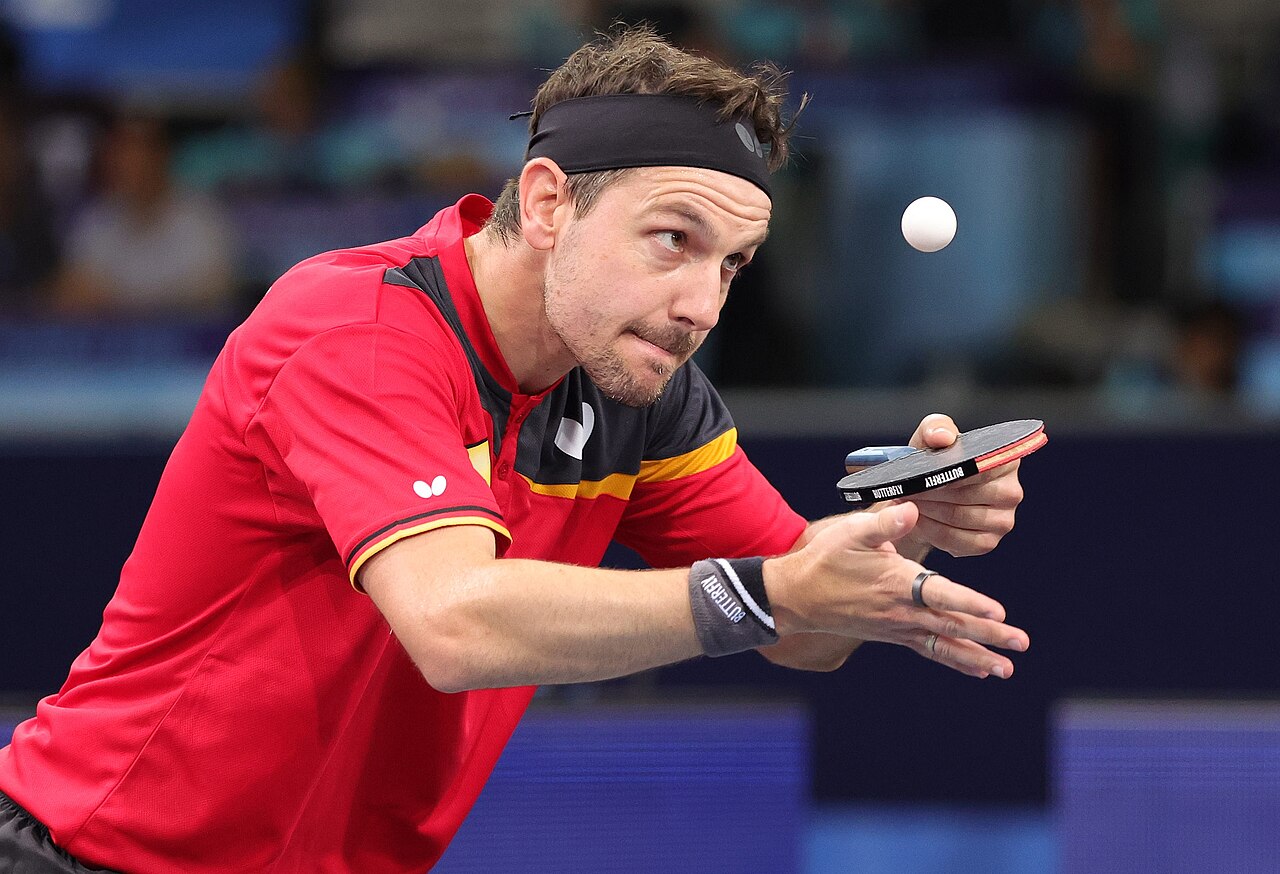
Spin starts at contact. When the paddle's rubber grips the ball's surface, it converts some of the stroke's linear energy into rotational energy. The key variable is the brush: a thin, fast graze across the ball's surface generates far more spin than a flat hit, even at the same swing speed.
Dwell time decides how much grip the paddle gets. This is the fraction of a millisecond the ball stays in contact with the rubber.
Thicker, tackier sponge holds the ball longer and transfers more rotation. High-RPM serves, which can approach 9,000 RPM, require a high coefficient of friction and specific sponge thickness to maximize that dwell time.
The numbers from match play confirm how extreme it gets. High-speed camera analysis has shown that top players generate spin rates of up to 9,000 to 10,000 RPM during a powerful loop.
Optical sensor studies of elite youth players measured rotation around 127 revolutions per second under match conditions, which is about 7,600 RPM. In flight, balls typically rotate between 30 and 100 revolutions per second while traveling at 5 to 25 meters per second.
Technique matters as much as equipment. A faster swing alone does not create more spin.
What creates spin is racket speed applied tangentially, brushing up, down, or across the ball. This is why a loop drive, which brushes upward through the ball, produces the heaviest topspin in the game.
Why the Magnus effect matters so much here
The Magnus effect is the engine behind every curved shot in table tennis. It was first documented by German physicist Heinrich Gustav Magnus in 1852. When a spinning object moves through air, it experiences a force perpendicular to both its velocity and its axis of rotation.
The mechanism is straightforward. A ball moving without spin has roughly symmetrical airflow over its surfaces, so pressure stays balanced and gravity runs the show.
Add spin and the symmetry breaks. The spinning surface drags air with it, so on one side the air moves faster and on the other side it moves slower.
Bernoulli's principle says faster-moving fluid means lower pressure. The pressure difference between the two sides pushes the ball toward the low-pressure side, creating a lateral or vertical force.
For topspin, the top of the ball moves against the oncoming air, the bottom moves with it, and the resulting force points downward. The ball dips far faster than gravity alone would pull it.
At table tennis scale, this force is enormous relative to the ball. An analytical study of spinning ball trajectories found that the Magnus effect can produce accelerations comparable to gravity itself. That is why a looped ball can be struck upward over the net and still slam down onto the table: the spin is manufacturing extra gravity.
The boundary layer decides how cleanly this works. This is the thin layer of air hugging the ball's surface.
In high-speed shots it transitions from smooth laminar flow to chaotic turbulent flow, and spin shifts the separation point asymmetrically. A bigger, lopsided wake behind the ball adds drag and contributes to the sharp kicks that make pro serves so hard to read.
How topspin, backspin, and sidespin behave
Topspin is the workhorse of the modern game. The Magnus force points down, so the ball drops earlier and at a steeper angle than a spinless ball would.
At a typical flight speed of 15 meters per second, every 1,000 RPM of topspin shifts the landing point forward by 15 to 20 centimeters, researchers found. A 9,000 RPM loop therefore lands dramatically shorter and kicks forward off the table, rushing the opponent.
Backspin does the opposite. The Magnus force points up, fighting gravity and keeping the ball floating longer. That is why a heavy chop stays in the air and dies on the bounce, and why pushing against backspin without lifting sends the ball straight into the net.
Sidespin bends the ball left or right in the air. It shows up most in serves, where the server brushes across the side of the ball. Combined with topspin or backspin, it creates corkscrew serves that curve one way in flight and kick the other way off the table.
The bounce multiplies everything. Spin changes how the ball grips the table on impact, so topspin kicks forward and fast, backspin skids or even checks back, and sidespin jumps sideways. Returners have to read the spin twice: once in the air and once off the table.
Spin dominates other racket sports through the same physics. A swerving soccer ball bends for the same reason, and even tennis balls going dead in the cold come back to how air and rubber interact. Table tennis just shows the effect at its most extreme.

Why a light ball spins more
The ball's weight is the multiplier. Under ITTF rules, an official table tennis ball is 40 millimeters in diameter and weighs just 2.7 grams, with a tolerance of only 0.1 grams. That is roughly the weight of a paperclip.
Newton's second law does the rest. A tiny mass means a tiny force produces a large acceleration.
The aerodynamic forces from spin that would barely bend a heavier ball throw a 2.7-gram ball around dramatically. This is the core reason spin matters more in table tennis than in almost any other sport.
The 40mm standard itself was chosen to calm the game down. The ITTF moved from 38mm to 40mm balls in 2000 to slow rallies and improve visibility for spectators. The bigger, slightly slower ball is easier to follow, though at the elite level the spin numbers stayed extreme.
Air resistance plays a bigger role here than most players realize. A light ball at 20 meters per second bleeds speed fast, which is why the Magnus force has time to work its curve over a short table. Heavier balls would punch through the air and barely bend; the table tennis ball is built to be bent.
Altitude changes the equation too. Thinner air means less drag and a weaker Magnus force, which is one reason altitude affects athletes across sports. A ball that dips viciously at sea level floats longer in thin mountain air.
How fast do pros really spin the ball?
High-speed cameras have recorded up to 9,000 to 10,000 RPM on powerful loops. Optical sensor measurements in elite youth matches found around 127 revolutions per second, or roughly 7,600 RPM. A major league curveball, by comparison, spins at about 2,500 RPM.
What is the Magnus effect in simple terms?
A spinning ball drags air around with it, making air move faster on one side than the other. Faster air means lower pressure, so the ball gets pushed toward the low-pressure side. The result is a curved flight path instead of a straight one.
Why does topspin make the ball dip?
Topspin rotates the top of the ball backward against the oncoming air. That creates high pressure on top and low pressure underneath, pushing the ball downward. The ball lands shorter and steeper than gravity alone would allow.
Does the ball's weight really matter that much?
Yes. At 2.7 grams, the ball is so light that small aerodynamic forces produce large accelerations. The same spin on a heavier ball would bend its path far less noticeably.
Why did the ITTF switch to 40mm balls?
The 40mm ball was introduced after the 2000 Olympics to slow the game and make rallies more visible to spectators. It replaced the older 38mm ball, which played faster and spun even more sharply.
The bottom line
Table tennis balls spin so much because everything in the sport is tuned for it. Grippy rubber and brushing strokes generate up to 10,000 RPM, the Magnus effect converts that rotation into real aerodynamic force, and a 2.7-gram ball responds to that force with dramatic curves.
Topspin dips, backspin floats, sidespin swerves, and the bounce doubles the trouble. It is the same physics as a curveball, just turned up to eleven on a paperclip-weight ball.
Latest in Sports
- Why Soccer Balls Swerve in Flight
- Why Tennis Balls Go Dead in the Cold
- Why Altitude Sickness Hits Some People Harder
- How to Read Trail Difficulty Ratings
Get one plain-English sports explainer in your inbox every morning. Subscribe for free.
Image Credits: Wikimedia Commons / Sandro Halank; Wikimedia Commons / Owula kpakpo
Related stories

Why Is Altitude Sickness Worse for Some People?
Altitude sickness hits some people harder because of genetics, ascent speed, and prior history, not fitness level. Here is what raises risk

Why Do You Get Blisters When Hiking and How to Prevent Them
Friction plus moisture plus heat equals a blister. Learn why hiking breeds all three, and the boots, socks, and tape system that keeps
How to choose hiking boots for beginners: fit, features, and break-in
Beginners should buy for fit first: snug everywhere, tight nowhere, with a thumb's width at the toes. Here is how to size, test,