
Why tennis players grunt when they hit the ball
By Rive News / Research desk | Rive News / Published October 29, 2026 at 9:00 AM PKT
Key takeaways
- A tennis grunt is usually a forceful exhale timed to the moment the racket meets the ball.
- Exhaling under load helps brace the core, which transfers force from the legs to the racket.
- Lab studies measured ball speeds about 3.8 percent higher when players grunted, with serves up by 4.9 percent.
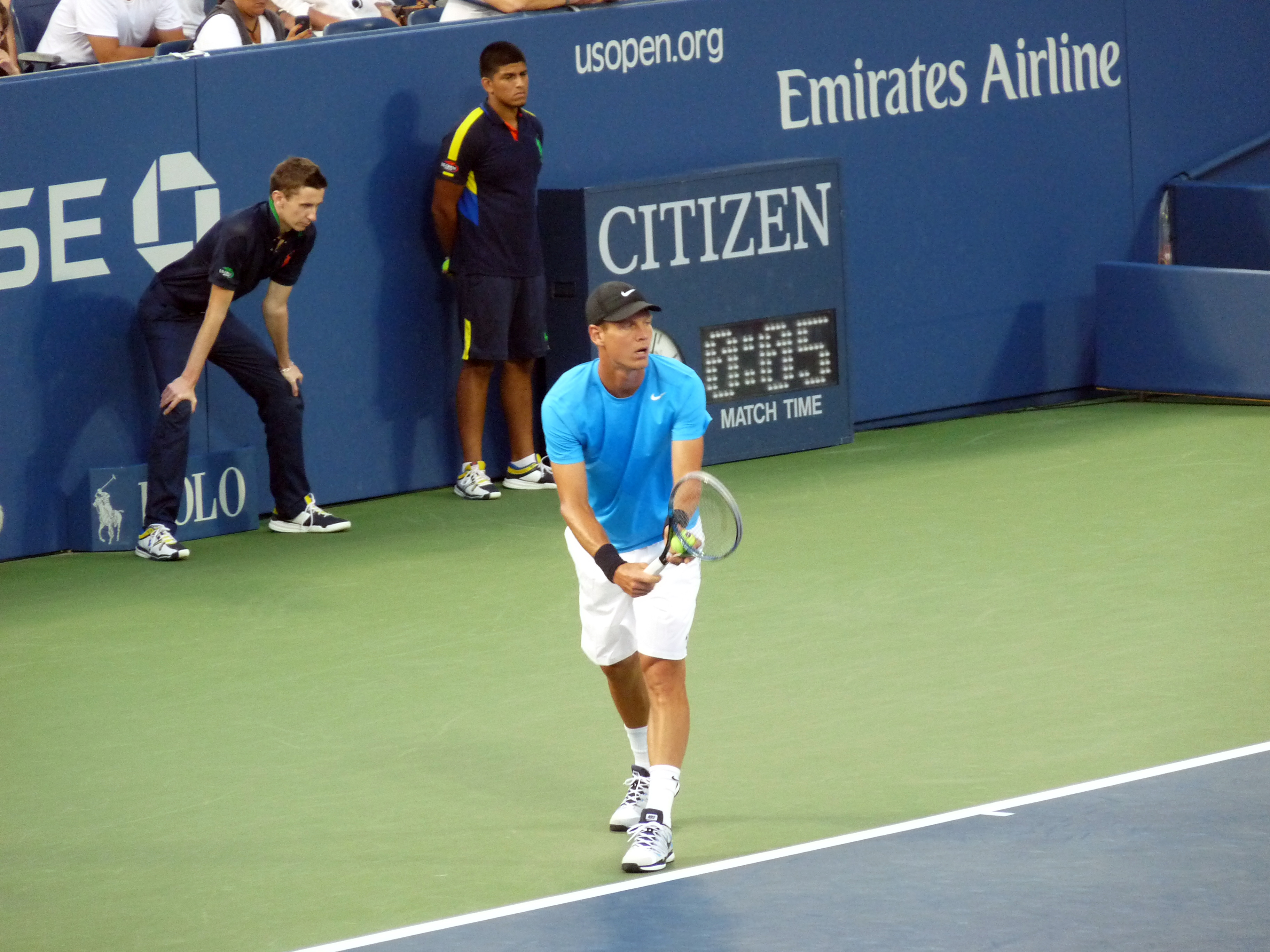
[Tomáš Berdych serves during the 2012 US Open.] Photograph: karlnorling
Image Credits: Wikimedia Commons
A tennis grunt is the sharp exhale many players make as they strike the ball. It can sound like a sigh, a shout, or a shriek, and some players are far louder than others.
This article explains why tennis players grunt, including the breathing mechanism behind the sound, what studies measured, whether it distracts opponents, and what the rules say.
Breathing out at the moment of effort
The core explanation is breathing, not shouting. A player inhales before the shot, then exhales forcefully as the racket meets the ball.
That exhale does real work. Breathing out against a partly closed airway raises pressure inside the trunk, which stiffens the core and stabilises the spine for a fraction of a second.
A stable trunk transfers force better. Power in a tennis shot starts in the legs, travels through the hips and core, and finishes in the arm and racket, and a soft middle leaks energy along the way.
Alison McConnell, professor of sport and health science at Bournemouth University, explained the sequence to Sportsnet: the player inhales before each shot, the inflated lungs stabilise the core, and the air is then released in a controlled way that does not destabilise the body.
In that account, the loud grunt is a by-product rather than the goal. The useful part is the timed exhale, and the sound comes from air forced through the vocal cords as it escapes.
The same pattern appears across sport. Weightlifters grunt under a heavy bar, martial artists shout as they strike, and sprinters breathe sharply at full effort, all for a similar reason: exhaling at peak effort braces the body.
A habit learned young
Many players learn to exhale on contact as juniors, and the sound becomes automatic. Coaches teach breathing timing because holding the breath too long starves muscles of oxygen, while breathing out too early loses trunk stability.
Nick Bollettieri, the coach who trained famous grunters including Monica Seles and Maria Sharapova, promoted grunting as a release of tension that also synchronised breathing with hitting. His players became the public face of the sound in the 1990s and 2000s.
Once a breathing pattern is grooved over thousands of practice balls, it stays. A player who tries to play silently often reports that their timing feels off, which suggests the grunt also works as a rhythm cue for the shot.
That habit explains why grunting clusters in certain training schools and families of players. It also explains why some players grunt on every ball while others stay nearly silent: they learned different breathing patterns, not different sports.
What the ball-speed studies found
The breathing story is plausible, but researchers also tested whether grunting changes the ball. A 2014 study at the University of Hamburg, reported in later reviews, had trained players hit forehands and serves with and without grunting.
When grunting was suppressed, serve velocity fell by an average of 3.8 percent and forehand speed by 2.7 percent in one account of the study. Mental Floss, summarising the research, reports the mirror image: vocal players hit the ball 3.8 percent harder overall, with serve velocity improving by 4.9 percent.
Those are small percentages, but tennis is a game of small margins. A serve a few percent faster gives the receiver less time, and a groundstroke a few percent heavier pushes the opponent further behind the baseline.
A separate line of research in PLOS ONE reached a similar conclusion on force: grunting, as well as strong exhalation without a grunt, led to increased force production. The sound itself may matter less than the forceful breath behind it.
The studies are small and lab-based, so the numbers should be read as suggestive rather than exact. They point in the same direction, though: timed exhalation helps, and silencing it costs a little pace.
Does grunting distract the opponent
The more controversial claim is that grunting hurts the opponent, not just helps the grunter. The key study here was published in PLOS ONE in 2010 by Scott Sinnett of the University of Hawaii at Manoa and Alan Kingstone of the University of British Columbia.
Sinnett and Kingstone showed 33 undergraduate students videos of a tennis player hitting to the left or right side of the court. Half the clips included a brief sound at the moment of contact, and the students had to judge the shot direction as fast and accurately as possible.
The result was clear in the lab. The extra sound made responses both slower and less accurate, and the authors concluded that a grunting player has a competitive edge on the professional tour.
The proposed mechanism is masking. Players judge spin and speed partly from the sound of the ball on the strings, and a grunt at contact can cover that sound. A later PLOS ONE paper on the same question calls this the blocking account: the grunt hides the racket-ball contact sound that opponents use to anticipate trajectory.
Sinnett illustrated the scale with a conservative estimate. At a ball speed of 50 miles per hour, the delay from the grunt meant the ball travelled an extra 2 feet before the opponent could respond, and the accuracy drop equated to being wrong-footed roughly once per game.
Nine-time Wimbledon champion Martina Navratilova put the complaint bluntly, saying the grunting prevented her from hearing the ball. The lab work does not prove the same effect at full professional speed, and the authors themselves noted the findings still needed validation on a real court.
What the rules actually say
Grunting is not banned under the rules of tennis. No rule sets a volume limit, and umpires do not carry noise meters at professional events.
The relevant rule is hindrance. Under the International Tennis Federation Rules of Tennis, if a player is hindered by a deliberate act of the opponent, the hindered player wins the point, while an unintentional hindrance usually leads to a let, meaning the point is replayed.
That distinction matters. A grunt that is part of a player's normal breathing is treated as unintentional, while a shout timed to put an opponent off, or a sound made after the shot, can be penalised.
The Women's Tennis Association discussed stronger action years ago, including teaching quieter breathing to young players and giving umpires noise guidance. Those proposals did not become a ban, and the tour's leadership later said it had no plans to act, partly because research suggested grunting could aid performance.
Junior programmes sometimes set their own guidance, and parents and coaches still argue about it at every level. The professional position, though, is settled: grunt if it is your natural exhale, and expect an umpire's attention only if the sound looks deliberate.
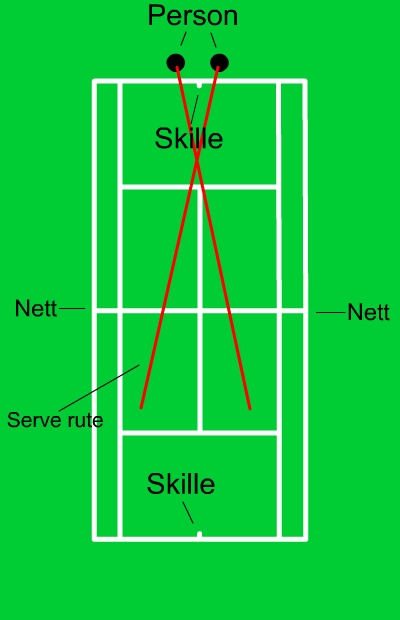
[A player serves on a tennis court.] Photograph: Nils Barlaug
Image Credits: Wikimedia Commons
Why some players are louder than others
Volume varies for reasons that have little to do with gamesmanship. Body size, vocal cord structure, lung capacity, and how forcefully a player exhales all change how loud the sound comes out.
Effort matters too. Players grunt loudest on serves and big groundstrokes, where force peaks, and stay quieter on drop shots and slices, where touch matters more than power.
Gender plays a role in attention, if not in cause. Women's grunting draws more complaints and commentary, even though leading men, including Rafael Nadal, grunt audibly, and the research base covers both.
Some players grunt only on one wing. A forehand that demands full body rotation may produce a grunt, while a compact backhand may not, which is another sign that the sound follows effort rather than strategy.
Should club players copy the pros
Club players do not need to grunt loudly, but the breathing lesson transfers. Exhaling on contact, even quietly, helps timing and keeps the core engaged through the shot.
A practical way to practise is to breathe out on every shot during a rally, without forcing volume. The exhale should peak at contact, not before it, and the body should stay relaxed in the arm and shoulder.
Players who hold their breath through a rally often tire faster and tighten up. A steady exhale pattern avoids that, and it doubles as a rhythm cue that keeps footwork moving between shots.
If a grunt draws complaints at a club, the quiet version gives nearly all the benefit. The research points to the forceful exhale, not the decibel level, as the active ingredient.
Frequently asked questions
Is grunting in tennis cheating?
No rule bans grunting itself. A deliberate sound made to distract an opponent can be ruled a hindrance, but a normal exhale at contact is part of play.
Does grunting make the ball go faster?
Lab studies suggest a small effect, around 3.8 percent higher ball speed when players grunt, with serves gaining about 4.9 percent in one summary.
Why do some players grunt louder than others?
Loudness follows lung capacity, vocal structure, effort, and learned breathing habits, which is why volume varies widely even among top players.
Can an opponent complain about grunting?
An opponent can ask the umpire to consider hindrance, but the umpire must judge whether the sound was a deliberate act, not just a loud natural exhale.
The bottom line
Tennis players grunt because a forceful exhale at contact braces the core, times the shot, and releases tension, with lab studies suggesting a small gain in ball speed and a possible masking effect on opponents. The sound is a by-product of that breathing pattern, learned young and grooved over thousands of balls, and the rules allow it unless it becomes a deliberate distraction. For club players, the useful takeaway is the quiet version: breathe out on contact, keep the core engaged, and let the sound take care of itself.
Tags: tennis, grunting, sports science
Rive News's research desk covers everyday science and sport explainers from published studies and official sources.
Related
- Dynamic vs static stretching before sport explained
- Why do athletes ice bath after training? The evidence explained
- How to improve your balance for any sport: 8 drills
Subscribe to Rive News for one plain-English explainer every weekday.
Rive News publishes explainers based on cited public sources; corrections are welcomed and noted on the article.
Related stories

Why Is Altitude Sickness Worse for Some People?
Altitude sickness hits some people harder because of genetics, ascent speed, and prior history, not fitness level. Here is what raises risk

Why Do You Get Blisters When Hiking and How to Prevent Them
Friction plus moisture plus heat equals a blister. Learn why hiking breeds all three, and the boots, socks, and tape system that keeps

How to choose hiking boots for beginners: fit, features, and break-in
Beginners should buy for fit first: snug everywhere, tight nowhere, with a thumb's width at the toes. Here is how to size, test,