
How a car airbag decides when to inflate in a crash
By Rive News / Research desk | Rive News / Published October 27, 2026 at 9:00 AM PKT
Key takeaways
- An airbag fires only when crash sensors and a control unit agree the impact is severe enough to need it.
- The trigger is how fast the car slows down, not the speed shown on the dashboard before impact.
- For a rigid barrier hit, reduced deployment starts near 9 to 16 mph and full deployment near 18 to 25 mph.
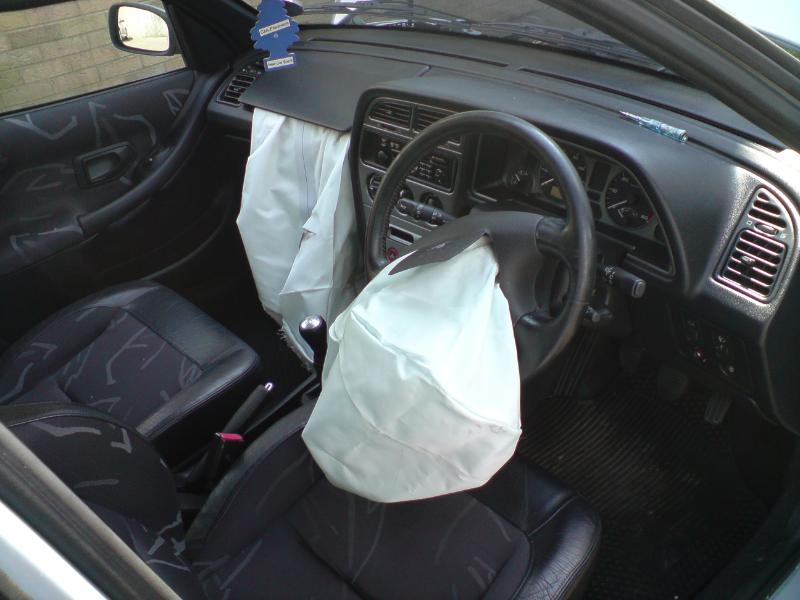
Deployed front airbags fill the space between occupants and the dashboard after a crash. Photograph: the subject
Image Credits: Wikimedia Commons
A car airbag is a fabric cushion that inflates in a fraction of a second during a crash and then deflates. It works as a supplemental restraint, which means it adds protection on top of the seat belt rather than replacing it. The bag gives the head and chest a softer surface to meet instead of the steering wheel, dashboard, or door frame.
The decision to inflate is made by electronics, not by the bag itself. Accelerometers around the car measure how quickly the vehicle slows down, and a central control unit compares those readings against a preset threshold.
If the readings pass that threshold, the unit fires the inflator. If they do not, the bag stays packed, even when the crash looks dramatic from outside.
This article explains car airbag decisions, including the sensors that watch for a crash, the decision the control unit makes, the thresholds that must be met, how inflation happens in milliseconds, and why some crashes leave the bags packed.
The sensors that watch for a crash
Crash sensors sit in places such as the front of the car, the doors, and the central control unit itself. Most are accelerometers, which measure changes in speed rather than speed itself. A car travelling at 60 mph and a car travelling at 20 mph can produce very different sensor readings depending on what each one hits and how fast it stops.
The front sensors usually report first because they sit closest to a frontal impact. Side sensors handle side impacts, where the distance between the occupant and the striking object is much smaller. That short distance is one reason side airbags must fire even faster than frontal bags, according to the United States National Highway Traffic Safety Administration (NHTSA).
A second sensor inside the control unit acts as a check on the outside sensors. Engineer Fix reports that the control unit cross-references the front sensor data with this internal safing sensor before it allows deployment. The point of the double check is to stop a single faulty sensor, a pothole, or a kerb strike from firing a bag on its own.
Sensor placement also explains why different bags fire in different crashes. A frontal impact loads the front sensors, while a side impact loads the door or pillar sensors. The control unit fires only the bags that match the direction and severity of the impact it has measured.
The decision the control unit makes
The airbag control unit, sometimes called the ACU or ECU, watches sensor data continuously while the car runs. It does not wait for a crash to start paying attention. It samples deceleration many times per second and runs the numbers through a crash algorithm that estimates how severe the event is likely to become.
The key number in that calculation is change in velocity, often written as delta-V. Delta-V describes how much speed the car loses in the crash and over how much time. A short, sharp stop produces a high delta-V, while a long, gradual stop produces a lower one, even if the starting speed was the same.
The control unit also weighs the duration of the deceleration, not just its peak. A pothole can produce a brief spike, but a genuine crash sustains high deceleration for roughly 50 to 100 milliseconds. That sustained pattern is what separates a real impact from road noise in the sensor data.
Once the algorithm decides the crash is severe enough, it sends an electrical signal to the inflator. NHTSA describes frontal airbags as inflating in less than one twentieth of a second, which is under 50 milliseconds. The whole chain from impact to full bag must finish before the occupant has moved far enough forward to hit the interior.
The thresholds that must be met
There is no single speed at which every airbag fires, because the trigger is deceleration rather than road speed. Engineer Fix puts the frontal threshold at roughly the equivalent of hitting a rigid barrier at 8 to 14 mph. That range covers the point where the benefit of the bag starts to outweigh the risk of injury from the bag itself.
The Buick Rainier owners manual gives a more detailed split for dual stage bags. It states that the threshold for reduced deployment is about 9 to 16 mph (14 to 26 km/h) into a wall that does not move or deform. It puts the threshold for full deployment at about 18 to 25 mph (29 to 40 km/h) under the same conditions.
Those numbers shift with what the car hits. A deformable object, such as another car with crumple zones, absorbs energy and stretches out the stop, so the car may need a higher road speed before the sensors see the same deceleration. A narrow object, such as a pole, concentrates force in one spot and can change which sensors report and when.
Seat belt use shifts the balance too. Airbag Injuries reports that for belted occupants, most airbags deploy at a higher threshold of about 16 mph, because the belt alone handles lighter crashes. Unbelted occupants move forward sooner, so the system may fire earlier to catch them before they reach the interior.
How inflation happens in milliseconds
When the control unit fires, current passes through a heating element that ignites a chemical propellant in the inflator. Older systems used sodium azide, which breaks down into nitrogen gas, while many modern systems use guanidine nitrate instead, according to ScienceABC. Either way, the reaction fills the nylon bag with gas in tens of milliseconds.
The bag bursts through its cover in the steering wheel, dashboard, or seat, and reaches full size before the occupant arrives. The occupant then presses into the bag, and gas escapes through small vents in the fabric. That venting is deliberate, since it lets the bag absorb energy gradually instead of bouncing the occupant back.
Deflation matters as much as inflation. By the time the car has stopped moving, the bag should already be empty, so it does not block the occupant from getting out or block rescuers from reaching them. A deployed bag is a one use device, and the whole module must be replaced after it fires.
Dual stage bags add one more layer to this process. In a moderate crash, only the first stage fires, so the bag inflates with less force.
In a severe crash, both stages fire for full protection. That staging is why the same car can produce a gentler deployment in one crash and a full force deployment in another.
Why some crashes leave the bags packed
A car can look badly damaged while its airbags stay packed, and that outcome is usually by design. Rear impacts, for example, throw occupants backward into the seat rather than forward into the dashboard, so frontal bags offer little benefit there. Many cars therefore do not fire frontal bags in a straight rear end collision.
Low speed parking bumps also fall below the threshold on purpose. Firing a bag in a 5 mph bump would risk burns, bruises, and hearing damage for no real gain, since the seat belt and the crumple zones already handle that impact. The system is tuned to stay quiet until the crash is severe enough that the bag clearly helps.
Angle matters as well. A glancing blow that scrapes along the side of the car may not produce the sustained deceleration the algorithm needs, even at higher speeds. The Buick manual makes this point directly, stating that whether frontal airbags deploy is not based on how fast the vehicle is traveling, but largely on what it hits, the direction of the impact, and how quickly the vehicle slows down.
A bag that fails to fire in a severe crash is a different matter, and it can point to a fault, a damaged sensor, or a previous deployment that was never repaired. A warning light on the dashboard deserves attention before the next journey, since the system runs a self check each time the car starts.
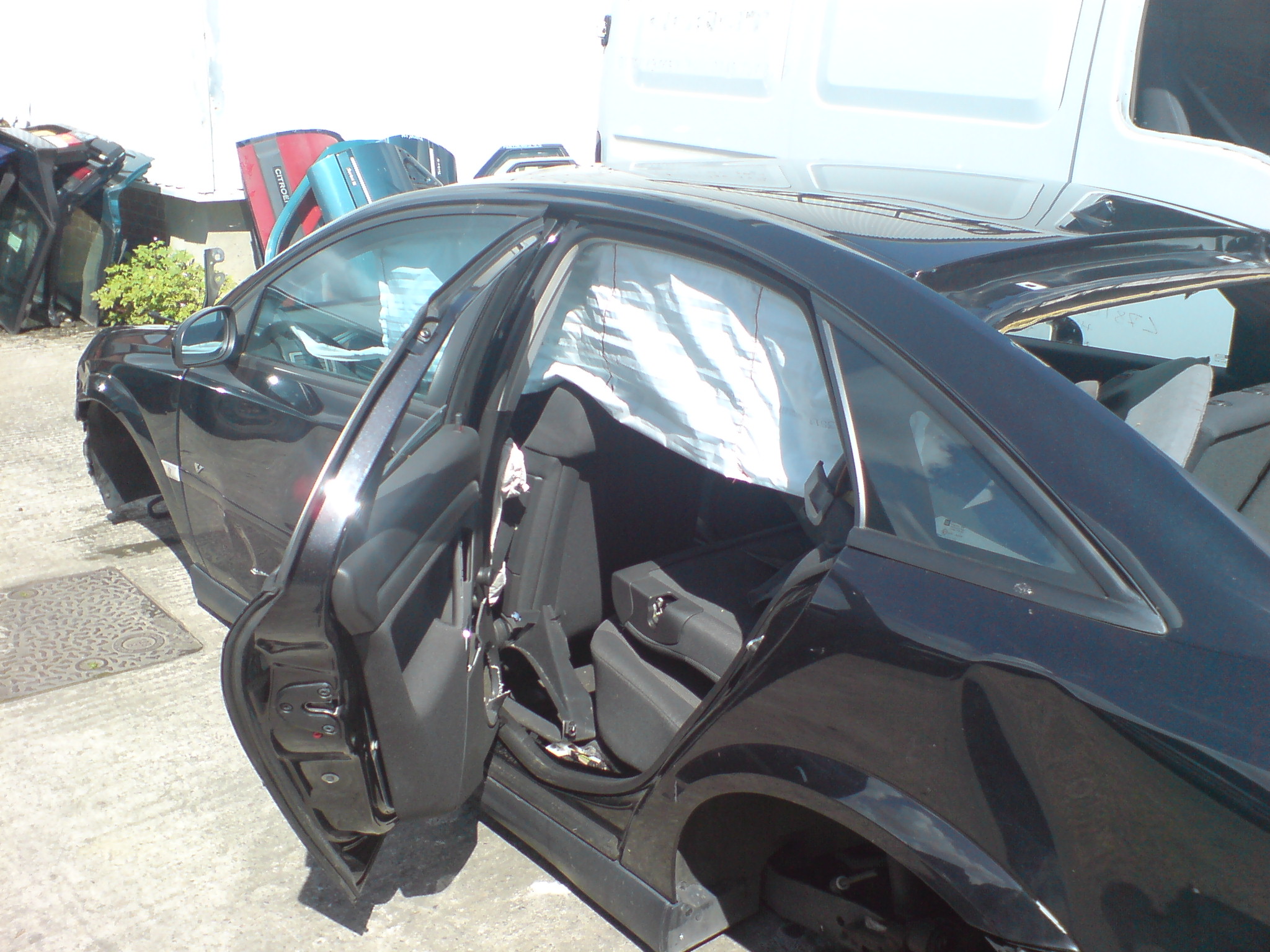
A curtain airbag drops down beside the windows to protect heads in a side impact. Photograph: the subject
Image Credits: Wikimedia Commons
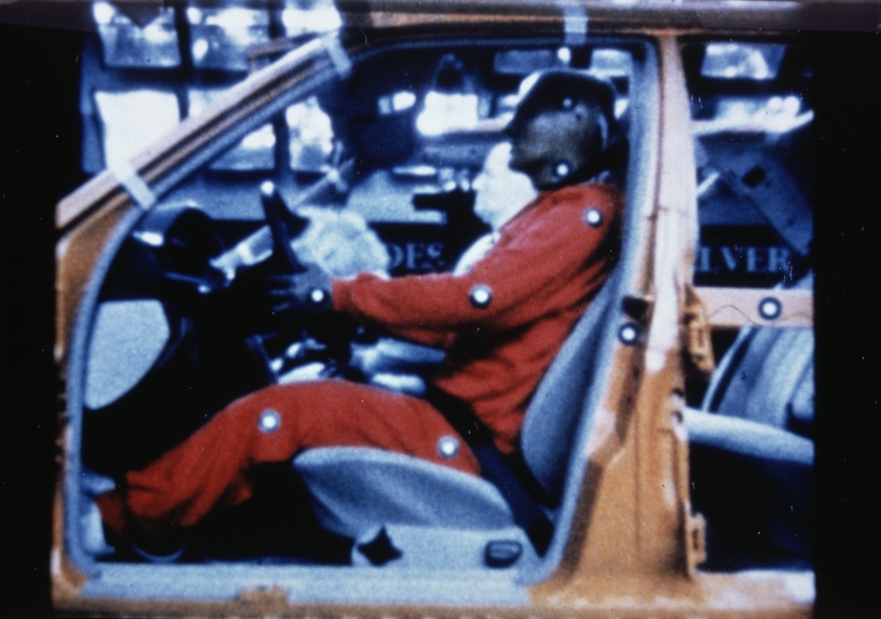
Crash test dummies let engineers measure how a body meets the bag before cars reach customers. Photograph: the subject
Image Credits: Wikimedia Commons
Frequently asked questions
Do airbags deploy in every crash?
No, they fire only in crashes that pass the severity threshold for that bag. Rear impacts, gentle parking bumps, and glancing blows often stay below it, so the bags stay packed by design.
Can a pothole set off an airbag?
A pothole alone is very unlikely to fire a bag in a healthy system. The control unit needs sustained deceleration plus agreement between sensors, and a pothole spike is too brief and too localised to pass both checks.
Why do some cars have two stage airbags?
Two stage bags let the car match force to crash severity. A moderate crash gets a softer first stage deployment, while a severe crash gets both stages for full protection.
Should you replace an airbag after it deploys?
Yes, a deployed bag and its inflator module are single use and must be replaced by a qualified repairer. The seat belts, sensors, and control unit should also be inspected, since the crash may have stressed them.
The bottom line
A car airbag decides by measuring how violently the car stops, checking that reading against a second sensor, and comparing the result with a preset threshold. Road speed alone never makes the call, since the object hit and the direction of impact change everything. Knowing that chain explains both the bags that fire and the crashes where staying packed is the correct answer.
If the airbag warning light stays on, book an inspection before relying on the system. A fault found in a workshop is far cheaper than a bag that stays silent in a crash.
Tags: airbags, car safety, crash sensors, airbag control unit
The Rive News research desk writes plain language explainers from public sources, with every key claim tied to a named document or dataset.
Related
- What the check engine light actually means
- How a catalytic converter cleans exhaust
- How electric car batteries degrade over time
- How hybrid cars decide when to use the electric motor
Subscribe for one practical explainer each week, written in plain language and checked against public sources.
Rive News standards: no invented quotes, no invented statistics, and every number traced to a public source.
Related stories

Why Does Tire Pressure Drop in Cold Weather?
Cold weather can cut tire pressure by 1 psi for every 10°F drop, thanks to the ideal gas law. Here is what happens inside the tire and what
Why Do Brake Rotors Warp, or Do They Actually?
Mechanics rarely see a truly warped rotor. The shudder usually comes from uneven pad deposits a few thousandths of an inch thick. Here
How to Buy a Used Car Without Getting Scammed: The Checklist
Over 450,000 cars a year have rolled-back odometers, NHTSA says. This checklist covers VIN checks, title washing, and the inspection that