
What the red line on a rev counter really means
By Rive News / Research desk | Rive News / Published October 28, 2026 at 9:00 AM PKT
Key takeaways
- The red line marks the maximum engine speed the manufacturer considers safe for sustained running.
- Past it, valves, pistons, connecting rods and bearings face forces and heat beyond their design limits.
- A rev limiter cuts fuel or spark to stop most over-revving, but a wrong downshift in a manual can still force the engine past it.
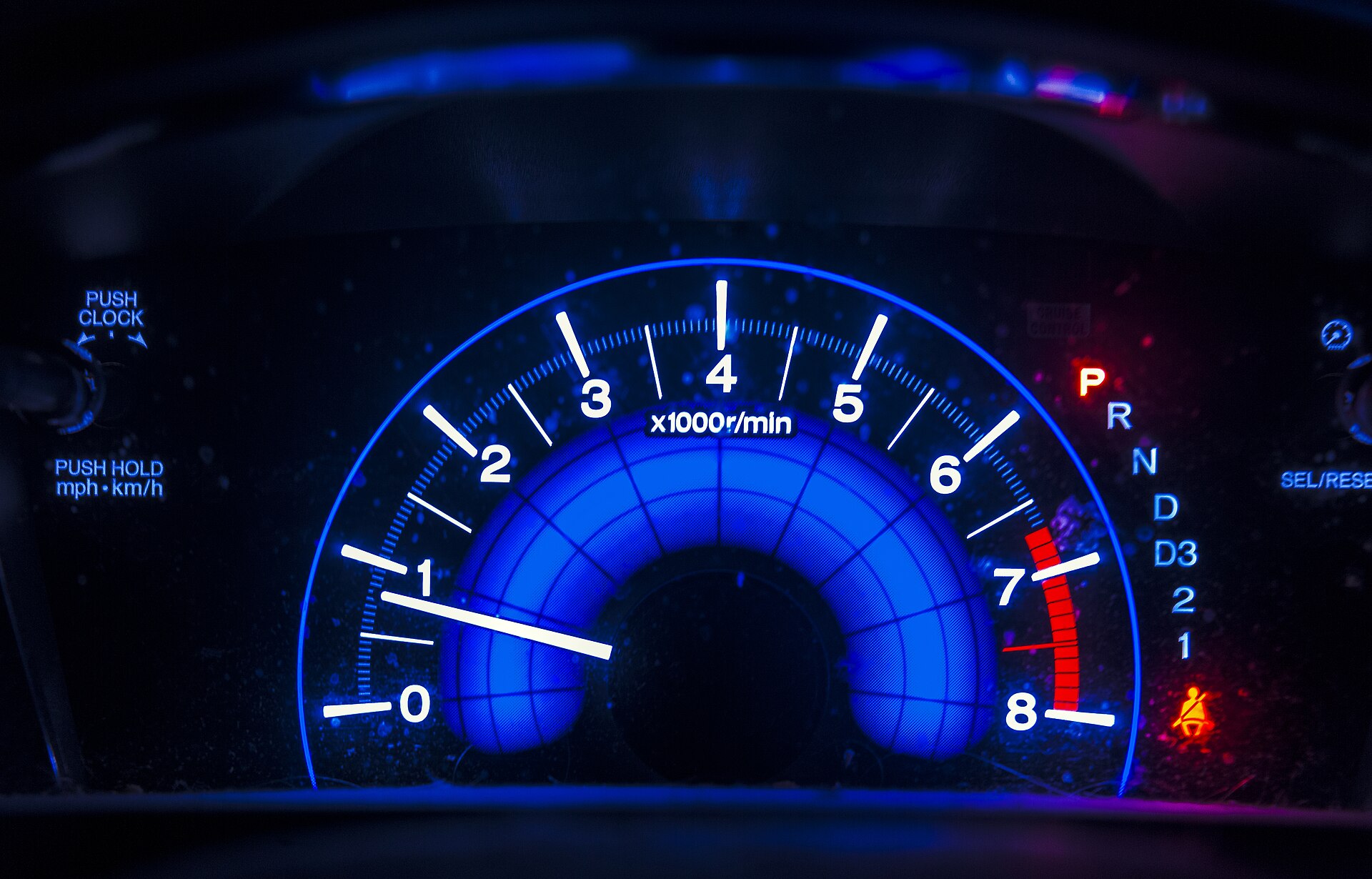
[A tachometer display on a car dashboard.] Photograph: the tachometer display
Image Credits: Wikimedia Commons
Every rev counter has a red band at the top of its dial. Most drivers know not to push the needle into it. Fewer know why that band sits where it does, or what actually breaks when it is crossed.
The red line is an engineering limit, not a decoration. This article explains how to read the dial, how makers set the limit, what fails past it, and how the rev limiter protects the engine. It also covers why diesel and petrol red lines differ, and what to do if you over-rev by mistake.
How to read a rev counter
A rev counter, also called a tachometer, shows engine speed in revolutions per minute, or RPM. On an analogue dial the numbers are usually single digits with a small "x1000" label on the face. Engineer Fix explains that a needle on the number 3 with that label means 3,000 revolutions per minute, not 3.
The white or light-coloured part of the scale is the normal working range. Some dials add a green section for the most fuel-efficient range.
At the top end, usually between 6 and 8 on a petrol car, the scale turns red. That red band is the red line, and the start of the band is the redline speed for that engine.
Digital rev counters show the same information as a bar or a number, often with the red zone at the right-hand end. The principle is identical: the red zone marks the top of the safe range, and the number at its start is the limit in RPM.
Idle speed sits at the bottom of the working range, typically around 700 to 900 RPM for a warm petrol engine and a little lower for a diesel. The gap between idle and redline is the engine's whole working life, and most everyday driving uses only the lower half of it.
How makers set the red line
The red line is set from the mechanical limits of the moving parts. Pistons, connecting rods, valves, valve springs and bearings all have speeds beyond which they cannot keep up, and the maker picks a limit with a safety margin below those failure points.
Piston speed is a key factor. At high RPM the piston must stop and reverse direction thousands of times a minute, and the forces on the connecting rods grow with the square of engine speed. Double the RPM and the forces roughly quadruple, which is why the last few hundred RPM before the red line matter far more than the same gap lower down the dial.
Valve control is another limit. At very high speed the valve springs may not close the valves fast enough, a condition known as valve float. When a valve stays open too long, it can meet the rising piston, and that contact bends valves and damages pistons in an instant.
Heat and lubrication set a third limit. High RPM means more combustion events per second, more heat for the cooling system to shed, and less time for oil to reach every bearing between loads. Engineer Fix notes that sustained running above the red line generates heat that can overwhelm cooling and lubrication, accelerating wear and risking overheating.
That is why red lines differ between engines. A small, short-stroke petrol engine with light pistons can safely spin faster than a long-stroke diesel with heavy internals.
Diesel red lines are usually lower, often around 4,000 to 5,000 RPM, while many petrol cars redline near 6,500 RPM. Neither figure is better in itself; each reflects what that engine's parts can survive.
What breaks when you cross it
Crossing the red line briefly does not always destroy an engine, but it loads parts beyond their design envelope. The failures that follow are mechanical and expensive, not just a warning light.
Valve float is the most feared short-term failure. Engineer Fix lists bent valves from piston contact, fractured connecting rods and stressed main and rod bearings among the consequences of running in the red zone. A bent valve stops sealing, so that cylinder loses compression and the engine misfires badly.
Connecting rod failure is more dramatic. A rod that stretches or breaks at high speed can punch through the engine block, and at that point repair usually means a replacement engine rather than a rebuild. Bearing damage is quieter but just as final: scored bearings lose oil pressure, and the engine soon seizes or knocks loudly.
Heat damage builds more slowly. Sustained high RPM can overheat the oil, thin it out and starve bearings of their protective film.
Piston rings can lose tension, and the head gasket can fail under the combined heat and pressure. These failures may not appear on the day of the over-rev, but they shorten the engine's life.
That risk is why owner's manuals state the limit so bluntly.
The Polaris owner's manual warns that the red line on the gauge indicates the maximum safe engine speed, that excessive speed can cause engine damage or failure, and it instructs the rider directly: "Do not allow engine speed to exceed the red line."
Car makers give the same warning in their own manuals, even if the wording differs.
The rev limiter and its limits
Most modern cars carry an electronic rev limiter that enforces the red line. Capital One explains that once the red line is reached, the limiter restricts fuel flow, limits the fuel injectors or cuts spark ignition entirely, and combustion returns once engine speed falls back into the safe range. The cut can feel like a sudden stutter or a soft pause, depending on whether the car uses a hard or soft limiter.
The limiter works well against the most common over-rev: holding the throttle open in gear or revving in neutral. It simply will not let the engine spin faster than its programmed ceiling, no matter how hard you press the pedal.
It cannot protect against a mechanical over-rev. In a manual car, shifting down too many gears at speed forces the wheels to drive the engine faster than its limit, and no fuel or spark cut can stop that, because the engine is being spun from outside. Engineer Fix warns that a manual driver can still mechanically force the engine into the red zone with an incorrect downshift, and that is the classic money-shift accident.
Automatics are safer here because the gearbox computer refuses downshifts that would over-rev the engine. Manual mode in an automatic still lets the driver choose gears, but the computer will usually block a shift that would push past the limit. That protection is one more reason to respect the gearbox's refusal rather than fighting it.
Using the rev counter well
The rev counter is a tool for choosing gears, not a target to chase. For everyday driving, shifting well below the red line saves fuel and wear, since peak efficiency and peak torque usually arrive far below the limit. Performance driving uses more of the range, but the fastest shift point is often slightly before the red line, where power is still rising.
Watch for a needle that behaves oddly at steady speed. A needle that jumps, drops or hunts at idle can point to misfires, a failing sensor or a throttle fault, and it deserves a diagnostic check. A needle that reads far higher than road speed suggests in a given gear may mean a slipping clutch in a manual or a slipping transmission in an automatic.
Cold engines deserve extra care. Oil is thicker when cold and has not fully circulated, so high RPM on a cold start wears parts faster than the same RPM when warm. Most makers advise gentle driving until the temperature gauge reaches its normal position, and that advice matters more than any single redline rule.
If you do over-rev by mistake, do not panic and do not keep pushing. Lift off, let the engine settle, and listen for new noises such as knocking, ticking or a rough idle.
If the engine sounds normal and no warning light appears, the limiter probably did its job. If a warning light comes on or the engine sounds different, stop and have it checked before driving far.
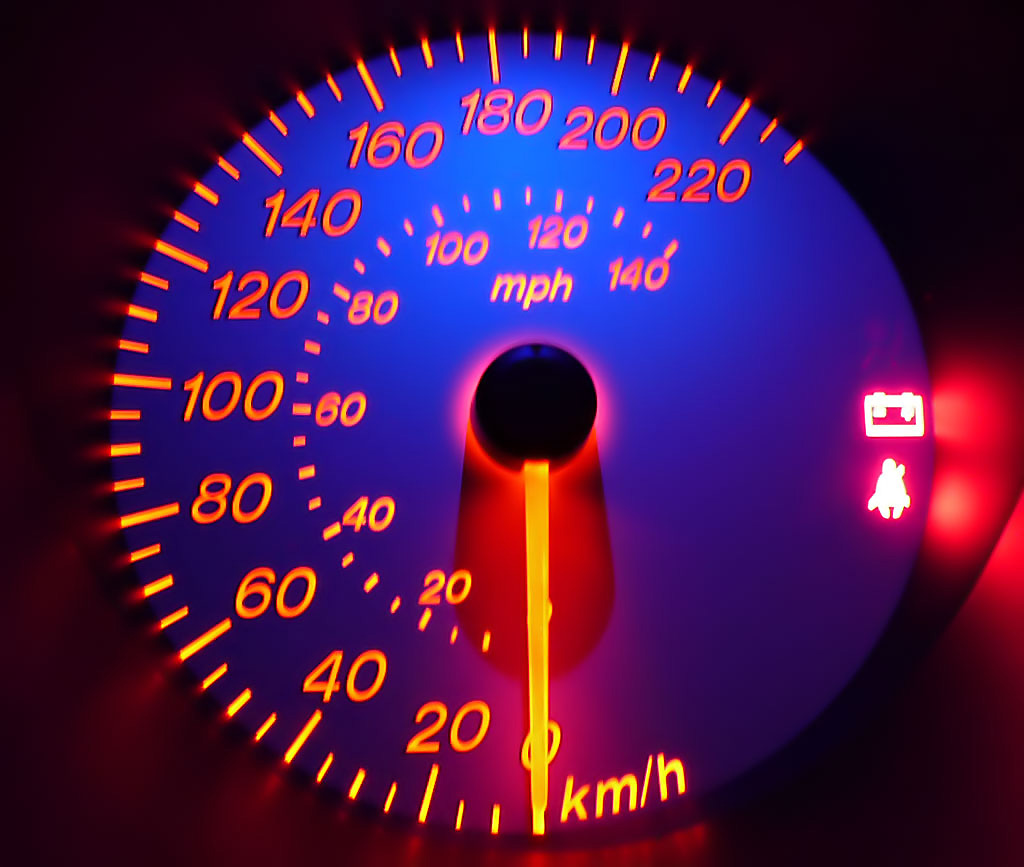
[A car dashboard with its gauges and controls.] Photograph: the car dashboard
Image Credits: Wikimedia Commons
Frequently asked questions
Is it bad to touch the red line briefly?
A brief touch that the rev limiter catches is usually harmless, since the limiter exists for exactly that moment. Sustained running in the red zone, or a mechanical over-rev from a wrong downshift, is where real damage happens.
Why do diesel cars have lower red lines?
Diesel engines have heavier internals and longer strokes, and they make their power at lower speeds. Their parts reach their safe speed limits sooner, so the maker sets the red line lower, often around 4,000 to 5,000 RPM.
Can an automatic car exceed its red line?
Not through the throttle, because the gearbox and rev limiter block it. A mechanical fault or a forced downshift in some manual modes could still over-rev an engine, but ordinary automatic driving will not pass the limit.
Does the red line change as a car ages?
The painted red line never moves, but an older engine has less margin behind it. Worn bearings, tired valve springs and thinner oil films mean an old engine tolerates high RPM worse than the same engine when new.
The bottom line
The red line on a rev counter is the maker's statement of the fastest speed the engine can safely sustain. It reflects piston forces, valve control, heat and lubrication limits that all get worse fast as RPM rises.
The rev limiter guards against most accidental over-revving, but it cannot stop a manual downshift that spins the engine from the wheels. Use the dial to choose gears, keep cold engines gentle, and treat the red zone as a boundary, not a challenge.
Tags: rev counter, tachometer, redline, engine care
Rive News's research desk covers everyday motoring questions with sourced explainers and no invented claims.
Related
- Why manual cars stall and what the biting point does
- What turbo lag is and why modern turbos have less of it
- Engine braking: what it is and when to use it
- What the check engine light actually means
Subscribe for one practical motoring explainer each week.
Standards: every factual claim in this article traces to a named public source listed above.
Related stories

Why Does Tire Pressure Drop in Cold Weather?
Cold weather can cut tire pressure by 1 psi for every 10°F drop, thanks to the ideal gas law. Here is what happens inside the tire and what
Why Do Brake Rotors Warp, or Do They Actually?
Mechanics rarely see a truly warped rotor. The shudder usually comes from uneven pad deposits a few thousandths of an inch thick. Here
How to Buy a Used Car Without Getting Scammed: The Checklist
Over 450,000 cars a year have rolled-back odometers, NHTSA says. This checklist covers VIN checks, title washing, and the inspection that