
How Does a Torque Converter Work in Plain Terms?
Key takeaways
- A torque converter transfers engine power to the transmission through fluid, with no direct mechanical link between the two.
- Its stator redirects the fluid flow, multiplying torque roughly 2 to 2.5 times when the car launches from a stop.
- At cruising speed a lock-up clutch connects engine and transmission solidly to stop wasted energy and improve fuel economy.
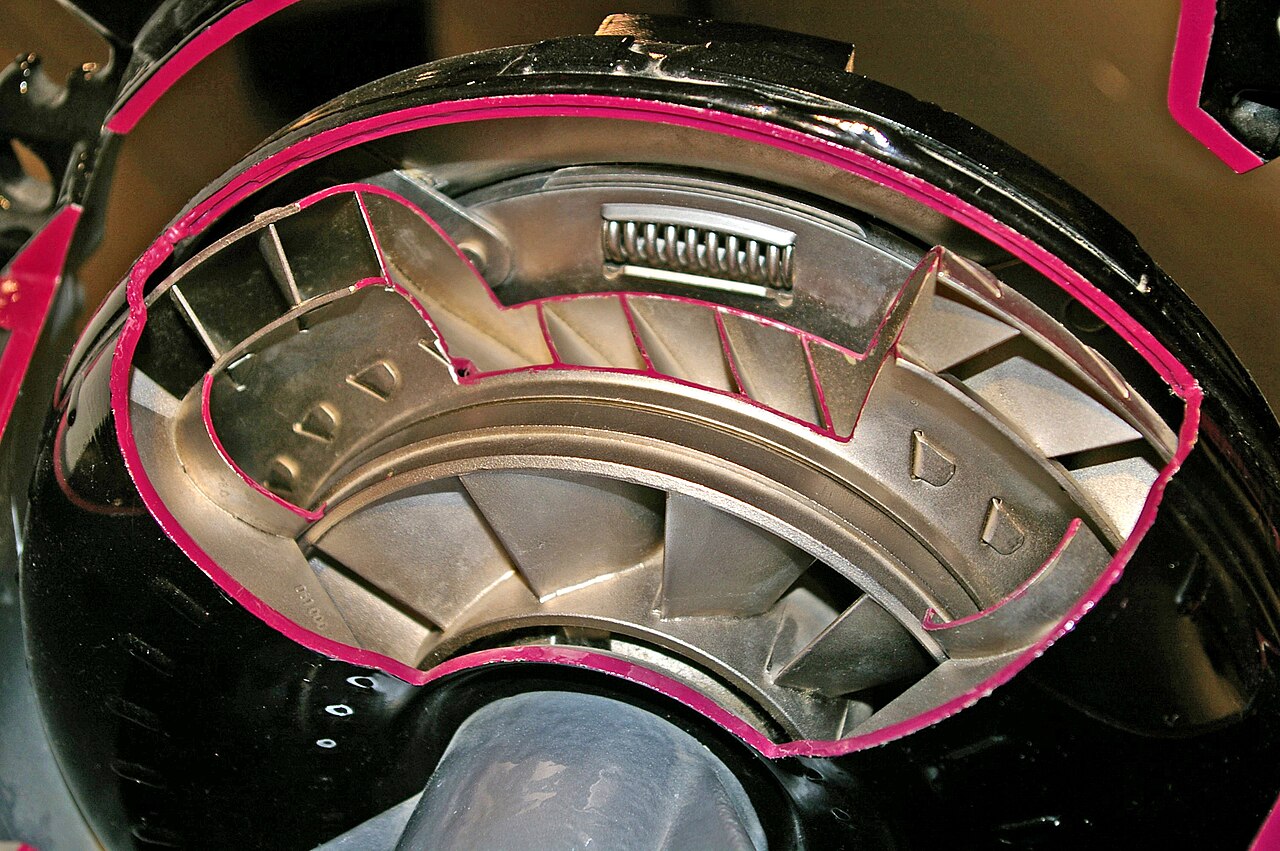
A cutaway model of a fluid-dynamic torque converter for Porsche automated gearboxes, on display at the Porsche Museum in Stuttgart. Photograph: Wikimedia Commons
Image Credits: Wikimedia Commons / Porsche Museum, Stuttgart
Every car with a classic automatic transmission has a device sitting between the engine and the gearbox that does something remarkable. It lets the engine spin while the car stands still, then smoothly converts that spinning into motion, all without a clutch pedal or any mechanical contact at all.
That device is the torque converter. It works by throwing fluid at a fan, and understanding those two fans, plus one clever redirect, explains almost the entire trick.
This article walks through the three main parts, the three phases of operation, and a century of history behind the device, ending with why modern converters still matter in an age of hybrids and electrics.
The problem the torque converter solves
A car engine cannot start from zero the way an electric motor can. It must idle, spinning at several hundred revolutions per minute, even when the car is not moving. In a manual car, the driver disconnects the engine from the wheels with a clutch pedal at every stoplight.
Automatics had to solve the same problem without asking the driver to do anything, and the early solution was the fluid coupling: two fan-like wheels facing each other inside a sealed case full of oil. One fan is bolted to the engine, the other to the transmission. The engine fan flings oil at the transmission fan, and the oil pushes it around.
The fluid coupling worked, but it had a weakness. It could pass torque along, but it could never increase it. Launching a heavy car from a stop demands more twisting force than the engine makes at idle, and the fluid coupling simply delivered what the engine gave it.
The torque converter fixes that weakness with a third element. And the idea is far older than most drivers realize.
A century of history in brief
The principle of transferring torque by recirculating fluid between two impellers with no rigid connection was patented by the German engineer Hermann Föttinger in 1905, according to Advanced Transmission's history of the device. His fluid coupling was designed for marine and industrial machinery, not cars.
Cars came later. In 1939, General Motors became the first manufacturer to put a fluid drive in a mass-produced automobile, introducing it with the Hydra-Matic transmission. The real turning point for the torque converter itself arrived after the war: Buick's Dynaflow transmission of 1948 replaced the simple fluid coupling with a true torque converter, and Packard's Ultramatic in 1949 and Chevrolet's Powerglide in 1950 followed, as Gears Magazine documents.
The pattern was set. Every mainstream automatic since has used some version of Föttinger's idea, refined with better blade shapes, better fluids, and the addition of a lock-up clutch in later decades to recover the efficiency the fluid connection wastes at speed.
The three parts, and what each one does
Strip a torque converter down and you find three fan-like wheels inside a sealed, doughnut-shaped case filled with automatic transmission fluid.
The impeller, also called the pump, is bolted to the engine's flywheel through the converter housing. It spins whenever the engine spins. Its curved vanes fling transmission fluid outward, turning engine power into a fast-moving stream of oil.
The turbine faces the impeller, and it is the only part connected to the transmission's input shaft. The stream of oil from the impeller strikes the turbine's vanes and pushes them around. This is where the power leaves the converter and enters the gearbox.
The stator is the clever part: it sits between the turbine and the impeller on a one-way clutch and redirects the oil returning from the turbine into the impeller at the right angle. Without it the returning oil would fight the impeller; with it, the oil pushes the impeller forward, adding force. That redirected push is what multiplies the torque.
Gears Magazine puts it neatly: without the torque multiplication provided by the stator, the setup functions merely as a fluid coupling. The stator is the entire difference between a torque converter and its simpler ancestor.
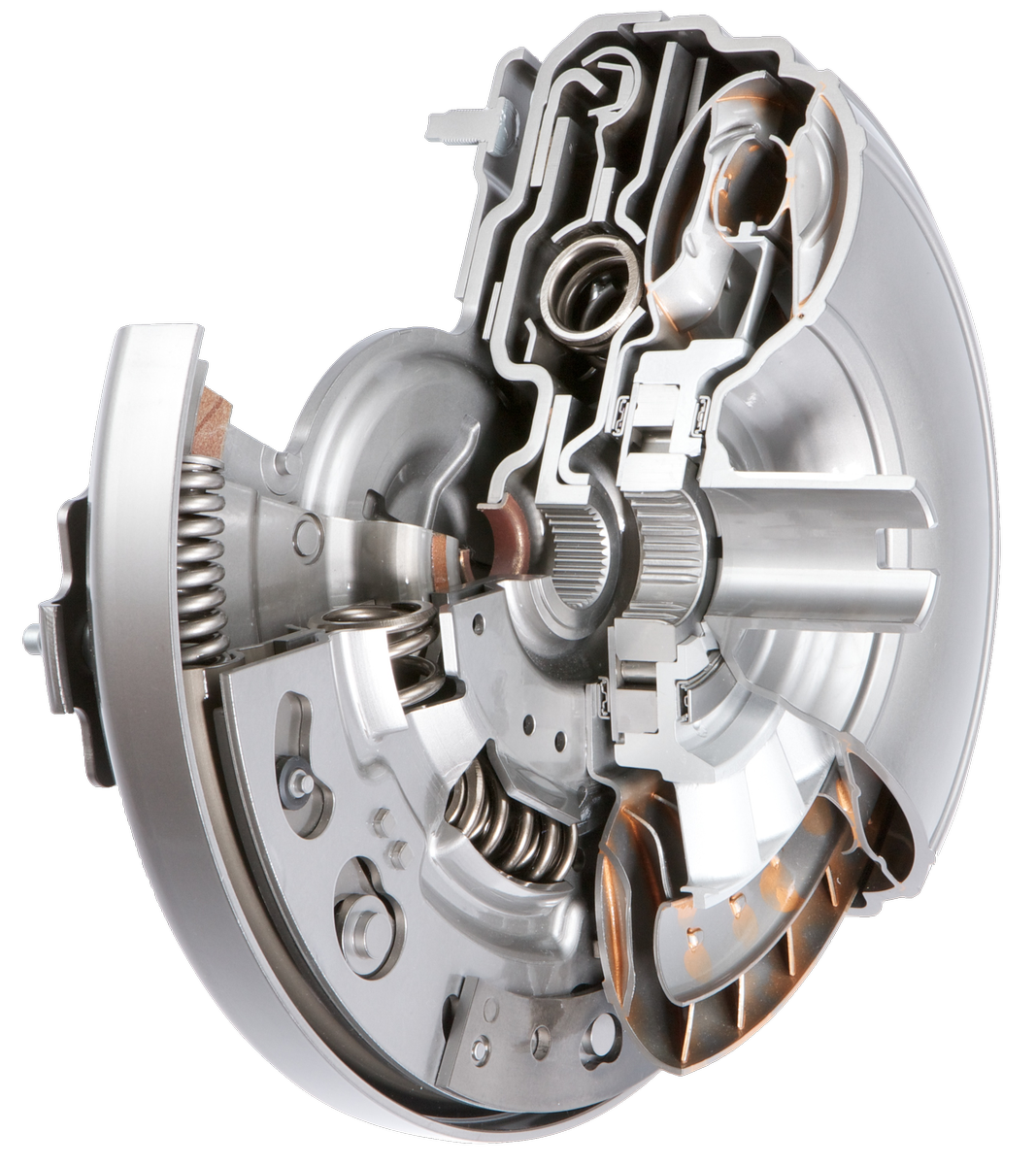
A sectioned model of a rear-wheel-drive torque converter with a centrifugal pendulum absorber in its damper. Photograph: LuK USA LLC / Michael Poehler / Wikimedia Commons
Image Credits: Wikimedia Commons / LuK USA LLC / Michael Poehler
The three phases: stall, acceleration, lock-up
The converter goes through three distinct operating phases, and each one matches something you feel from the driver's seat.
Stall is the red-light phase. The engine is turning and the impeller is spinning, but the turbine is held still because the brakes are on. The converter churns oil against a stationary turbine, which is why the car creeps forward the moment you release the brake, while torque multiplication peaks at roughly two and a half times the engine's input torque.
Acceleration is the green-light phase. As the car starts moving, the turbine begins to spin, but it lags behind the impeller. The stator keeps redirecting the returning oil and multiplying torque, though the ratio falls as the turbine catches up.
Coupling, or lock-up, is the cruising phase. Once the turbine speed nearly matches the impeller speed, the stator's one-way clutch lets it freewheel so it does not obstruct the oil flow. Then the lock-up clutch mechanically ties the impeller and turbine together, eliminating slip, so no energy is lost churning oil and highway fuel economy improves.
Advanced Transmission describes the same sequence and notes that the lock-up clutch allows the impeller and turbine to lock together at higher speeds, reducing slipping and increasing fuel efficiency. Modern converters engage it in surprisingly low gears, sometimes as early as second, to claw back the efficiency automatics used to lose to manuals.
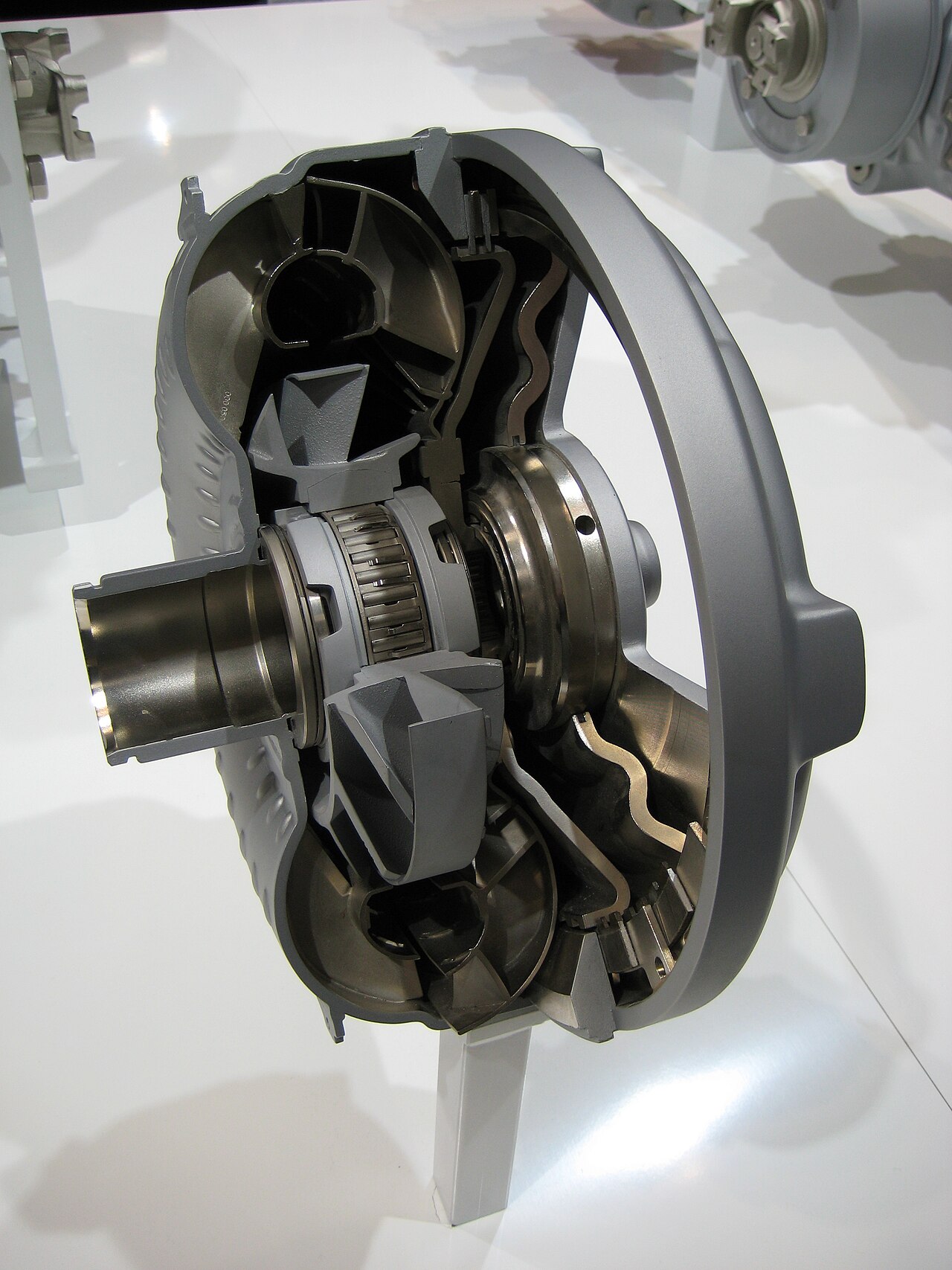
A ZF torque converter on display at the Bauma trade fair in 2007. Photograph: Aconcagua / Wikimedia Commons
Image Credits: Wikimedia Commons / Aconcagua
Why the fluid matters as much as the hardware
The converter's oil is not just lubrication. It is the working medium, and its behavior decides how well the whole device performs. Automatic transmission fluid is engineered to stay stable across a wide temperature range, because a converter at stall on a summer day generates serious heat.
That is also why transmission fluid changes still matter on cars with sealed-for-life claims. Overheated or degraded fluid foams, and foamed fluid cannot transfer torque cleanly. The symptoms of a struggling converter, shuddering on acceleration, delayed engagement when shifting into drive, or a transmission that runs hot, often trace back to the fluid before they trace back to the hardware.
If your car has an automatic, it shares its transmission fluid with the converter, and the two age together. The signs of tires slowly losing pressure get more attention, but the fluid inside the bell housing works harder than the air inside the tires.
Where torque converters fit in 2026
The converter's long reign is finally being challenged. Electric vehicles do not need one, since electric motors make full torque from zero speed. Many hybrids use power-split devices or dual-clutch gearboxes instead.
Engineers keep refining it. Multi-plate lock-up clutches engage earlier and stay locked longer, pendulum absorbers damp the vibration that direct lock-up would otherwise send into the cabin, and blade designs squeeze out the last percentage points of efficiency. A 120-year-old idea, patented before the first traffic light, is still earning its place under the hood.
It is a useful reminder that the cleverest car parts are often the invisible ones. Drivers never touch the torque converter, never see it, and rarely think about it, yet it performs its little fluid ballet every single time the car pulls away from a light.
Frequently asked questions
Can a torque converter replace a clutch completely?
In a traditional automatic, yes. The converter performs the clutch's job of disconnecting the engine from the wheels at a stop and reconnecting it smoothly. Some newer automatics add a lock-up clutch inside the converter for efficiency, which is a different device from a manual gearbox's friction clutch.
What does a failing torque converter feel like?
Common symptoms include shuddering or vibration during acceleration, a noticeable delay when shifting into drive or reverse, unusual whining noises, and higher-than-normal transmission temperatures. Because these symptoms overlap with general transmission trouble, a proper diagnosis checks the fluid condition and scans for fault codes before condemning the converter itself.
Why do some automatics still feel sluggish off the line?
A small amount of delay is inherent: the impeller must spin the fluid up before the turbine responds, which is the fluid equivalent of clutch slip. Modern converters minimize it with tighter blade clearances and early lock-up, but the brief softness at launch is the price of the smoothness automatics are famous for.
Do CVTs use torque converters?
Many do. A continuously variable transmission still needs something to launch the car from a standstill and absorb the speed difference at idle, and plenty of CVT designs use a torque converter for exactly that job. Others use a clutch pack or a simple fluid coupling instead.
The bottom line
A torque converter is three fans and some clever plumbing. The engine-driven impeller throws fluid at the turbine, the turbine drives the transmission, and the stator redirects the returning fluid so the whole arrangement multiplies torque when the car needs it most, at launch. Once the car is moving, the lock-up clutch ties everything together solidly for efficient cruising.
Föttinger's 1905 patent solved the problem of starting a heavy machine smoothly without a mechanical clutch. Nearly a century of automatics later, from the 1939 Hydra-Matic to today's lock-up converters, the fluid is still doing the work. Next time your car creeps forward at a green light with no input from you, that is a century-old idea, churning oil in the dark, doing its job.
Latest in Auto
- Why car doors lock automatically when you drive off
- Why do indicators make that clicking sound?
- Why does your windscreen fog up on the inside?
- Why do tyres lose pressure slowly even without a puncture?
Get a new automotive explainer in your inbox every morning, subscribe to the Rive News newsletter.
Related stories

Why Does Tire Pressure Drop in Cold Weather?
Cold weather can cut tire pressure by 1 psi for every 10°F drop, thanks to the ideal gas law. Here is what happens inside the tire and what

Why Do Brake Rotors Warp, or Do They Actually?
Mechanics rarely see a truly warped rotor. The shudder usually comes from uneven pad deposits a few thousandths of an inch thick. Here

How to Buy a Used Car Without Getting Scammed: The Checklist
Over 450,000 cars a year have rolled-back odometers, NHTSA says. This checklist covers VIN checks, title washing, and the inspection that