
Why Does Chocolate Get White Spots on the Surface?
Key takeaways
- White spots are nearly always fat bloom or sugar bloom, not mold and not spoilage.
- Fat bloom comes from cocoa butter recrystallizing after temperature swings; sugar bloom comes from moisture.
- Bloomed chocolate is safe to eat, though the texture may be grainy or waxy.
Those pale spots or dusty film on a chocolate bar look alarming, but they are almost never a sign of spoilage. Food scientists call the phenomenon bloom, and it comes in two distinct types: fat bloom and sugar bloom. Both are physical changes in the chocolate, not contamination.
This article explains what each type is, why cocoa butter behaves this way, how to tell the two apart, and how to store chocolate so it does not bloom.
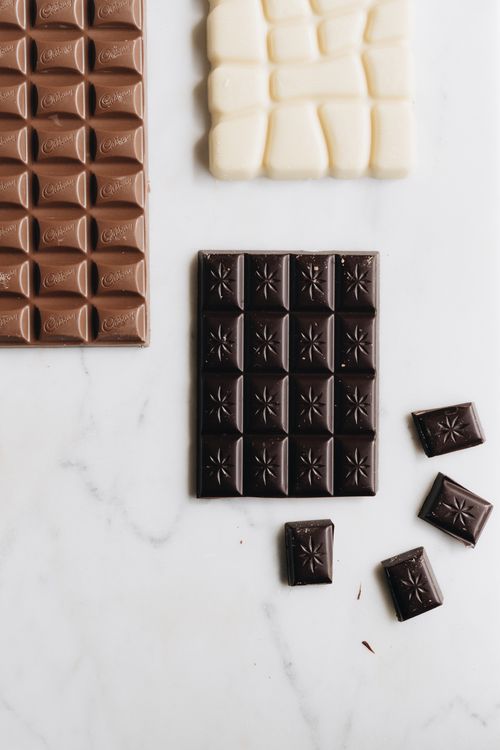
Image Credits: Pexels (free-use license)
What fat bloom is
Fat bloom is the grayish-white film or streaking that appears when cocoa butter separates from the rest of the chocolate and migrates to the surface. The average cocoa bean is about 50% cocoa butter and 50% cocoa fiber, as research chemist Nathan Kilah wrote in The Conversation, cited by Live Science.
Cocoa butter is unusual because it can crystallize in six different forms, called polymorphs. Only one, the beta-V form, gives chocolate its ideal qualities: glossy, firm, a sharp snap, and stability at room temperature with a melting point of about 34°C (93°F).
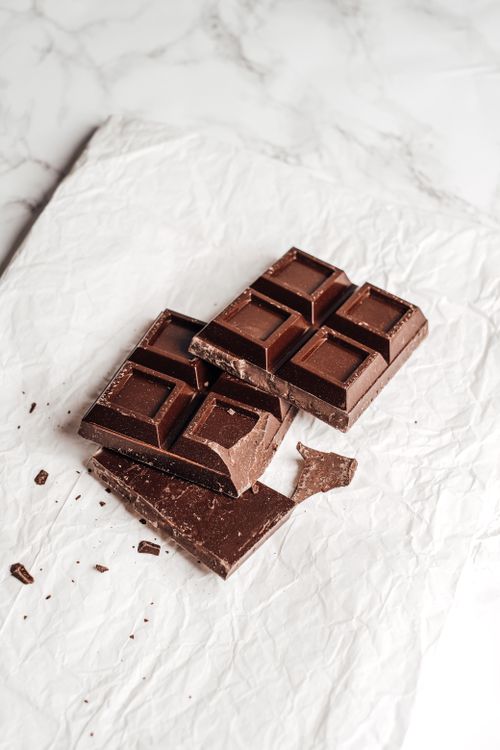
When chocolate is improperly tempered or exposed to temperature swings between 18°C and 28°C (64-82°F), less stable crystal forms grow instead. These lower-melting crystals migrate toward the surface through tiny fat pathways and recrystallize into visible white or grayish clusters. That is fat bloom.
Warm storage above 24°C accelerates it, and above 32-34°C (90-93°F) the cocoa butter partly melts and recrystallizes out of control, according to the Zucchero chocolate guide.
What sugar bloom is
Sugar bloom looks different: dry white spots with a rough, dusty texture. It starts with moisture.
Water on the chocolate dissolves some of the surface sugar. When the moisture evaporates, the sugar is left behind as fine crystals.
The classic trigger is condensation. Moving cold chocolate from the refrigerator into warm, humid air coats it in moisture, exactly like a cold soda bottle sweating on a summer day. Lindt describes this condensation path in its bloom guidance, cited by Totally the Bomb.
High humidity alone can also introduce moisture without any temperature shock. And the refrigerator, which many people reach for in hot weather, can cause condensation during transitions in and out of cold environments.
How to tell the two apart
The two blooms feel and look different. Fat bloom appears as smooth pale streaks or a dull gray film. Sugar bloom looks like dry, dusty, or blotchy white spots and feels grainy.
Food-science writers at Zucchero note two simple tests from a 2020 study in Scientific Reports by Heuler and colleagues: a spatula warmed on a 40°C (104°F) hot plate melts fat bloom, while a drop of water dissolves sugar bloom. One piece of chocolate can even carry both kinds at once.
Just as important is what bloom is not. Bloom is not mold.
Mold appears fuzzy and irregular, often greenish-gray or blue-black, and grows only under sustained high humidity with prolonged temperature abuse. If the white coating looks fuzzy or raised, that is a different problem than bloom.
Is bloomed chocolate safe to eat
Yes. The Canadian Food Inspection Agency says chocolate bloom is harmless and bloomed chocolate can be eaten or used in baking.
Iowa State University Extension adds that bloom affects neither the taste nor the shelf life of chocolate and does not make it unsafe. It only affects how it looks and feels.
The texture may disappoint. Fat-bloomed chocolate can taste waxy, and sugar-bloomed chocolate can taste grainy. As chocolatier sources quoted by Live Science explain, blooming disrupts the chocolate's crystalline structure, so the melt sensation is less smooth.
Fat bloom is physically reversible by melting and re-tempering the chocolate. Sugar bloom is not reversible, because the sugar crystals have already re-formed on the surface.
How to prevent it
Preventing fat bloom is mostly about temperature. Store chocolate cool and steady at 18°C (64°F) or below, without fluctuations. Avoid warm spots like the top of the refrigerator or a sunny shelf.
Preventing sugar bloom is mostly about moisture. Keep water away from the chocolate, seal packaging tightly, and warm cold chocolate slowly so condensation never forms on the surface.
Professional chocolatiers prevent bloom at the source through tempering, the controlled heating and cooling of liquid chocolate that builds a stable crystal structure. Properly tempered chocolate starts with far more beta-V crystals, so it resists bloom much longer. Home cooks can approximate this by melting bloomed chocolate and using it in ganache or baked goods, where the crystal structure is rebuilt or no longer matters.
If your home runs hot above 28°C for days, the refrigerator can be a last resort. Wrap the chocolate tightly in two layers of heavy foil, place it in an airtight container, chill at 4°C for up to seven days, then let the sealed container acclimatize at 10°C for four hours before opening.
FAQ
Can I still bake with bloomed chocolate?
Yes. The Canadian Food Inspection Agency confirms bloomed chocolate is suitable for baking. Once melted into a batter or ganache, the surface crystals no longer matter.
Does bloom mean the chocolate was poorly made?
Not necessarily. Bloom occurs even in professionally tempered chocolate if it is exposed to thermal cycling or humidity swings. Poor tempering is one cause, but bad storage is just as common.
Why does white chocolate bloom more than dark?
White chocolate and milk chocolate have higher fat content than dark chocolate. More fat means more cocoa butter available to migrate to the surface, so fat bloom shows up more easily.
How long does chocolate last after it blooms?
Bloom does not extend or shorten the timeline. Chocolate stored dry below 28°C stays safe indefinitely as long as there is no mold, insect damage, or off odor, according to USDA food-safety guidance.
The bottom line
White spots on chocolate are fat bloom from cocoa butter or sugar bloom from moisture, and both are harmless. Keep chocolate at a steady 18°C or below, keep it dry, and let it warm up slowly after any cold storage. If it blooms anyway, the flavor is still fine for eating or baking.
Latest in Food & Cooking
- Why baking powder makes cake rise without yeast
- How to tell if cooking oil has gone bad
- Why garlic turns blue when cooking
- Why pancakes come flat instead of fluffy
Subscribe for one practical food-science explainer every morning.
Related stories
Why Does Bread Go Stale Faster in the Refrigerator?
Bread goes stale faster in the fridge because starch recrystallizes fastest near 4°C. Here is the retrogradation science and the right way
Baking soda and baking powder: what's the difference?
Baking soda is pure sodium bicarbonate; baking powder adds two dry acids for double-acting lift. Learn when to use each, plus exact

What Is the Maillard Reaction in Simple Terms?
The Maillard reaction is the browning chemistry between amino acids and sugars above 140 C that creates the crust, color, and rich flavor