
Why potatoes turn green in sunlight so fast
By Rive News / Research desk | Rive News / Published October 28, 2026 at 9:00 AM PKT
Key takeaways
- Light triggers green chlorophyll in potatoes, and solanine rises alongside it.
- Chlorophyll itself is harmless, but solanine is bitter and can cause illness in large amounts.
- Small green patches can be cut away deeply, while heavily green potatoes should be thrown out.
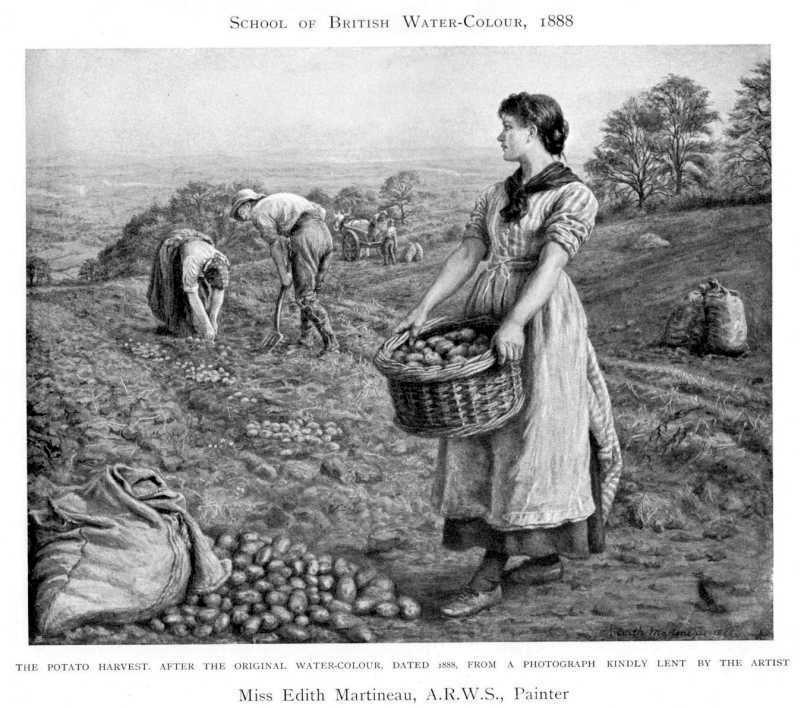
[Workers harvesting potatoes in a field, from an 1888 print.] Photograph: Wikimedia Commons contributor
Image Credits: Wikimedia Commons
A potato left on a sunny counter does not ripen. It greens.
The change can start in days, and it signals that the tuber is defending itself against light. That defence matters because the green colour arrives with a bitter compound that the potato did not have in the same amount underground.
This article explains why potatoes turn green in sunlight, including chlorophyll, solanine, how much green is too much, whether peeling helps, and how dark storage prevents the problem.
Potatoes grow in the dark for a reason
The potato we eat is a tuber, a swollen underground stem built for storage. Purdue University explains that the tuber grows underground, away from light, and its eyes are buds that can sprout into shoots. Light is not part of its normal growing environment.
When a tuber meets light, it reacts as if it has been exposed above ground. It starts making chlorophyll, the green pigment that powers photosynthesis in leaves. The tuber is not becoming a leaf, but it switches on the same pigment machinery.
That switch can happen in the garden as well as the kitchen. Purdue notes that potatoes turn green when growing too close to the soil surface, and when stored under even low-light conditions. A windowsill, a clear container, and a shop display under bright lights can all trigger it.
Chlorophyll is harmless, solanine is not
The key distinction is between the colour and the compound behind it. Chlorophyll is not toxic. Purdue states this directly, then adds the warning that matters: another response to light is increased production of solanine, a colourless alkaloid.
Solanine is the potato's chemical defence. It tastes bitter and deters pests and animals from eating the exposed tuber. The amount rises with the length of exposure and the intensity of light, according to Purdue, so a potato in bright sun for a week carries more than one in dim light for a day.
Eating a large quantity of solanine can cause illness, and Purdue notes that extreme cases can be fatal. Most people are unlikely to eat enough affected tissue to fall ill, partly because solanine tastes bitter enough to put them off. That bitterness is a useful warning, not a guarantee of safety.
How much green is too much
There is no exact colour chart for safety, and greenness alone does not measure solanine. The two rise together, but the toxin is colourless and spreads beyond the visible green. Treat green as a warning flag, not a precise meter.
A small, shallow green patch on an otherwise firm potato is the lowest-risk case. Purdue advises that the highest solanine concentration sits in the skin, and removing the green portion also removes most of the toxin. Cut generously past the green edge, and remove any sprouts, which are also high in solanine.
A potato that is green across much of its surface, soft, sprouted heavily, or bitter after cooking should be thrown out. Peeling cannot fix deep or widespread greening, since the toxin may extend into the flesh. When in doubt, discard it, since potatoes are cheap and the risk is avoidable.
Cooking does not rescue a green potato either. Solanine is not destroyed by normal boiling or baking, so a green potato that goes into a pot comes out with its toxin largely intact. The fix happens at selection and storage, not at the stove.
Why peeling sometimes works and sometimes fails
Peeling works when the problem is shallow. Solanine concentrates in and just under the skin, so a deep peel of a lightly green patch removes the worst of it. Purdue's guidance rests on that distribution: skin first, flesh second.
Peeling fails when greening is deep or the potato is already bitter throughout. In that case the visible green is only the surface of a wider change. Cutting away the green leaves bitter flesh behind, which is a sign to stop and discard the potato.
Taste can help here, but it should not be the only test. If a cooked potato tastes noticeably bitter, do not finish the serving. Bitterness after cooking is a strong hint that solanine levels stayed high despite peeling.
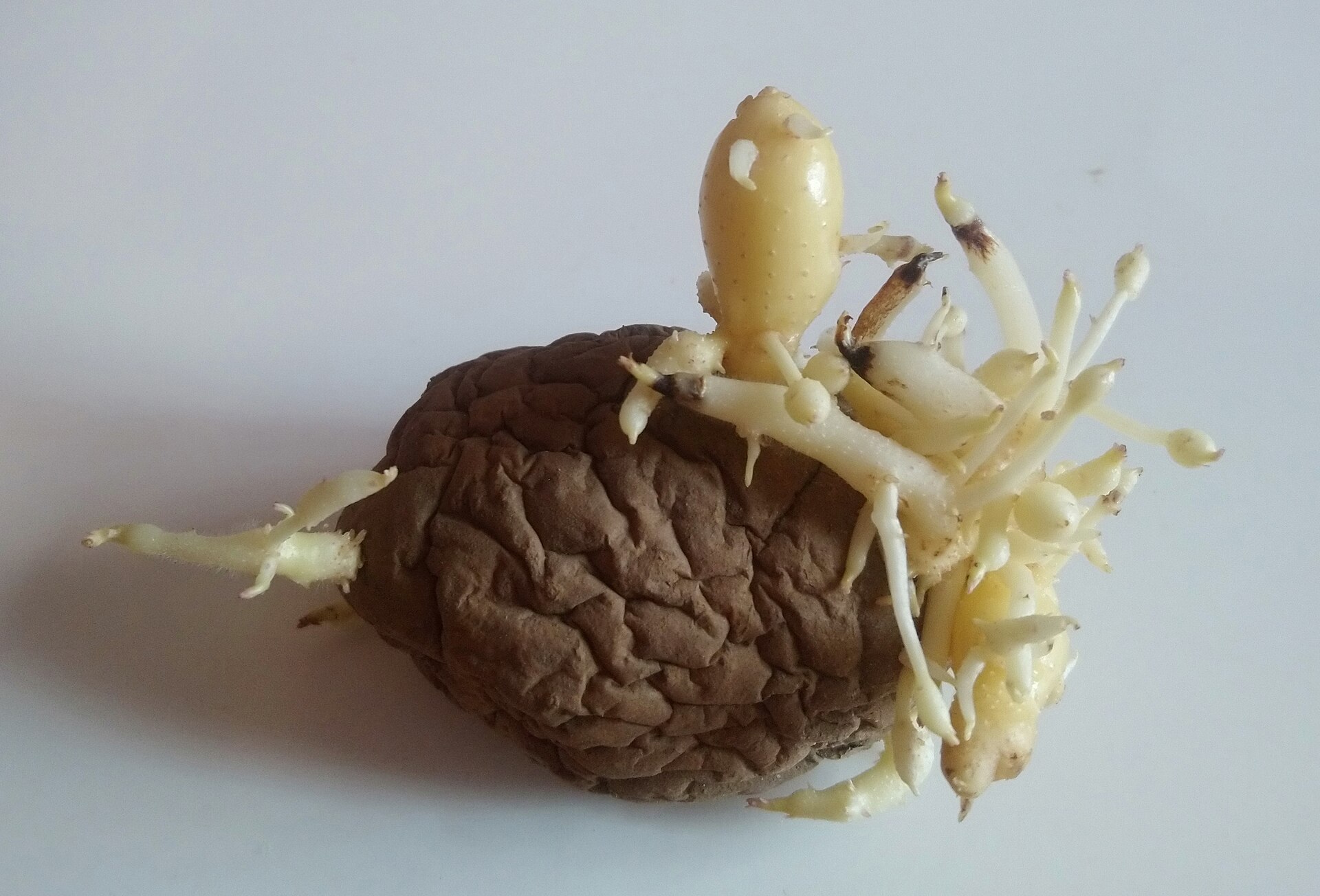
[A sprouting potato with shoots growing from its eyes.] Photograph: Wikimedia Commons contributor
Image Credits: Wikimedia Commons
Storing potatoes so they never green
Darkness is the whole prevention plan. Purdue recommends mulching garden plants to keep tubers covered, and storing harvested potatoes in complete darkness. A paper bag, a closed cupboard, or a dark pantry all work, while a clear bowl on the counter does not.
Temperature and air matter too, though they do not cause greening on their own. Cool, dry, ventilated storage keeps potatoes firm longer and slows sprouting. Warm storage speeds sprouting, and sprouts themselves carry high solanine, so keep potatoes away from heat sources as well.
Shop displays deserve the same caution. Brightly lit supermarket bins can start greening before the potato reaches home. Choose potatoes from the bottom or back of a display where light is weaker, and check the skin before buying.
Frequently asked questions
Are green potatoes poisonous to touch?
No, handling a green potato is not the danger. Solanine causes problems when eaten in quantity, not through skin contact. Wash hands after handling as normal, and keep the safety decision about eating, not touching.
Can I eat a potato with one small green spot?
A small, shallow spot can usually be cut away deeply, along with any sprouts, if the rest of the potato is firm and normal. If the green covers a large area, runs deep, or the potato tastes bitter, throw it out instead of trying to salvage it.
Does cooking destroy solanine in green potatoes?
No, normal cooking temperatures do not reliably break solanine down. Boiling, baking, and frying leave most of it intact. That is why peeling and selection matter more than cooking method for green potatoes.
Do sweet potatoes turn green the same way?
No, sweet potatoes are a different plant and do not green through the same chlorophyll and solanine response. Their storage problems are different, mainly sprouting and softening. The green warning applies to ordinary potatoes.
The bottom line
Potatoes turn green because light wakes up pigment machinery that belongs underground. Chlorophyll gives the colour, solanine gives the risk, and the two rise together.
Keep potatoes in the dark, cut away small green patches deeply, and throw out heavily green or bitter ones. The green is doing its job as a warning, and the safest response is to heed it.
Tags: potatoes, solanine, storage, food safety
Rive News's research desk covers food science and everyday cooking questions, checking each claim against published sources before writing.
Related
- Why potatoes turn green and what solanine means
- How to make crispy potatoes without deep frying
- Why garlic turns blue when cooked
- Why meat turns brown in the fridge
Subscribe for one food science explainer each week.
Rive News publishes researched explainers with named sources and a corrections note on every article.
Related stories
Why Does Bread Go Stale Faster in the Refrigerator?
Bread goes stale faster in the fridge because starch recrystallizes fastest near 4°C. Here is the retrogradation science and the right way
Baking soda and baking powder: what's the difference?
Baking soda is pure sodium bicarbonate; baking powder adds two dry acids for double-acting lift. Learn when to use each, plus exact
What Is the Maillard Reaction in Simple Terms?
The Maillard reaction is the browning chemistry between amino acids and sugars above 140 C that creates the crust, color, and rich flavor