
Turtles hide in their shells because shadows look like predators
Key takeaways
- A passing shadow looks like a swooping predator to a turtle, so it pulls its head and legs inside its shell within seconds.
- Turtles retract in two ways: cryptodires pull their heads straight back, while pleurodires fold the neck sideways.
- A turtle that hides at your shadow is scared, not tired, so give it space and slow, predictable movement.
A passing shadow is one of the fastest ways to make a pet turtle disappear. One moment your slider is basking on its rock, and the next only a smooth dome sits there. Head, legs, and tail have all tucked inside.
This is not sulking or laziness. It is an ancient survival reflex, and it is worth taking seriously. A sudden dark shape overhead matches the one attack pattern turtles have faced for millions of years: a predator dropping from the sky.
This article explains why turtles pull into their shells at passing shadows, including why shadows read as danger, how the shell defense actually works, why some turtles hide more than others, and what it means for pet turtle owners.
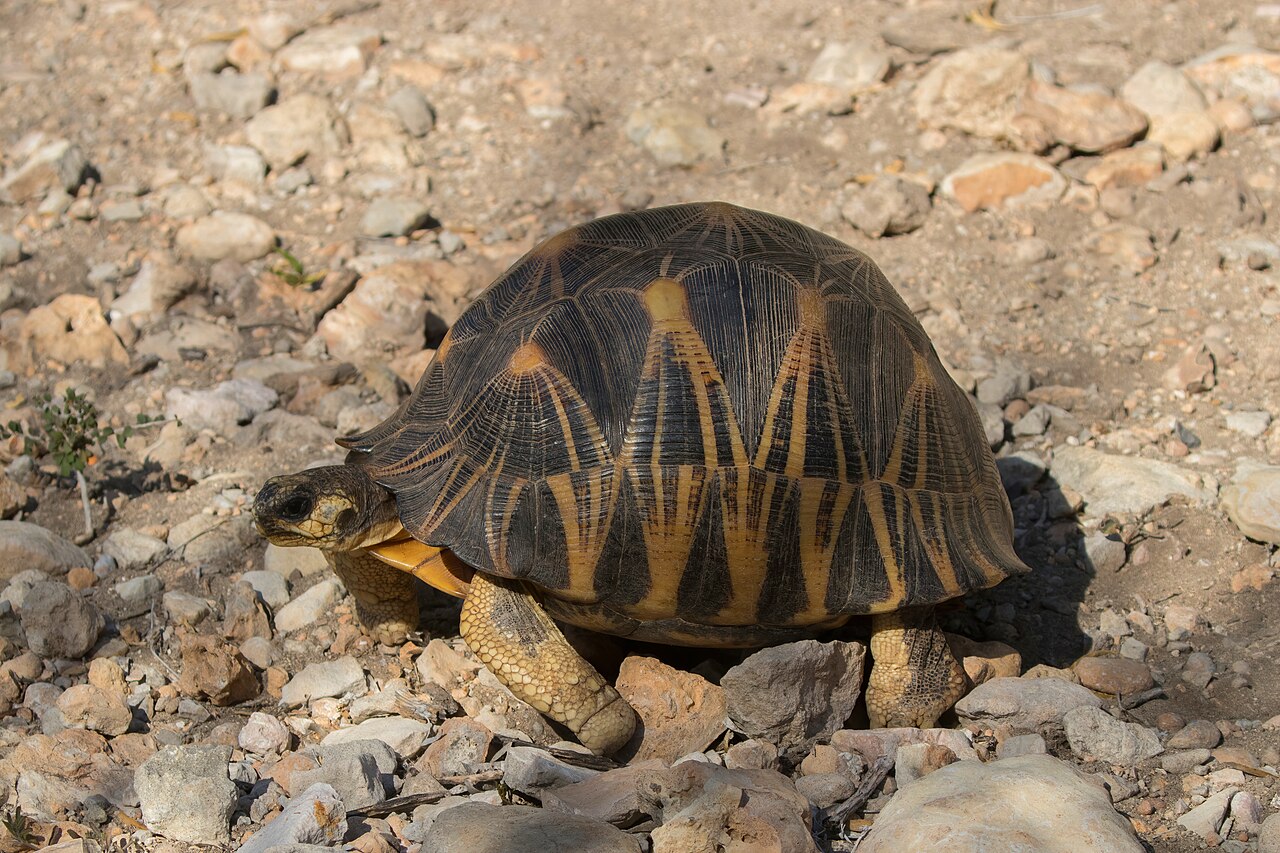
Image Credits: Wikimedia Commons / Charles J. Sharp
Why a passing shadow reads as danger
Turtles see their world far better than most owners expect. According to the State of the World's Sea Turtles program, sea turtles have color vision and can detect near-ultraviolet wavelengths that humans cannot see. Behavioral trials with green turtle hatchlings found they preferred light in the 360 to 500 nanometer range, from ultraviolet to blue, as reported in a 2018 PeerJ study (PMC6151116).
That sharp vision is tuned for threats. In the wild, danger often arrives as a sudden change in light. A hawk's shadow sweeping the water, a raccoon's shape blocking the sun, or a heron's beak dropping from above all begin the same way: a quick darkening overhead.
A turtle that hesitates at that signal does not get to hesitate twice. Quick retreat beats careful identification every time.
Side approaches alarm them too. Turtles watch a wide field of view through strong peripheral vision, and motion from the side or from above reads as a predator's approach, according to the pet-care site Turtle Pet Guide. Walk past a basking turtle fast and you have just replayed that script.
Vibration completes the warning system. Sea turtles are especially sensitive to low-frequency sound and vibration, with peak sensitivity at or below 400 hertz, according to the same State of the World's Sea Turtles guide. Your footsteps cross the room and your turtle feels them through its shell long before it sees your hand.
Turtles assess risk much like other animals do. Dogs bark at some strangers but not others after a split-second threat check, and a turtle runs the same calculation: sudden movement plus shadow equals possible predator.
How the shell defense actually works
Pulling inside the shell looks simple, but the anatomy behind it is a 200-million-year project. Living turtles fall into two groups based on how they retract their necks, according to Smithsonian Magazine, reporting on research by paleontologist Jérémy Anquetin of the Jurassica Museum published in Scientific Reports. Cryptodires pull their heads straight back into the shell, while pleurodires fold the neck sideways under the shell rim.
Two ways to pull in a head
The split is ancient. Side-necked turtles first appeared more than 200 million years ago, and hidden-necked turtles branched off around 165 million years ago. A fossil species called Platychelys oberndorferi, which lived about 150 million years ago, could only partly retract its head, showing how the full tuck developed over geological time.
The shell itself is living armor. It is built from bony plates that incorporate the animal's ribs and vertebrae, and research on freshwater turtles has linked the shell directly to the animal's behavioral defense strategy, alongside metabolic and antioxidant measures, in a study indexed on PubMed Central and covered by the Times of India.
Why retraction happens so fast
Retraction happens fast because the neck is built for it. In cryptodires, which include red-eared sliders, box turtles, and most tortoises, the wide spacing of the neck vertebrae lets the neck fold into an S-shaped curve as it withdraws.
Muscles pull the head straight back, and folds of skin and scale seal the opening. The turtle becomes a smooth, sealed case with nothing soft exposed.
Not every turtle can pull this off. Sea turtles cannot retract at all; their streamlined shells traded retraction for swimming power.
Snapping turtles barely manage it because their plastron, the bottom shell, is too small to cover the underside. Your pet slider, though, is a full cryptodire retracter, which is why it vanishes so completely.
Other pets use different hardware for the same job. Dogs tilt their heads to tune their hearing toward a sound, while a turtle's answer to an alarming stimulus is the opposite: pull everything in and go still.
Why some turtles hide more than others
Species sets the baseline. Box turtles and tortoises are champion retracters, while snapping turtles and softshells rely more on biting or burrowing.
Red-eared sliders, the most common pet turtle, retract fully but will often dive off the basking platform first if the water is right there. The shell is their fallback, not always their first move.
Age and history matter too. Hatchlings hide at everything because everything in their world can eat them. Adults are calmer but still spook at genuinely sudden movement.
A turtle that was recently moved, chased, or handled roughly will hide far more than one that has lived quietly in the same tank for a year. Patience matters most in those first weeks.
Environment plays a role as well. Tanks placed in busy hallways get constant shadows and startling traffic, so the turtle barely basks.
A tank in a calm corner, with the basking spot out of the foot-traffic shadow path, produces a much bolder turtle. If the water is cold or the lighting is wrong, the animal hides for comfort rather than fear, so check temperature and basking heat before blaming your shadow.
Individual temperament is real. Keep two sliders in identical setups and one will still be the shy one. That difference is normal, not a defect.

Image Credits: Wikimedia Commons / Gedalya Lubman
What this means for pet turtle owners
The single most useful habit is slow movement around the enclosure. Move at a walking pace, keep your hands low, and avoid sweeping your arm over the tank where its shadow crosses the water. Approach from the front where the turtle can see you coming, not from above or the side.
Give new turtles a settling-in period. A turtle that just arrived in your home will hide at every shadow for days or even weeks, and that is normal.
Let the animal come out on its own; never try to pull a turtle out of its shell. Forcing contact resets trust to zero.
Build trust through routine. Feed at the same spot and the same time, move the same way each visit, and keep the room calm. It is gradual work, a lot like crate training a puppy step by step: small consistent steps beat one big push.
Learn to read the body language. A turtle that hides is frightened, and learning that signal is the start of real pet communication, much like learning why cats purr taught cat owners to read feline mood. A curious turtle stretches its neck up; a scared one drops low and vanishes.
Over time your turtle will start reading you back. A pet turtle learns the difference between the hand that feeds and a strange fast shape, just as a dog stares at you while eating because it has learned exactly what your hands mean. Predictable, gentle behavior earns a bolder turtle.
When hiding is a warning sign
Watch for hiding that never stops. Constant withdrawal, loss of appetite, erratic swimming, or swollen eyes can point to stress or illness such as a respiratory infection. A reptile vet should check any turtle that hides for days on end.

Image Credits: Wikimedia Commons / Brocken Inaglory
Frequently asked questions
Is it normal for my turtle to hide every time I walk past?
Yes, especially in a new home. The reflex fires before the turtle identifies you, so even a familiar owner can trigger it by moving fast or casting a shadow. Slow down and give it weeks of calm routine.
How long will a turtle stay inside its shell?
Minutes to a few hours, depending on how scared it is. A turtle that feels the danger has passed will poke its head out, check the area, and resume basking. Constant hiding for days points to stress or a health problem.
Why does my turtle not hide at all anymore?
It trusts you. Pet turtles habituate to familiar, predictable people and stop treating their movements as threats. That is a good sign, but it does not mean the animal wants handling, which most turtles only tolerate.
Can a shadow itself hurt my pet turtle?
No, shadows are harmless light changes. The only harm comes from chronic stress if the turtle is startled dozens of times a day. Keep the tank away from busy walkways and avoid hovering over it.
Should I pick up my turtle to show it there is no danger?
No. Picking up a hiding turtle confirms its fear, not your kindness. Let it emerge on its own terms, and offer food from a consistent spot so it builds positive associations.
The bottom line
Your turtle hides from shadows because its brain is wired to treat sudden darkness overhead as a predator. That reflex is millions of years old and you will not train it away, but you can work with it. Move slowly, approach from the front, keep a calm routine, and your turtle will reward you by staying out and staying curious.
Latest in Pets
- How to crate train a puppy, step by step
- Why cats knead with their paws
- Why dogs eat grass and vomit
- Foods that are toxic to dogs
Subscribe to the Rive News newsletter for weekly pet behavior explainers.
Related stories
Why Does My Dog Eat Grass and Vomit?
A UC Davis study of 1,571 owners found grass eating is normal dog behavior, not self-medication: only 10% were ill first. What the science
Why Does My Dog Stare at Me While I Eat?
Dogs stare at you while you eat because it has worked before, and mutual gaze raises bonding hormones. Learn the reinforcement science
Foods toxic to dogs: the list, with reasons
Chocolate, xylitol, grapes, onions: common foods can harm dogs. Learn what makes each one toxic, the warning signs, and what to do if your