
Why Does a Spinning Top Stay Upright While It Spins?
Key takeaways
- A fast-spinning top stays upright because its angular momentum resists changes to its spin axis.
- Gravity cannot tip the top directly; its torque turns the axis sideways, producing the slow circling motion called precession.
- Spin faster and the wobble slows down, until friction drains the spin and the top finally falls.
A spinning top is a toy that balances on a single point while whirling around its own axis. Give it a sharp twist and it can stand upright, wander across a table, and even pull itself back toward vertical, all while gravity tugs at it constantly.
This article takes a closer look at why a spinning top stays upright, including angular momentum, the torque of gravity, precession, how spin speed changes the motion, and why every top eventually falls.
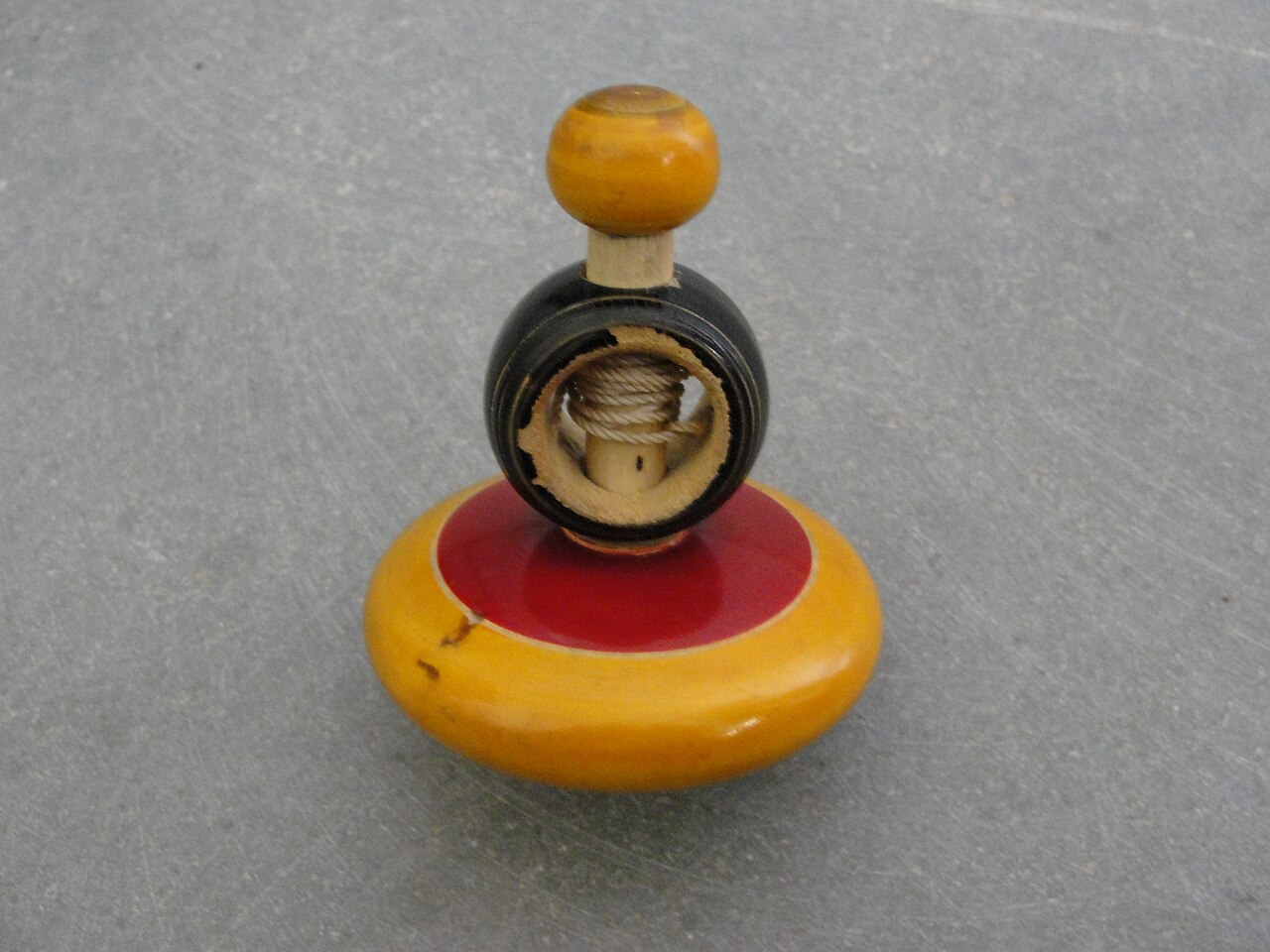
Angular momentum: spin resists being redirected
Spin a top fast and it carries angular momentum, written as L = I times omega, where I is the moment of inertia (roughly, the rotational mass) and omega is how fast it turns. Professor Robert B.
Laughlin of Stanford University explains the effect plainly in his lecture notes: just as a large force is needed to alter the course of a fast-moving object, a large torque is needed to change the orientation of a gyroscope with high angular momentum. A top that is spinning very fast will "drift across a table without tipping, resisting the lure of gravity to do so."
The key insight, and the one most people get wrong, is that spin does not create an upward force. As the physics educators at Academa put it, spin does not manufacture an upward force and it does not cancel gravity.
Gravity remains present, downward, with the same strength whether the top spins or not. What changes is how the top responds to that downward pull.
This is the same principle behind the gyroscopes in your phone, which sense orientation by resisting changes to their spin axis, and the gyroscopic instruments that guide aircraft through the sky.
Gravity's torque turns the axis sideways, not downward
If gravity simply pulled the top down, it would fall like any motionless object. The difference is where the pull acts.
Gravity acts at the top's center of mass, but the contact point with the table sits below and off to the side. Because gravity's line of action misses the contact point, it also produces a turning effect: torque.
Here is the part that surprises everyone. That torque does not point downward.
According to Academa's vector-first explanation, the gravitational torque points sideways, perpendicular to the plane containing the axle and the direction of gravity. A torque that opposed the angular momentum would slow the spin and bring the top toward rest.
But a sideways torque does something different: it turns the angular-momentum vector itself. Since the axle follows that vector in a rapidly spinning top, the axle turns sideways too.
That slow sideways turning is precession. The top is not held up by a hidden force. It is held up because the torque that would tip it over keeps being redirected into a gentle circular drift instead.
Stanford's Laughlin gives the same idea in compact form: torque is the rate of change of angular momentum, and because angular momentum is defined perpendicular to the direction of motion, pushing a spinning gyroscope sideways makes it respond in a perpendicular direction. A classic classroom demo, also described by Academa, suspends a bicycle wheel from one end of its axle.
It does not fall. It precesses.
Spin faster and the wobble slows down
One prediction of the physics sounds backward at first: spin the top faster, and its slow circling motion gets slower, not faster. Academa illustrates this with two identical tops.
Set the ratio of mass, gravity, and lever arm so that m g l divided by I equals twenty per second squared. The first top spins at 100 radians per second and precesses at 0.2 radians per second. The second spins twice as fast, at 200 radians per second, and precesses at only 0.1 radians per second.
The faster top is not weaker. It carries more angular momentum.
That larger vector is exactly why the same gravitational torque changes its direction by a smaller angle each second. Stanford's notes state the relationship as omega of precession equals torque divided by angular momentum. Bigger spin means bigger angular momentum, which means slower precession.
This is why a freshly launched top stands almost perfectly still, and why the wobble grows only as the spin decays. The same mathematics governs why a compass needle points north: small, steady forces produce predictable, directed motion.
Friction: why every top eventually falls
Friction plays a double role in the life of a top. First, it is necessary: without friction, the twist of your fingers would never grip the top's stem and convert into rotation.
But once the top is spinning, friction turns against it. The rubbing at the contact point and the drag of the air steadily convert rotational energy into heat, as the physics guides at Modern Physics describe.
Angular velocity drops, and as it does, the precession rate climbs. The slow circle widens, the wobble grows more violent, and the top finally tips over.
There is something fitting about the long history of this toy. Spinning tops are among the oldest toys archaeologists have ever found: a clay top unearthed in Iraq was dated to the 35th century BC, nearly six thousand years ago, and a wooden top carved around 1300 BC was found in the tomb of Tutankhamun, according to the toy historian Art of Play. Thousands of years of children have watched the same sequence, a steady spin, a growing wobble, a final tumble, without knowing that torque, angular momentum, and precession were choreographing it.
Frequently asked questions
Why does a top stand upright instead of falling over immediately?
Because the gravitational torque that would tip it over points sideways rather than downward, so it rotates the spin axis instead of toppling it. The axle follows the angular-momentum vector around in a slow circle called precession.
What is precession in simple terms?
Precession is the slow circling of a spinning object's axis. For a top, gravity pulls the tilted axle in a direction perpendicular to the fall, so the axis sweeps around in a cone instead of dropping. The precession rate equals torque divided by angular momentum.
Why does the top wobble faster as it slows down?
Since the precession rate equals torque divided by angular momentum, and angular momentum shrinks as friction slows the spin, the same gravity produces a faster and faster wobble. The shrinking spin leaves less resistance against the steady gravitational torque.
Do tops work the same way as gyroscopes?
Yes. A spinning top is a simple gyroscope. The same principle, angular momentum resisting changes to the spin axis, stabilizes bicycles, spacecraft, and the gyroscopes inside smartphones and aircraft instruments.
The bottom line
A spinning top stays upright not because spin fights gravity, but because gravity's torque can only turn the spin axis sideways. That sideways turning is precession, and it keeps the top circling instead of falling.
Faster spin means a bigger angular-momentum vector, a slower wobble, and a longer ride. Friction ends the performance every time, but the physics is worth a second look: the same effect keeps aircraft level, phones oriented, and bicycles stable at speed.
Latest in Science
- Why Does a Compass Needle Point North?
- Why Do We See Stars Only at Night?
- Why Do Stars Appear to Move Across the Sky Overnight?
- Why Does Your Phone Always Know Which Way Is Up?
Subscribe to the Rive News newsletter for one clear science explainer in your inbox every morning.
Image Credits: Wikimedia Commons / Thamizhpparithi Maari; Wikimedia Commons / Federlight; Wikimedia Commons / File Upload Bot (Magnus Manske)
Related stories
Why diamond is hard and graphite is soft when both are carbon
Diamond and graphite are both pure carbon, yet diamond is 10 on the Mohs scale and graphite is 1 to 2. The difference is not the atoms;
Why Hot Water Can Freeze Faster Than Cold: The Mpemba Effect Explained
Hot water can freeze faster than cold under specific conditions. The Mpemba effect, named for a 1963 schoolboy experiment, still divides
How Magnets Work at the Atomic Level: Spins, Domains, and Iron
Magnetism comes from electrons: their spin and orbits make each atom a tiny magnet. In iron, quantum forces align these atomic magnets into