
What Is the Difference Between Snorkeling and Freediving Gear?
Key takeaways
- Snorkelers stay at the surface breathing continuously, so their gear favors comfort: short flexible fins and easy masks.
- Freedivers hold their breath and dive deep, so their gear is built for efficiency: long rigid fins and low-volume masks.
- The snorkel itself differs too: snorkelers need a good breathing tube, while many freedivers use a simple streamlined snorkel or none at all.

A mask, a snorkel, and a pair of fins. Both sports start with the same three pieces, which is why people assume the gear is interchangeable. It is not.
The difference comes down to what each activity demands from the body.
Snorkeling is surface swimming. You float face-down, breathe continuously through the tube, and watch the reef below. DeeperBlue's comparison puts typical snorkeling at the surface with no breath-hold and almost no training required.
Freediving is breath-hold diving to depth. Typical freedives go deeper than 10 meters, competitors push beyond 130 meters, and breath-holds run well over 30 seconds, which requires a course with a certified instructor.
Because one sport breathes constantly at the surface and the other holds its breath underwater, every piece of gear gets engineered in a different direction.
Masks: comfort versus low volume
A snorkel mask is built for a wide field of view and an easy seal at the surface. Volume, the amount of air trapped between the mask and the face, barely matters when you never go deeper than a duck dive. Many snorkelers even choose full-face masks that cover the nose and mouth together so they can breathe through either.
A freediving mask is built around one number: internal volume. OpenWaterHQ explains why. As a freediver descends, water pressure squeezes the air space in the mask against the face, so the diver must exhale a little air into the mask to equalize it.
A low-volume mask needs less air to equalize, which saves precious oxygen on a breath-hold dive. Less trapped air also means less positive buoyancy, so the diver needs less lead on the weight belt.
The practical rule is simple. A snorkeler should pick the mask that seals comfortably and gives the clearest view. A freediver should pick the lowest-volume mask that still fits, because every wasted milliliter of air is oxygen spent on equalizing instead of diving.
Fins: short and flexible versus long and stiff
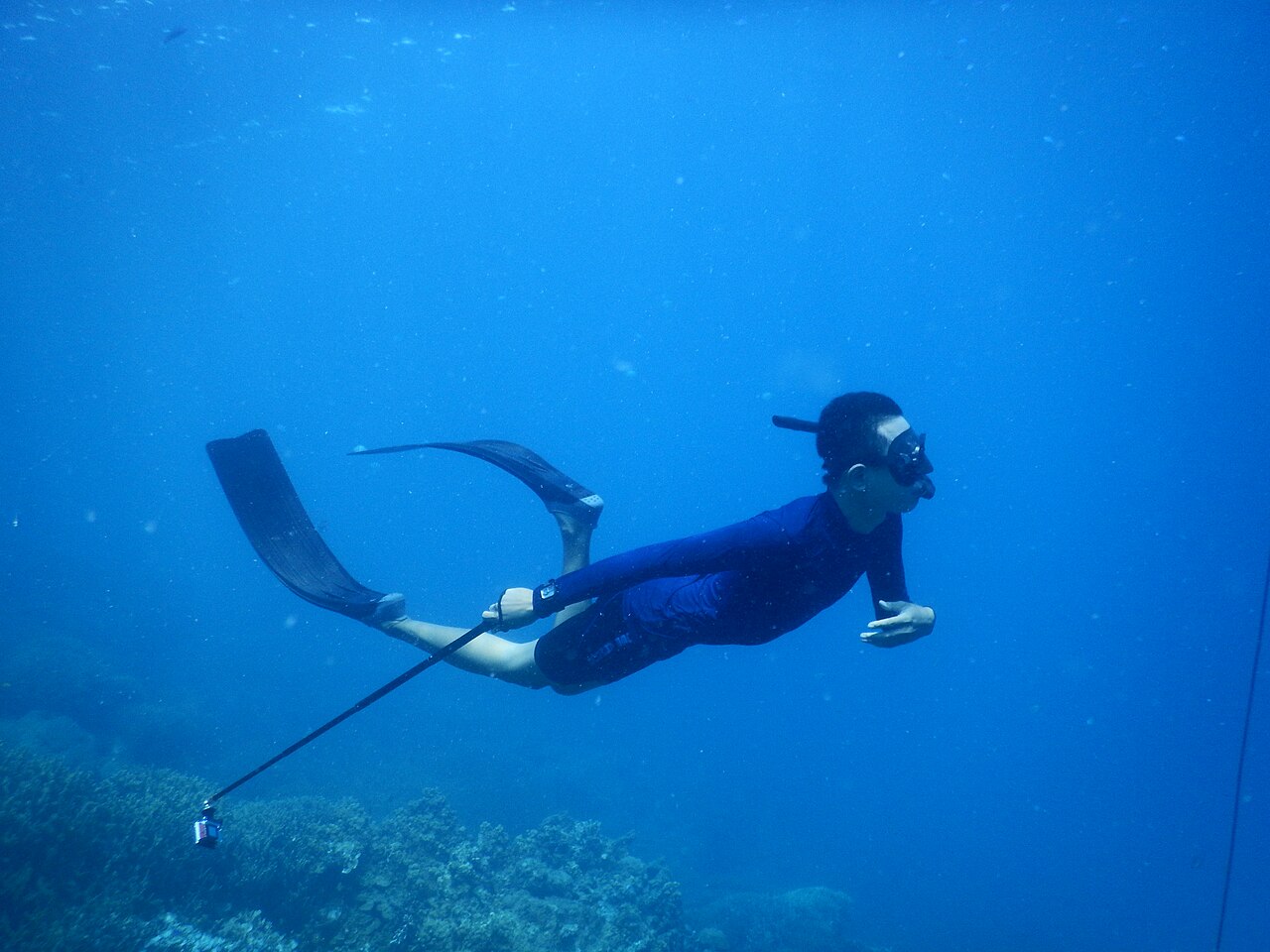
This is the most visible difference in the water. Snorkeling fins are short, soft, and easy to kick. LassDive's comparison explains the logic: snorkelers need easy-handling, comfortable fins rather than power or speed.
Short blades are also easier to pack for travel, which matters for a holiday sport.
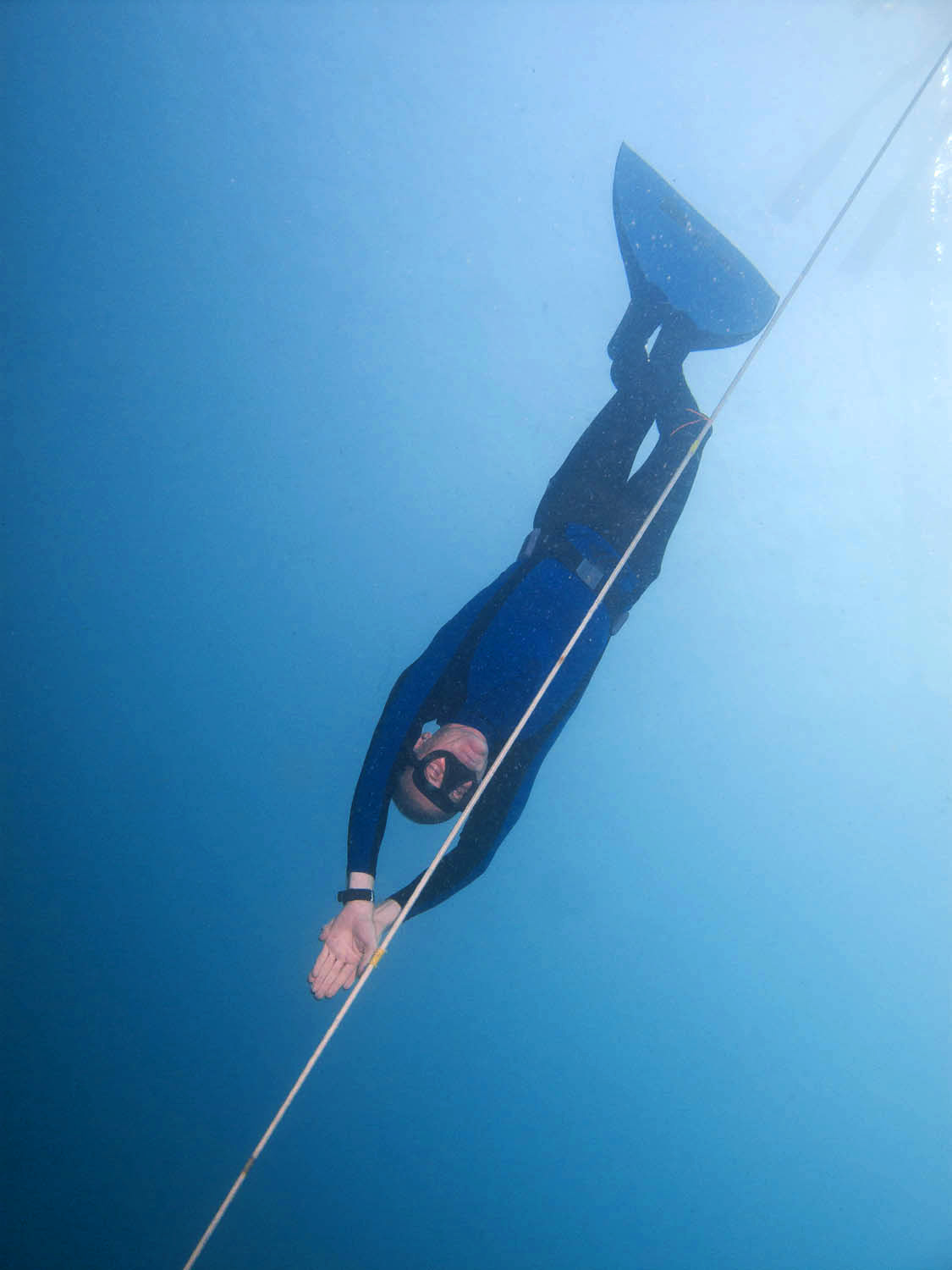
Freediving fins are the opposite: very long and stiff. DeepBlueDiving's guide describes them as long blades that make each kick powerful and energy-efficient. The reason is oxygen economics.
A freediver is holding their breath, so every kick must produce maximum thrust for minimum effort. Long blades move more water per stroke, which means fewer kicks, less muscle work, and less oxygen burned on the way down and back up.
There is also a stiffness tradeoff. Soft blades are gentle on the legs but wasteful at depth. Stiff blades demand stronger legs and better technique but reward the diver with efficiency.
Beginners in freediving courses often start on medium-stiffness composite blades and move stiffer as their kick improves.
Snorkels: the breathing tube question
For snorkelers, the snorkel is the whole point: a J-shaped tube that lets you breathe while your face stays underwater. Modern snorkel designs add splash guards, purge valves that clear water with a sharp exhale, and dry tops that seal the tube when a wave washes over. Comfort and easy breathing are the design goals.
Freedivers barely use the snorkel during the dive itself. Most breathe up at the surface through a snorkel, then remove it or let it flood on descent, because a snorkel full of water at depth is dead weight and a drag source. Some competitive freedivers skip the snorkel entirely and use a nose clip instead.
When freedivers do carry one, it is a simple, flexible, streamlined tube with minimal drag, not the feature-loaded snorkels sold to snorkelers.
Wetsuits, weights, and flotation
Exposure protection follows the same split. Snorkelers in warm water often wear just a rash guard for sun protection, adding a thin wetsuit only in cooler seas. They also commonly wear flotation aids: snorkel vests, flotation belts, or life jackets that let them rest at the surface without effort.
Freedivers go the other way. They wear proper wetsuits, often two-piece open-cell suits that seal closely to the skin for warmth at depth, where water is colder and dives last minutes. And they wear weight belts, because a wetsuit's buoyancy fights the descent.
DeeperBlue lists the weight belt and sometimes a lanyard, which tethers the diver to the descent line, as standard freediving equipment.
The flotation philosophy is reversed. Snorkelers want to be positively buoyant so floating is effortless. Freedivers want to be neutrally buoyant at their target depth, slightly positive at the surface for safety, so they can sink with minimal kicking once past the first meters.
A snorkel vest on a freediver would be dangerous; no weights on a deep freediver would be exhausting.
Training and safety gear
The gear gap extends to what each sport requires beyond the body. Snorkeling needs almost no training; DeeperBlue notes that even non-swimmers can snorkel wearing a life jacket. The safety kit is simple: a buddy, a flotation aid, and sun protection.
Freediving demands training because the risks are specific to breath-hold diving: shallow-water blackout, lung squeeze, and equalization injuries. DeeperBlue recommends a course with a certified instructor. The standard safety setup includes a trained buddy, a freediving buoy marking the dive site at the surface, a lanyard on deep dives, and a dive watch or computer tracking depth and time.
None of this exists in snorkeling because the sport never goes where these hazards live.
Can you use one set for both?
Partly. A decent mask works for both sports, though a freediver will eventually want lower volume. Snorkeling fins work for casual freediving in shallow water, but they are inefficient enough that they cap how deep you can comfortably go.
A snorkeling wetsuit or rash guard works for warm-water freediving.
The reverse is harder. Long freediving fins are awkward for surface snorkeling and terrible on a crowded tour boat. A low-volume freediving mask works fine for snorkeling but gives up some field of view.
If you plan to do both seriously, budget for two fin sets first; the mask can wait.
FAQ
Is freediving just deep snorkeling?
No. Snorkeling is continuous breathing at the surface. Freediving is breath-hold diving with specific techniques for equalization, efficient kicking, and safety.
The training and the risks are different.
Do freedivers wear snorkels?
Usually only at the surface during breathe-up. Most remove the snorkel or let it flood before descending, and some use a nose clip instead.
Can I freedive in snorkeling fins?
In shallow water, yes. But short flexible fins are inefficient, so you will work harder and burn oxygen faster, which limits depth and bottom time.
Which sport is easier to start?
Snorkeling by far. You can learn it in an afternoon with rental gear. Freediving requires instruction because breath-hold diving carries real risks like shallow-water blackout.
The bottom line
Snorkeling gear and freediving gear look similar because both start with a mask, snorkel, and fins. The engineering diverges from there: snorkeling optimizes for comfort at the surface, while freediving optimizes for oxygen efficiency at depth. Short flexible fins, an easy mask, and flotation for snorkelers.
Long stiff fins, a low-volume mask, a wetsuit, and a weight belt for freedivers. Match the gear to the sport and both get safer and more fun.
Topics: snorkeling, freediving, dive gear, masks, fins
Latest in Sports
- How to get back into a kayak after capsizing
- Why do trail running shoes have lugs and road shoes do not?
- Why do down sleeping bags lose warmth when wet?
- How to choose a kayak paddle length
Subscribe for weekly outdoor skills explainers in your inbox.
Related stories

Why Is Altitude Sickness Worse for Some People?
Altitude sickness hits some people harder because of genetics, ascent speed, and prior history, not fitness level. Here is what raises risk

Why Do You Get Blisters When Hiking and How to Prevent Them
Friction plus moisture plus heat equals a blister. Learn why hiking breeds all three, and the boots, socks, and tape system that keeps

How to choose hiking boots for beginners: fit, features, and break-in
Beginners should buy for fit first: snug everywhere, tight nowhere, with a thumb's width at the toes. Here is how to size, test,